We the people, the real custodians of the Constitution

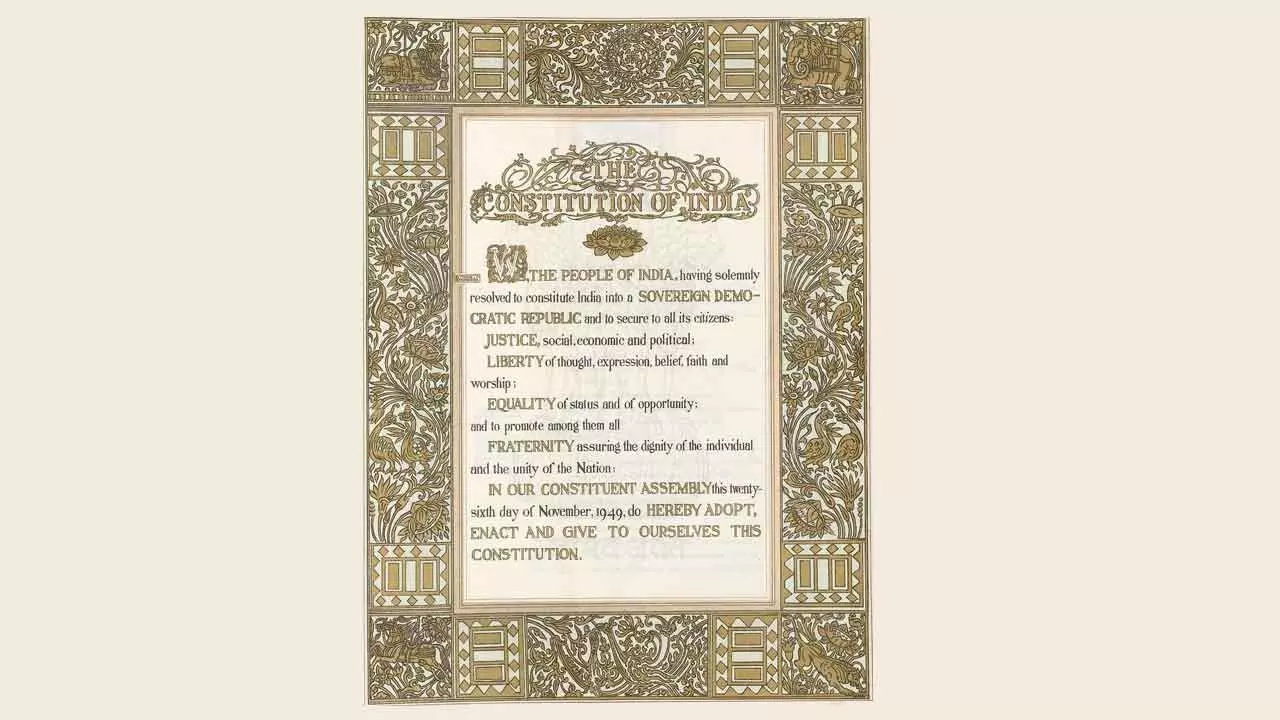
The Indian Constitution, is the grundnorm, the fundamental law, from which all authorities derive their power. It is the paramount law of the land and all laws must conform to the Constitution. The Legislature, Executive and the Judiciary derive their power and authority from this supreme legal, social and political document.After successfully completing 75 years, the Indian Constitution is now celebrating the diamond jubilee. The credit for this goes to “the people of India” who gave the Constitution to themselves.
The Constituent Assembly which came into existence in accordance with the Cabinet Mission of 1946 met for the first time on 9th December,1946. Pandit Jawaharlal Nehru, the first Prime Minister of free India, moved the Objective Resolution on 13th December, 1946.The resolution is to frame a Constitution for a Sovereign, Independent Indian Republic. After detailed discussion and debate, the Resolution was adopted on 22nd January, 1947. It ultimately took shape as the Preamble, which declares India as the sovereign, socialist, secular democratic republic. The Preamble is most aptly described as the key to the Indian Constitution.
The strength of Indian Constitution lies in its flexibility. Though the Indian Constitution is the lengthiest of all the written Constitutions,the framers never intended it to be rigid. Their foresight and vision made the Indian Constitution not only living but a growing document keeping in view the hopes and aspirations of its masters, the people. The Parliament of India, in exercise of its constituent power has amended the Constitution 106 times so far taking the number of Articles from 395 to 448, number of Parts from 22 to 25 and Schedules from 8 to 12. However, the fundamental and basic characteristic of parliamentary system of democracy remains the same.
The Supreme Court of India, the final arbiter in dispensation of justice, has clearly held as long back as in 1973in Keshavananda Bharati case that though the Parliament has the power to amend the Constitution, the basic features of the Constitution are not amendable under art. 368. Several such features are identified as basic by the Supreme Court in number of cases, which are only illustrative and not exhaustive. On this historic occasion of diamond jubilee of Indian Constitution, it is most appropriate to remember certain important Constitutional amendments effected to strengthen the democratic and federal foundations of the country.
Amendment of Art. 3 effected in 1955 is very much crucial for Indian federalism. It has facilitated the formation of the State of Telangana. Art. 3 deals with the formation of new States and alteration of areas, boundaries and names of existing States. This Article as originally envisaged, did not lay down the time limit for expression of views by the concerned States on the Reorganisation Bill referred by the President of India. This could hold up or delay thereorganisation legislation by Parliament. The Constitution 5th Amendment empowered the President of India to lay down the time limit to the concerned State Legislatue to express its views.
At the time of reorganisation of the State of Andhra Pradesh into Telangana and Andhra Pradesh, the President of India had given six weeks time to the Andhra Pradesh Legislature to express its views on the AP Reorganisation Bill, 2014. On the request of the State Legislature, the same was extended by one more week.The Legislature of the undivided State of Andhra Pradesh expressed its views and the Parliament of India passed the APReorganisation Bill paving way for the formation of Telangana as a State in the Indian Union.In the absence of the Constitution 5th Amendment, expression of views on the provisions of the Reorganisation Bill in limited time would not have been possible because of the prevailing situation in the State at that time.
The Constitution 73rd and 74th amendments in 1992 enabled the decentralization of decision making and strengthened the democratic process at the grass roots level ensuring timely elections to the panchayat raj institutions and urban local bodies. These amendments have added new Articles 243 to 243ZG and Schedules XI and XI-Ato the Indian Constitutionmaking provision for devolution of powers and responsibilities to the local bodies for preparation of plans and implementation of schemes for economic development and social justice in relation to the matters mentioned in the newly added Schedules. 12769 grama panchayats, 540 mandal parishads and 32 zilla parishads in Telangana have become more vibrant by virtue of these constitutional amendments directly impacting the lives of more than two crore rural population.The people living in 13 municipal cororations and 129 municipalities of Telangana are also enjoying better civic amenities.
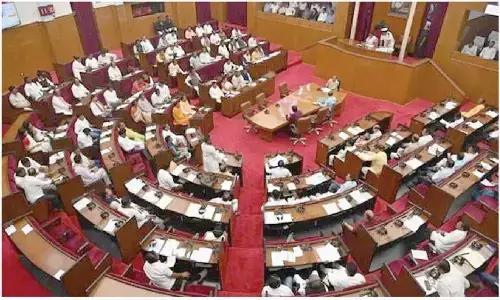
The Constitution 52nd Amendment concerns the Members of all the legislative bodies in India. It is intended to put an end to the scourge of defections from one political party to another for selfish interests of lure of office. They have become rampant and likely to undermine the very foundation of our democracy negating the verdict of the people. It is popularly known as the anti-defection law. It is for the first time “political party” has found a mention in the Indian Constitution with this amendment.This amendment inserted a new clause in Art. 102 and 191and a new Schedule X to the Constitution.
A member of a House shall become disqualified if he has voluntarily given up his membership of the political party on which he has been elected; or if he votes or abstains from voting in the House contrary to the direction of the political party on which he has been elected. Disqualification shall not apply in the case of splits of 1/3rd of members and merger of party.The Supreme Court in KihotaHollohon case has ruled by majority that this provision is not in violation of the basic structure of the Constitution and the privilege of freedom of speech guaranteed in the House guaranteed to the Members in the Constitution.
However, in 2003, the Parliament has deleted the exemption provided for the split of political party by virtue of 91st amendment in view of the criticism that the anti-defection law is trying to punish the individual defections leaving out the bulk. This amendment had also laid down maximum ceiling on the Council of Ministers both at the Centre and in the States. This anti-defection law has become a hot topic for criticism as it has stirred up more controversies than putting an end to it. Another landmark amendment concerning the parliamentary system of democracy in India is reservation of seats for women in Lok Sabha and the Legislative Assemblies.
According to the “Men and Women in India 2023” released by the Ministry of Statistics and Programme Implementation, Government of India, women constitute 48.5 percent of total population of India, but the women representation in Legislatures is a meager10 per cent.Though there is a slight improvement in the number of women members in the 3rd Assembly of Telangana than the 2nd House, the representation of women stood at staggeringnumber of 10.
The situation is comparatively better in Andhra Pradesh Legislative Assembly as women constitute 13 per cent of total strength of the House. In general, women were left behind in the democratic process of the country despite equal status given to them in the Constitution. The Constitution 106th Amendment Act 2024,with a view to ensure gender equality in politics, provides for reservation of 33 per cent of seats in the Lok Sabha and State Legislative Assemblies by insertion of Art.330A and 332A. It is a revolutionary step in the direction of empowerment of women. The only drawback is its implementation has been linked to the delimitation of the Lok Sabha and Assembly constituencies after next census.
The Constitution has provided the best possible checks and balances to ensure that no authority oversteps its powers and encroach upon the functions of others. This should not make the people lax and rest on their oars. It is very apt to recall the observation of the Dr. B.R. Ambedkar, the father of Indian Constitution in his concluding speech in the Constituent Assembly on 2th November, 1949, “However good a Constitution may be, it is sure to turn out bad because those who are called to work it, happen to be a bad lot. However bad a Constitution may be, it may turn out to be good if those who are called to work it, happen to be a good lot.
The Constitution can provide only the organs of State such as the Legislature, the executive and the Judiciary. The factors on which the working of those organs of the State depend are the people and the political parties they will set up as their instruments to carry out their wishes and their politics.” It is for the people to be ever vigilant to preserve and protect the ideals enshrined in the Constitution and shape their destiny.
(The writer is former State Chief Information Commissioner)