




- Delhi Rains: Heavy Downpour Floods IGI Airport, Nine Flights Diverted Within An Hour
- Congress failed to implement women’s guarantees: Madhusudhanachari
- ‘Dharmasthala Niyojakavargam’ review: A meaningful political drama with a strong social message
- Navies of India and Thailand reaffirm commitment to capacity building, training
- Poco X8, X8 Power Launch in India with Big Batteries and Snapdragon Chips
- AP, Telangana to receive rains amid cyclonic circulation in Bay of Bengal
- Govt to make all efforts for better solution to Bhopal sealing issue: CM Mohan Yadav
- South Korean President Lee designates flood-hit Tongyeong as special disaster zone
Thousand days, a 1000 steps towards a new Telangana
In Short
Meanwhile, its approach to women’s empowerment goes beyond welfare. Women’s self-help groups have received around Rs 27,000 crore in interest-free loans. By encouraging women’s groups to operate buses, petrol stations and solar power projects, the government is attempting to move women from being beneficiaries of government programmes to becoming owners, entrepreneurs and participants in economic activity. That shift—from welfare to empowerment—could prove to be one of the most significant aspects of the women-centric agenda.

Share :
Thousand days, a 1000 steps towards a new Telangana
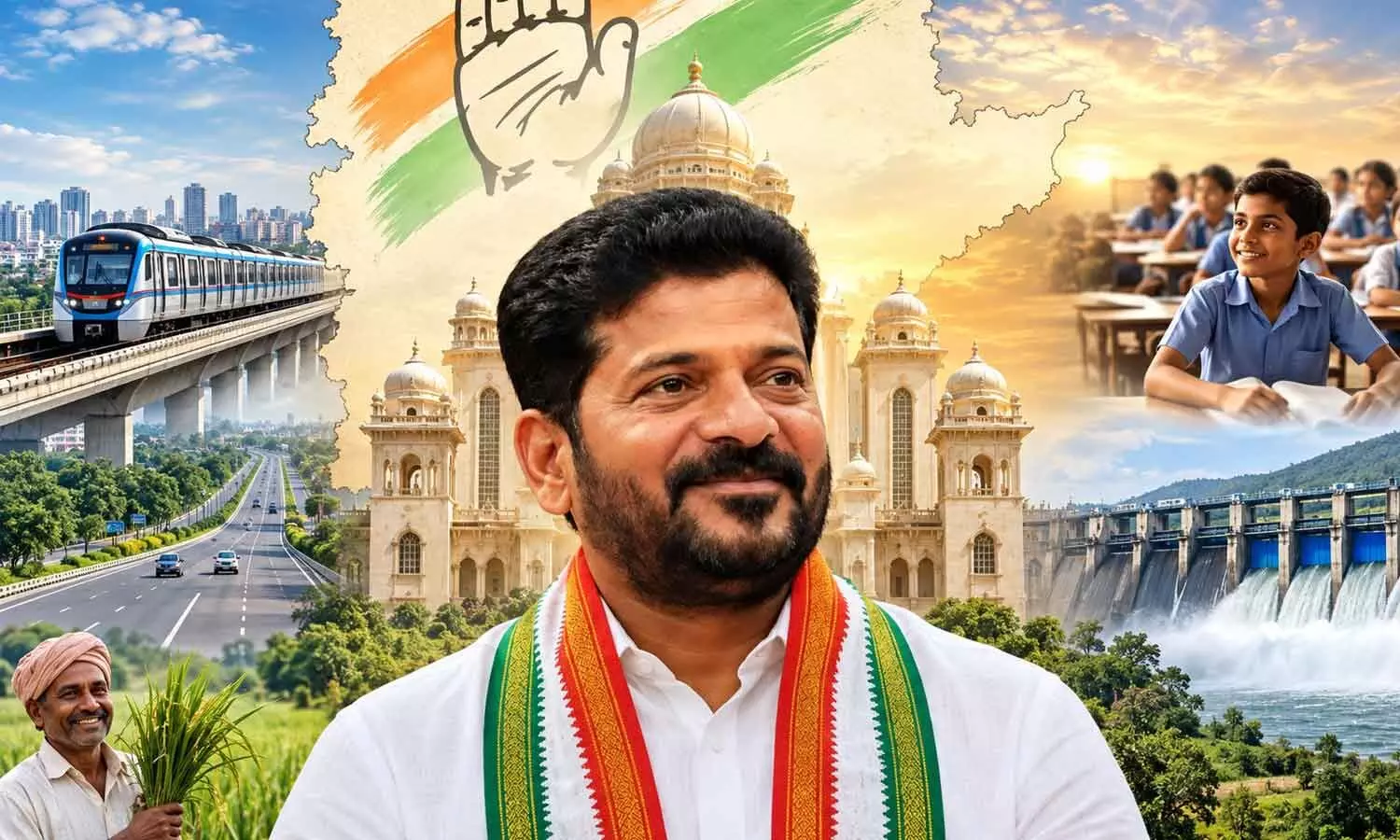
The completion of 1,000 days of the Congress government in Telangana marks more than a milestone in the calendar of governance. It is an opportunity to look back at a journey defined by people-centric governance, welfare, development and a clear vision for the future.
Since assuming office on December 7, 2023, the Congress government, under Chief Minister A Revanth Reddy, has sought to place people at the centre of governance. From farmers and women to youth, students and weaker sections, the government has focused on translating electoral promises into programmes that directly touch people’s lives. At the same time, the story of these 1,000 days is therefore not merely about welfare schemes. It is about attempting to strike a balance between welfare and development, immediate needs and long-term aspirations, and social justice and economic growth.
When Telangana was formed, the state had a revenue-surplus position. After nine-and-a-half years of BRS rule, however, the state was left facing substantial debt and serious financial challenges. Despite these constraints, the Revanth Reddy government chose not to compromise on welfare.
Instead, it strengthened mechanisms for direct interaction with citizens through initiatives such as Praja Vani and Gram Sabhas, enabling the government to understand people’s concerns and respond to their needs. The underlying philosophy has been simple: governance must begin with listening to the people.
Agriculture has remained one of the principal pillars of the government’s 1,000-day journey. It has spent around Rs 1.75 lakh crore on the agriculture sector during this period. Farm loan waivers worth more than Rs 20,000 crore have benefited 25.35 lakh farmers, providing significant relief to farming families. Under Rythu Bharosa, farmers have received around Rs 36,000 crore. The government has also approximately spent Rs 30,000 crore on free agricultural power, nearly Rs4,000 crore as a bonus for fine-quality paddy, and Rs 3,500 crore on Rythu Bima.
These measures demonstrate the government’s attempt to provide farmers not merely with financial assistance, but with a sense of security and confidence. The government has simultaneously focused on completing irrigation projects, acquiring land for pending projects and addressing bottlenecks that have delayed the utilisation of irrigation potential. For a state whose rural economy remains deeply connected to agriculture, strengthening the farmer is fundamental to strengthening Telangana itself.
Women’s empowerment has been another defining feature of the government’s first 1,000 days. The Mahalakshmi scheme, under which women were provided free travel on TSRTC buses from December 9, 2023, has emerged as one of the most visible welfare initiatives. Over the past 30 months, the government has spent around Rs 11,000 crore on the programme, providing women with a direct economic benefit and greater mobility. Meanwhile, its approach to women’s empowerment goes beyond welfare. Women’s self-help groups have received around Rs 27,000 crore in interest-free loans.
By encouraging women’s groups to operate buses, petrol stations and solar power projects, the government is attempting to move women from being beneficiaries of government programmes to becoming owners, entrepreneurs and participants in economic activity. That shift—from welfare to empowerment—could prove to be one of the most significant aspects of the women-centric agenda.
For poor families, social security begins with the basics: a home, electricity and food. Under the Indiramma Indlu scheme, houses have been sanctioned for 4.5 lakh families, taking forward the government’s objective of providing housing to economically vulnerable households. Under Gruha Jyothi, households are being provided up to 200 units of free electricity, while LPG cylinders are being made available for Rs 500, helping reduce the monthly financial burden on poor and middle-class families.
The government has also addressed the long-pending demand for ration cards. 16.32 lakh new ration cards have been issued, taking the total number of food security cards in the State to 1.06 crore, benefiting around 3.43 crore people. The decision to provide fine-quality rice free of cost to eligible beneficiaries is another major step towards strengthening food security. For millions of families, these measures are not merely government statistics. They translate into reduced household expenditure and greater economic security.
One of the most important political and social challenges facing Telangana has been restoring confidence among its youth. The Congress government has undertaken more than 70,000 government recruitments, creating employment opportunities for thousands of young people. But government jobs alone cannot meet the aspirations of a rapidly growing young population.
Recognising this, the government has simultaneously focused on skill development through the establishment of the Young India Skills University (YISU) and the transformation of ITIs into Advanced Technology Centres. The objective is to prepare Telangana’s youth not only for today’s employment market but also for the industries of tomorrow.
The government’s proposal to seek an Assembly resolution enabling young people to contest legislative elections from the age of 21 is another indication of its stated commitment to greater youth participation in public life. For Gen-Z, participation in governance must extend beyond being voters. They must also have opportunities to become decision-makers.
The government’s focus on education has also acquired a new dimension. The introduction of breakfast in government schools and colleges addresses an important but often overlooked issue—student nutrition. A hungry child cannot be expected to concentrate fully on learning.
The government has also initiated the construction of 100 Young India Integrated Residential Schools, aimed at creating modern educational institutions capable of providing quality education to students from disadvantaged backgrounds. Investing in education is ultimately an investment in Telangana’s human capital. The quality of the state’s future workforce will depend substantially on the quality of education provided today.
The government’s larger vision goes beyond welfare. Through ‘TelanganaRising 2047’, it has set the ambitious objective of transforming Telangana into a $3-trillion economy by 2047. Attracting global investments, expanding industries, creating employment opportunities and developing Telangana into a world-class industrial and technology hub are central to this vision.
The challenge now is to ensure that economic growth reaches every region and every section of society. Investments must translate into jobs; industries must create local opportunities; and infrastructure must support both urban expansion and rural development. If successfully implemented, ‘TelanganaRising 2047’ can provide the economic foundation needed to sustain the state’s welfare and development programmes for generations.
The Congress government has also sought to place social justice at the centre of its political agenda. In keeping with Rahul Gandhi’s vision of ensuring justice and a fair share for every social group, the government undertook a caste census and moved towards providing 42 per cent reservation for Backward Classes in local bodies.
The completion of the SC categorisation process represents another significant step in addressing longstanding demands for equitable representation. These measures have the potential to make Telangana an important reference point in the national debate on social justice and representation.
Healthcare expenses can push vulnerable families into debt. Recognising this reality, the government increased the Aarogyasri coverage limit to Rs.10 lakh, expanding access to quality medical treatment for poor families. The true measure of a healthcare system is not merely the number of hospitals or programmes it has, but whether an ordinary family can access treatment without being pushed into financial distress.
Hyderabad remains the economic engine of Telangana, and its future will have a direct bearing on the state’s future. The Congress government has therefore placed special emphasis on the city’s infrastructure, including Musi River rejuvenation, Metro Rail expansion, road development, improved drainage and other major infrastructure projects.
A rapidly expanding Hyderabad needs infrastructure designed not merely for today but for the next several decades. The challenge is enormous, but so is the opportunity. A modern, connected and sustainable Hyderabad can strengthen Telangana’s position as a global destination for investments, technology, industry and talent.
In a democracy, criticism from the Opposition is both legitimate and necessary. Constructive criticism can help governments rectify mistakes and improve delivery. However, criticism should not become an end in itself. The BRS and BJP have frequently attacked the Congress government over its performance. The Congress view is that these attacks are driven by political considerations rather than an objective assessment of the government’s achievements.
The party also maintains that the state continues to face challenges because of the financial legacy it inherited and the Centre’s alleged failure to extend Telangana its rightful share of funds, projects and commitments arising from the bifurcation of the state. A cooperative relationship between the Centre and the state, based on the principles of cooperative federalism, can only accelerate Telangana’s development. Political differences are inevitable in a democracy, but the development of Telangana must remain above partisan politics.
A thousand days may appear to be just a number in the passage of time. In governance, however, 1,000 days provide an opportunity to measure what has been promised, what has been implemented and what direction the government has chosen for the future. The journey so far encompasses farmers’ welfare, women’s empowerment, employment, skill development, education, healthcare, housing, food security, social justice, infrastructure, investments and industrial development. The government’s stated objective is to combine welfare with wealth creation and social justice with economic growth.
The real test, however, lies ahead. The coming years will determine whether the foundations laid during these 1,000 days can be converted into sustained economic growth, better employment opportunities, stronger public services and improved quality of life for every citizen.
For now, the completion of 1,000 days represents a significant milestone in the Congress government’s journey. Indiramma Rajyam has completed a thousand steps on the path of progress. With people’s welfare as its foundation, development as its destination and ‘TelanganaRising 2047’ as its vision for the future, these 1,000 days seek to mark the beginning of a larger journey—a journey towards a stronger, more prosperous and more inclusive Telangana.
(The writer is an MLC and TPCC President)
PV Sunitha Selected as Best Teacher in Hyderabad District
Kappan conviction reopens old Pala battle, Jose K. Mani calls verdict an insult to constituency
In Jharkhand's Jamtara, beneficiaries explain transformation in their lives under PMAY scheme
Sr Men Inter-Department Hockey: PSPB, RSPB, FCI, SAI win one-sided matches
PM Modi congratulates Giorgia Meloni on becoming Italy's longest-serving Prime Minister
ISRO launches EOS 05 satellite successfully from Sriharikota
Nepal Flood Rescue: 2 Workers Pulled Alive From Hydropower Tunnel After 9 Days
CM Chandrababu wishes Telugu People on Sri Krishna Janmashtami
IndiGo flight hits pole while parking at Srinagar airport; passengers, crew safe
PV Sunitha Selected as Best Teacher in Hyderabad District


