




- Kiren Rijiju, Arjun Ram Meghwal, Pralhad Joshi participate in 'Swachhata Hi Seva' campaign
- Anne Hathaway says during her pregnancy she could ‘smell time’
- Gold rates today in Delhi, Mumbai, and Kolkata slashes, check the prices on 1 Oct 2026
- Petrol and diesel prices today in Hyderabad, Delhi, Chennai and Mumbai on 1 October 2026
- Gold rates today in Bengaluru and Chennai slashes, check the prices on 1 October, 2026
- TN cybercrime police caution public against online scam offers
- Piyush Goyal, US Trade Representative Greer discuss India-US interim trade pact
- Lies, hatred and abuse have replaced governance, alleges former minister Puvvada Ajay Kumar
The architecture of inclusion: How Sukumar Sen built a republic of voters
In Short
Into this monumental void stepped Sukumar Sen, an ICS officer appointed as India’s first Chief Election Commissioner (CEC).

Share :
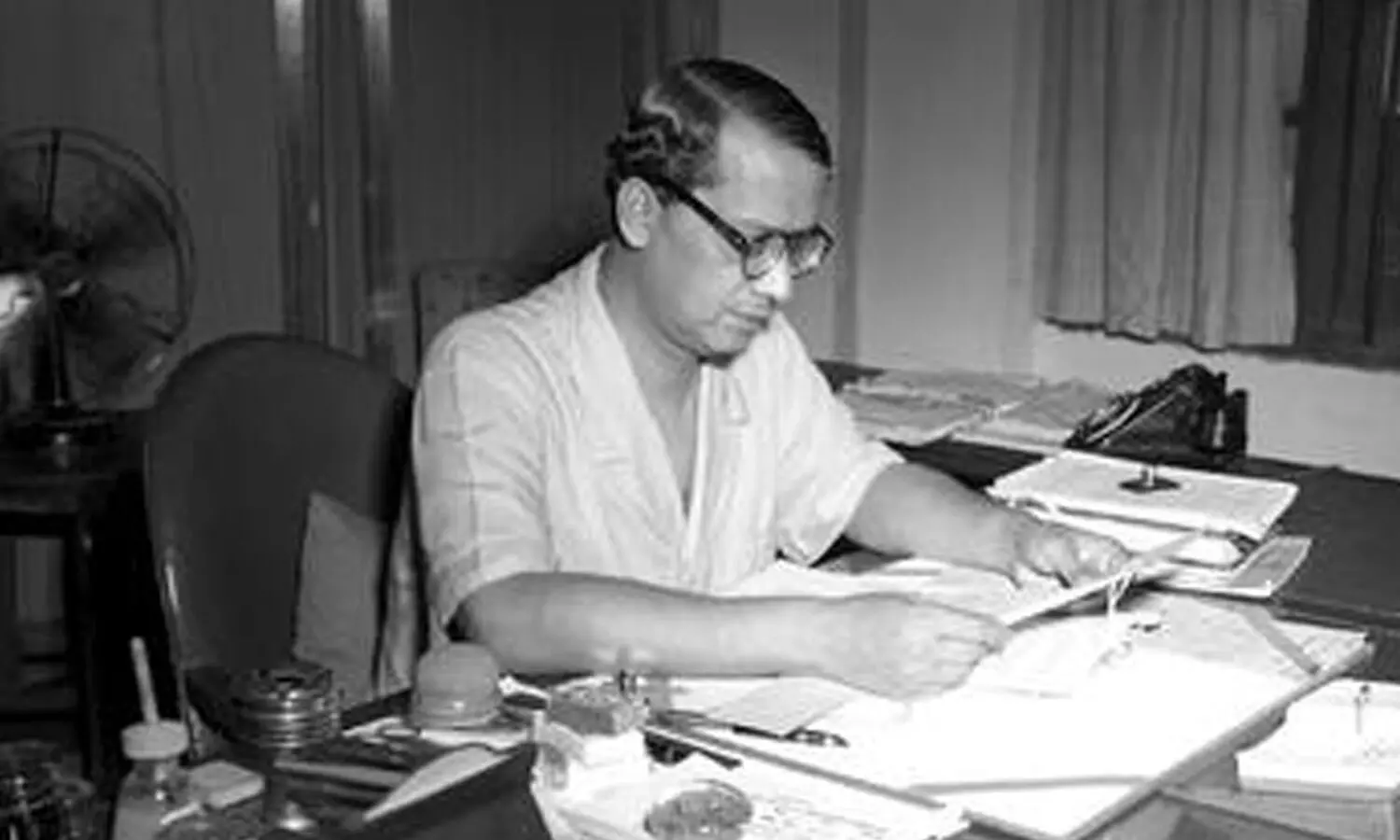
Sukumar Sen
“Democracy begins not with the politician. It begins with the voter.”
In 1950, a newly sovereign nation embarked on the most ambitious democratic experiment in human history. India was a vast, deeply diverse landscape recovering from the trauma of Partition, where nearly 85 per cent of the population was illiterate and infrastructure was virtually non-existent. There were no digital databases, no standardised identification cards, no automated networks, and no modern technology.
Into this monumental void stepped Sukumar Sen, an ICS officer appointed as India’s first Chief Election Commissioner (CEC).
Tasked with executing the inaugural general election, Sen did not merely manage a bureaucratic process; he helped build the foundational instinct of Indian democracy. His mission was as radical in its simplicity as it was staggering in its scope: find every citizen, register them, and give them a voice. Today, as contemporary political discourse grows increasingly obsessed with lists, exclusions, and deletions, returning to Sen’s original vision offers a vital reminder of what it truly takes to sustain a government of the people.
The enrolment epic
The logistics facing Sen and his team were unprecedented. India’s electorate in 1950 spanned over 17 crore voters—a demographic larger than the combined populations of the United States and western Europe at the time. To enroll them, thousands of election workers traveled on foot, by bullock cart, on horseback, and aboard boats. They trekked across the snow-bound valleys of Himachal Pradesh, crossed the arid expanses of Rajasthan, and navigated the dense forests of the Northeast.
They went door to door and village to village to compile the electoral rolls from scratch. When social stigmas prevented many women in northern states from giving their individual names to male officials—offering only their relations as “mother of X” or “wife of Y”—Sen refused to accept the compromise. He insisted that every citizen must be recognized in their own right, and delayed registration drive timelines until millions of women were properly named and cataloged on the rolls.
To overcome widespread illiteracy, Sen’s team devised an intuitive visual language. They introduced distinct symbols for political parties—a pair of bullocks, a tree, an elephant—and color-coded ballot boxes so that every individual, regardless of formal education, could cast a secret ballot with dignity and confidence.
Building vs. maintaining-The founding instinct:
Sukumar Sen and the architects of early India did not inherit a functional democracy; they had to construct one out of hope, determination, and civic faith. Because they built it from the ground up, they understood a fundamental truth that often gets lost in modern administration: the strength of a republic is measured by its capacity to include, not its efficiency at weeding out.
The state seeks out the voter
In recent decades, administrative focus has subtly shifted. Where the founding impulse was driven by a relentless urge to expand the circle of participation, modern election machinery is frequently pre-occupied with verification algorithms, identity cross-checks, and purging records. While accurate rolls are essential for integrity, an over-emphasis on deletion risks transforming a welcoming public apparatus into a defensive gatekeeper.
Reclaiming the citizen-centric republic:
When Gyanesh Kumar assumed office as Chief Election Commissioner in 2024, he inherited a sophisticated electoral machinery powered by instant digital verification, advanced satellite communications, and millions of Electronic Voting Machines (EVMs). Yet, despite these vast technological leaps, the central challenge of democracy remains unchanged: ensuring that no legitimate voice is silenced or left behind.
Technology is a powerful amplifier, but it must serve the original ethos established in 1950. A database should be a bridge to participation, never a barrier. When administrative systems prioritise procedural rigidity over universal access, they risk eroding the trust that Sen worked so tirelessly to forge.
The founders of India understood that politicians do not create democracy; citizens do. The act of placing a mark on a ballot is the primary assertion of human equality in a complex society. As Indian democracy continues to evolve in a digital age, honoring Sukumar Sen’s legacy requires a deliberate return to that original instinct—a commitment to an inclusive republic where the fundamental duty of the state is to seek out every voter and ensure their place in the nation’s story.
“The vote is the most powerful non-violent tool we have in a democratic society.” — John Lewis
(The writer is a former OSD to the Union Civil Aviation Minister)
Upasana Singh says Poonam Dhillon issued her show-cause notice for supporting Ranveer Singh amid Don 3 row
Kiren Rijiju, Arjun Ram Meghwal, Pralhad Joshi participate in 'Swachhata Hi Seva' campaign
Anne Hathaway says during her pregnancy she could ‘smell time’
Raj administration agrees to Beniwal's demands after massive protest in Sri Ganganagar
KCR family amassed Rs 1L-cr wealth: Revanth Reddy
Will complete 36 irrigation projects in 3 years: Naidu
CM Naidu calls for continuous skill training of govt staff
Job creation coalition govt’s only agenda: Lokesh
CM Vijay accuses AIADMK of aligning with DMK during Dharapuram campaign
Green energy scheme ‘big push’ towards achieving 900 GW non-fossil capacity by 2035: PM Modi


