Small people & big egos

In the last two decades, millions of Indians have moved from modest financial means to far better lifestyles. Many are the first in their families to own cars, travel abroad, or afford luxury brands. While there is nothing wrong with progress, the problem begins when financial upgrades are not matched with emotional upgrades. Money can buy comfort, but it cannot buy stability, maturity and humility
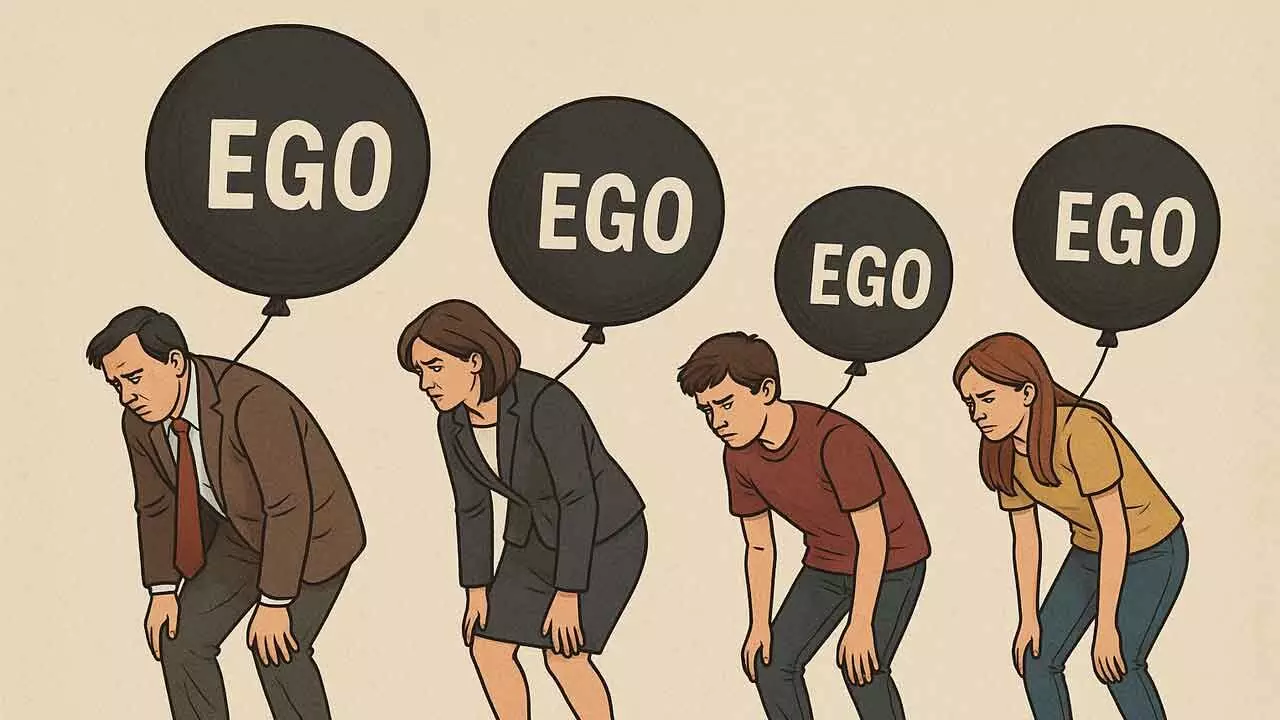
I often wonder what has happened to us as people. We belong to a civilization that taught the world humility, simplicity, openness, and the grace of being grounded. We inherited centuries of wisdom that celebrated self-restraint over self-importance, respect over arrogance, and learning over posturing. Yet, in present-day India, I see an alarming rise of big egos across all layers of society.
This is not an elitist issue. It is not restricted to the rich, the powerful, or the highly educated. In fact, the irony is that big egos are now flourishing in places where they have no business to exist, in lower-income groups, middle class, and upper middle-class circles. The security guard who talks down to delivery staff, the junior executive who refuses to learn from seniors, the young tech professional who believes he knows more than anyone who came before him, the shopkeeper who treats customers with disdain, the disease is everywhere.
It is a paradox I cannot ignore. A society with limited resources in the past, which once valued humility as a natural way of life, is now brimming with a strange, misplaced arrogance.
What a big ego looks like today
When I speak of “big ego” here, I am not talking about healthy self-confidence or self-esteem. I am referring to the toxic, hollow, complex ego that thrives on appearances, not substance. You can spot it almost instantly:
♦ False pride masking insecurity.
♦ Close-mindedness to any perspective that is not their own.
♦ An I-know-it-all attitude that refuses guidance.
♦ Arrogance in tone and body language.
♦ Complex social conduct designed to confuse or intimidate others.
♦ Being difficult to deal with, as a way to feel important.
♦ Insubordination at work without cause.
♦ Disrespect towards people who cannot retaliate.
♦ Highly reactive to the smallest disagreement.
♦ Sharp-tongued in conversations, often without provocation.
♦ A lack of genuineness, where relationships are more transactional than authentic.
♦ Fake social exhibitionism, lies, show-off, and deceit.
I have seen it in public spaces, in offices, in families, and even in places meant to serve, hospitals, schools, and government offices. It has become a big social trend to appear inaccessible, unapproachable, to project toughness, to fake wealth and superiority.
Why this is happening
This rise in inflated egos is not random. There are clear social and economic shifts feeding this behaviour.
1. Economic leap without emotional growth
In the last two decades, millions of Indians have moved from modest financial means to far better lifestyles. Many are the first in their families to own cars, travel abroad, or afford luxury brands. While there is nothing wrong with progress, the problem begins when financial upgrades are not matched with emotional upgrades. Money can buy comfort, but it cannot buy stability, maturity and humility.
2. Social media amplification
Platforms like Instagram, Facebook, and LinkedIn have created a constant stage for self-promotion. Likes and comments have become the new measure of self-worth. This environment encourages ‘performance’ and ‘posturing’ over authenticity, credibility and humility.
3. Education without human skills
Our education system often rewards memorisation and competition, not real knowledge, congruence or mental acuity. Millions of graduates enter the workforce every year with bare minimum technical skills but mostly without inter-personal skills, social congruence, emotional skills to collaborate, listen, and learn.
4. Workplace insulation
High-paying jobs, especially in multinational companies, sometimes shield individuals from criticism. When people work in environments where accountability is diluted and performance reviews are more about managing internal politics than merit, they start believing they are untouchable.
The young and the arrogant – a dangerous start
This trend is perhaps most alarming among teenagers and young adults. Many of them are stepping into adulthood already wearing the heavy armour of ego. They neither learn from their parents nor from their teachers. In fact, they often dismiss both as outdated or irrelevant.
Part of the problem is the absence of powerful role models in their lives. Many do not have mentors they admire or emulate. The cultural and social vacuum is being filled by social media influencers who sell ‘attitude’, not wisdom. Add to this an overreliance on search engines and Gen AI technology, and you have a generation that feels it knows everything at the tap of a screen. Unfortunately, many can’t differentiate between information and experience driven from knowledge application.
I have seen youngsters openly mocking experts in highly specialized fields, dismissing decades of earned experience with the confidence of someone who has read a few online articles and watched few subject videos. It is downright silly, but also deeply worrying. The access to information has been confused with ownership of wisdom. Knowledge without humility is like a car without brakes - it will eventually crash, and often at a high speed.
This inflated sense of self at such a young age is dangerous when they enter professional life. Imagine a 23-year-old in their first job, convinced they have nothing to learn, quick to dismiss senior colleagues, and allergic to feedback. They are not just limiting their own growth; they are damaging the collaborative culture that workplaces depend on.
What they fail to understand is that careers are built not just on a skill-set, but on relationships, reputation, respect and the ability to work with people very different from oneself. Ego blocks all three. Young professionals who cannot manage their egos will find themselves isolated, passed over for promotions, or quietly excluded from high-value projects.
The ripple effect
The danger of a big ego is not just personal. It has a ripple effect that damages relationships, workplaces, and even national productivity. For the nation, this is not just a generational quirk. If our youngest workforce is already ego-heavy and humility-light, our future competitiveness is at risk. We will have more graduates than ever, but fewer ace professionals capable of contributing meaningfully to teams, companies, and national progress.
In families
Ego-driven attitudes are causing fractures in family structures. Respect between generations is eroding. Parents find it difficult to guide their own children. Siblings compete for status rather than support each other. Spouses turn minor disagreements into irreparable conflicts.
In workplaces
Teams suffer when one or more members are arrogant, dismissive, or resistant to collaboration. Ego slows down decisions, fuels office politics, and increases attrition. Talented professionals leave toxic environments, which further weakens productivity.
In society
When ego becomes a social norm, civility dies. People cut in queues, refuse to say sorry, or refuse to listen. Social cooperation, which is vital for any functioning society, gets replaced by self-interest and suspicion.
The most dangerous aspect is, this behaviour is contagious. Spend enough time around arrogant people and you either start imitating them or become perpetually defensive against them. Either way, the quality of social interactions collapses.
The professional and economic cost
As a strategist to organizations, I see this problem reflected in hard numbers. Global Capability Centers (GCCs) and multinational corporations in India are struggling to retain talent because of attitude issues. Some CEO’s openly admit that technical skills are not much of the problem, but professionalism is.
When inflated egos cause insubordination, poor teamwork, and high attrition, the cost of operations goes up. Projects slow down, client satisfaction dips, and competitive advantage is lost. This is not just an HR issue, it is a business risk. India’s demographic advantage means little, if a large part of our workforce becomes unemployable not because of skill shortage but because of an attitude surplus.
The Emotional Intelligence lens
From an Emotional Intelligence perspective, big ego is not strength, it is weakness in disguise. It is often a defence mechanism for deep-seated insecurity.
♦ Lack of self-awareness: People with big egos rarely recognize how their behavior affects others. They confuse misplaced arrogance with confidence.
♦ Poor self-regulation: They react impulsively, get defensive quickly, and struggle to accept mistakes leading to massive conflicts in their personal and professional life.
♦ Low empathy: They have little interest in understanding the needs or feelings of others.
♦ Weak social skills: They cannot build genuine, long-lasting relationships because their interactions are self-serving. In short, ego inflates as emotional intelligence deflates.
Corrective measures – where do we start?
If we want to contain this growing menace, change must happen at multiple levels.
At the individual level:
♦ Practice self-reflection: Make it a habit to ask, “Was I respectful today? Did I listen more than I spoke?”
♦ Seek feedback: Invite trusted friends or colleagues to point out your blind spots.
♦ Deliberate humility: Do things that remind, you are not the centre of the universe, volunteer, serve, mentor without expecting returns.
♦ Be Curious: Replace “I know” with “I am learning.”
In families:
♦ Teach children to respect everyone, from the household help to elders.
♦ Make humility part of family values, not just academic success.
♦ Model the behaviour you want your children to follow.
In workplaces:
♦ Establish clear codes for behaviour and respect.
♦ Make Emotional Intelligence a mandatory part of leadership training.
♦ Reward collaboration, humility, and problem-solving, not just technical competence.
At the national level
♦ Integrate value-based education into school curricula.
♦ Celebrate public figures who display humility along with achievement.
♦ Encourage leadership that is grounded, simple and people-focused.
A strategist’s warning
This social trend is not just a social irritant, it is a strategic weakness for a nation aspiring to lead on the global stage. Collaboration is the oxygen of progress. If our people cannot work together without ego clashes, our growth will be slower, our innovations weaker, and our global reputation poorer.
Ancient India understood this. That is why humility and simplicity were never presented as weakness; they were seen as power under control. We have forgotten this. In trying to look bigger, we are becoming smaller.
The real sign of growth is not the size of our homes or the digits in our pay checks; it is the size of our character. A small person with a big ego is still a small person.
It is time we grew smaller in ego and bigger in wisdom. Because if we do not, our society will keep producing taller buildings and shorter people.
(Author is the Chairman for Nation Building Foundation, Chief Spokesperson BJP, Expert in Emotional Intelligence, Harvard Business School certified Strategist.)