Rahul Gandhi must evolve roadmap for a vibrant India

His ‘Vote Chori’ gamble is ill-timed
The Congress party’s “Vote Chori” campaign has sparked energy among its base and elevated Rahul Gandhi’s stature within the I.N.D.I.A. bloc. But the movement risks fizzling out if it is not translated into the lived realities and local dialects of anger, loss, and injustice that resonate with ordinary voters. History shows how powerful slogans can tilt electoral battles, but only when they marry rhetoric with grassroots mobilisation. The challenge before Congress is clear: convert moral indignation into political arithmetic—or risk squandering a rare strategic opening.
In politics, slogans matter. They condense complex grievances into bite-sized rallying cries, ignite passions, and create emotional resonance. The Opposition has learned this lesson repeatedly, sometimes at its own expense.
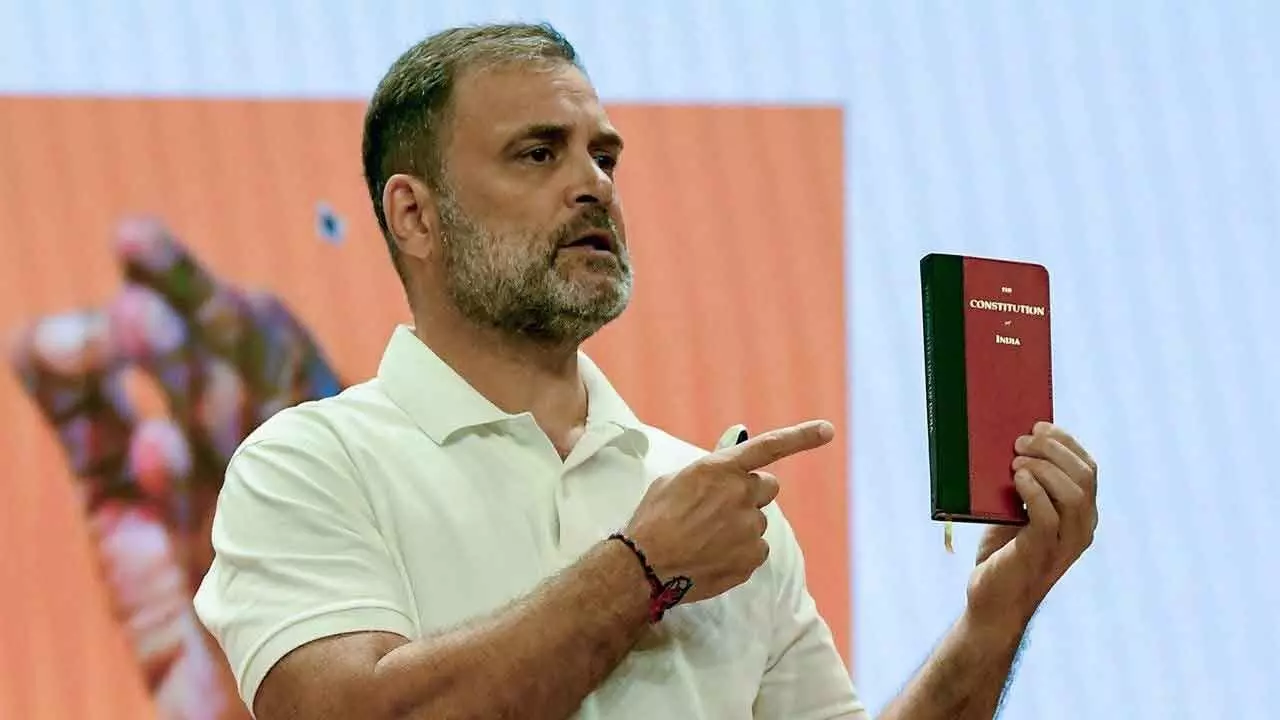
In 2024, when the INDIA bloc campaigned on the fear that a BJP majority would “change the Constitution and end reservation,” the slogan carried weight because it tapped into something tangible: security of rights, jobs, and identity.
Now, Rahul Gandhi seeks to recreate that moment with his “Vote Chori” campaign. The charge is that elections are being stolen, democracy subverted, and people’ will is being undermined. At first glance, it appears potent.
After all, what could be more alarming than a democracy where votes don’t count? Yet, despite energising Congress loyalists and improving his personal standing within the INDIA bloc, the message risks being misdirected: the right slogan, delivered to the wrong audience.
Indian electoral history shows that voters tend to privilege the concrete over the abstract. Issues like job security, caste reservations, subsidies, and infrastructure resonate more deeply than abstract notions of systemic rigging. The BJP understands this instinctively. More importantly, it has mastered the art of narrative jiujitsu—flipping attacks into endorsements.
We saw this in 2019, when “Chowkidar Chor Hai” was turned on its head with Modi’s “Main Bhi Chowkidar” campaign. Instead of tarnishing him, the Opposition inadvertently strengthened his connection with ordinary voters, who saw him as a victim of disrespectful elites.
A similar fate threatens “Vote Chori.” Rather than exposing institutional subversion, it risks being recast as Rahul Gandhi’s excuse for repeated defeats.
The danger for the Congress is clear: if “Vote Chori” is interpreted as crying wolf, it could weaken rather than strengthen the party’s case.
Rahul Gandhi now seeks to position himself as the voice of India’s Gen Z. He warns that the youth are being robbed of jobs, opportunities, and their future. He paints the BJP as a kleptocracy not just of votes but of aspirations. But here, too, the framing falters and is being criticised by his opponents as “Nepokid”.
Instead of articulating a credible economic vision—on employment, growth, trade tariffs, or foreign policy—he seems to call for street-level mobilisation, even anarchy. References to Nepal’s recent youth-led turbulence only deepen suspicions. Does he believe provoking India’s young into confrontation with the state will catapult him into power? Does he want India’s Gen Z on the streets instead of in startups, civil services, or the army?
For a 56-year-old leader who has repeatedly failed to put his party back on a winning trajectory, such gestures come across as acts of desperation. Without a roadmap for jobs, growth, and security, “Vote Chori” risks sounding hollow, if not reckless.
Shirking responsibility:
Even more alarming is his claim that protecting democracy is “not his job.” He insists it is the responsibility of agencies like the Election Commission and Enforcement Directorate. But as Leader of Opposition, as an elected MP, and as a constitutional functionary who has sworn an oath to uphold the Constitution, this abdication is indefensible.
Protecting democracy is not optional for a political leader; it is the core of one’s mandate. By shrugging off this responsibility, he undermines his own credibility and gives the impression of seeking shortcuts through agitation rather than engaging with the hard work of politics.
Adding to the confusion is Rahul Gandhi’s shifting focus. He first accused the BJP of nationwide “Vote Chori,” but after limited traction, narrowed the charge to Karnataka assembly constituencies. He points to targeted deletions of voters in 2018. But the Congress has been in power in Karnataka for two years. If irregularities existed, why did the state government not address them? Why did skeletons remain locked in cupboards?
Such inconsistencies weaken the campaign. They reduce “Vote Chori” from a national cry of injustice to what looks like electoral excuse-making. Voters can smell opportunism; they prefer authenticity.
Perhaps the most glaring failure is Rahul Gandhi’s avoidance of economic issues. During the Bihar campaign, he mentioned unemployment only after being prodded by RJD’s Tejashwi Yadav—and even then, dismissed it in a single sentence. Now, he seeks to own the Gen Z plank. But without concrete plans for job creation, skills, or growth, it is difficult to see how the youth would rally behind him.
Meanwhile, the BJP is quick to exploit the gap. It attacks Congress on infiltration, promises expulsion of “illegal voters,” and warns that Rahul’s “Vote Chori” is a cover for appeasement politics. Combined with Narendra Modi’s enduring charisma, such counterattacks could blunt the Opposition’s message.
The immediate test of Rahul Gandhi’s gamble will be Bihar. Here, unemployment is real, but so are caste loyalties and alliance arithmetic. Congress’ refusal to craft a realistic seat-sharing formula with the RJD could prove disastrous. A pragmatic cap of 25 seats for Congress, with the RJD contesting the bulk, would strengthen the bloc. But ego often trumps strategy in Indian politics, and Rahul Gandhi’s darbaris—inside the party and on television—continue defending the indefensible.
The NDA, for its part, cannot afford complacency. Nitish Kumar’s Rs 1000 unemployment dole is unlikely to translate into automatic votes. Seat-sharing within NDA is also fraught, with Chirag Paswan demanding a larger slice. Yet, the Modi factor remains decisive. Recent controversies—such as AI-generated videos mocking Modi’s mother and tasteless personal attacks—have triggered a backlash that may consolidate support for the BJP.
Prashant Kishor’s rising influence and AIMIM’s inroads will further splinter the Opposition vote, complicating the INDIA bloc’s chances.
Ultimately, the problem is not that Rahul Gandhi lacks slogans. It is that he lacks substance. “Vote Chori” may stir anger among his base, but it does not answer the central question every voter asks: What will you do for me? Until Rahul Gandhi articulates a clear economic vision, a credible plan for jobs, a strategy for foreign relations with Pakistan and China, and a roadmap for safeguarding democracy through institutions rather than street protests, his campaign will remain vulnerable to BJP’s counterpunches.
Elections are not won by lamenting stolen mandates. They are won by offering hope, growth, and stability. In failing to do so, Rahul Gandhi risks becoming not the protector of democracy, but its weakest link.
(The author is former Chief Editor of The Hans India) Rahul Gandhi must evolve roadmap for a vibrant India,