India will gain immensely from the agreement with the US

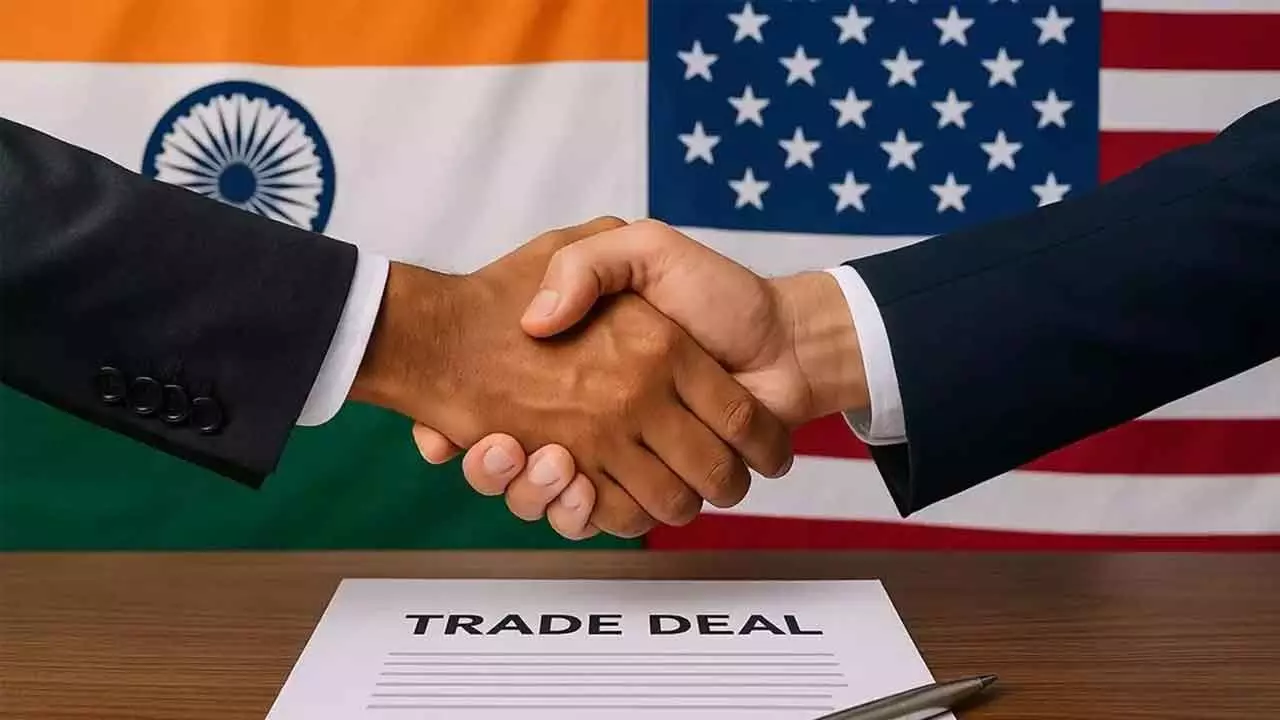
The recent interim agreement announced by India and the United States and their joint statement on the issues will go a long way in reshaping the economic strength and mutual friendship of the two countries, in the days ahead. According to the joint statement, the interim trade agreement provides that India will reduce or remove tariffs on all US industrial goods and on a specified range of agricultural products, while the United States will lower tariffs on Indian imports from about 50 per cent to 18 per cent, through amendments to the existing executive orders.
The agreement is to be implemented in phases, with further reductions expected after the formal signing of the interim pact, tentatively mid-March, and it includes a clause allowing either side to revisit commitments if the agreed tariff levels are altered. Importantly, the framework makes it explicitly clear that sensitive Indian agricultural and dairy products are excluded, with the government maintaining that these will continue to be fully protected. The agreement lays out provisions for preferential market access and rules of origin which are designed to ensure that the gains largely accrue to both the countries, alongside a gradual reduction of US tariffs on major Indian exports such as textiles, apparel, pharmaceuticals, gems and diamonds, metals, and aircraft-related components amongst other products mentioned in the framework.
It also seeks to address long-standing non-tariff barriers to improve cooperation in areas such as digital trade, technology, and supply-chain resilience. It also indicates New Delhi’s intention to substantially step up imports of US energy, technology-related products and other strategic goods, even as talks remain open on a more comprehensive bilateral trade agreement.
Can India afford to move away from Russia as it always stays close to it? If we stop importing oil from Russia, would it be reasonable to yield to US pressure and become dependent on oil imports from Venezuela? That question needs to be deeply pondered.
Foreign affairs often appear straightforward at first glance, but when problems arise, they become messy and complicated. Every country, including India, has that experience. No matter who is in power, foreign policy rarely changes as easily as it might seem. Early on, Prime Minister Narendra Modi tried to forge a new understanding — including with Pakistan — but found it was not as simple as was hoped. Foreign affairs are rarely resolved as per our plans; something always seems to get in the way, as past experiences show. If, as the US. is asking, India were to stop importing oil from Russia, the consequences would certainly have to be debated.
Modi expressing happiness at the deal with Washington clearly contributes his willingness to this joint statement. Moreover, India presumes that this agreement will not be a stumbling block in the relationship with Russia. However, the world eagerly awaits the outcome of this interim agreement in furtherance of peace across all countries involved in various matters related to the US.
So far, in its foreign policy toward the US, our country has acted independently rather than following the example of European or NATO states. That independent stance — practiced for many years, including toward several Islamic countries and some Western states — allowed India to maintain a proud, sovereign presence. During the days of Jawaharlal Nehru, China struck, trampling border agreements and precipitating armed conflict.
Pakistan’s persistent attempts to inflame Kashmir repeatedly, aided by China, and efforts to portray India as a permanent enemy on the world stage — especially before the United Nations — eroded the stature of Indian leadership that until then had been a major influence even among Arab countries and others. Losing the opportunity to secure a permanent seat on the UN Security Council — effectively ceded to China — was not only unfortunate but also deprived India of important diplomatic leverage.
On the other hand, Russian support in certain difficult moments helped India stand assertively. But when the Soviet Union dissolved and Russia remained only as Russia, it lost the leadership stature that could have made it an equal power to the United States.
Trade and migration disputes, especially employment-related issues like H-1B visas, have left India in a difficult position over the past two years. Undoubtedly, Modi has shown political acumen and managed, as far as possible, to keep the US, Russia and China at an equal distance.
The big question now is how long we will continue to strengthen our own country. That is why it is the Centre’s responsibility to handle this agreement with utmost care so that it contains no elements harmful to the country.
(The writer is a retired IPS officer, who has served as an Additional DGP of Andhra Pradesh)