Greed: How much is too much?

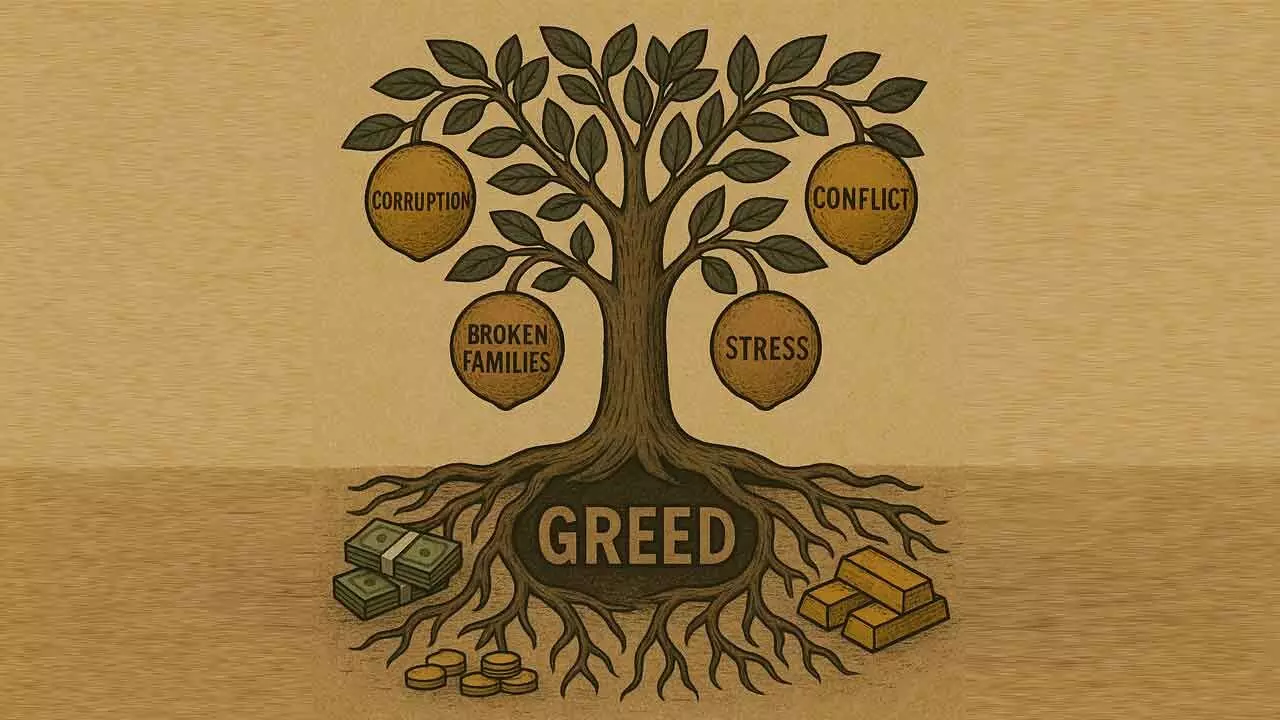
Ambition is the fuel of progress. It drives people to innovate, to create, to strive for excellence. Greed, on the other hand, is ambition without boundaries
I often wonder if our society is truly progressing, or if we are digging our own grave with gold-plated shovels. We live in an age where poverty is no longer the most pressing challenge, but insatiable greed is. Families are disintegrating, relationships are breaking apart, and communities are turning fragile. It is not because people lack resources, but because they are endlessly chasing more.
We must ask ourselves a question that is both urgent and uncomfortable. How much is too much? Where does ambition stop being admirable and start becoming corrosive? How do we know when ambition has turned into greed, and when society has moved from growth to decay?
Defining greed
Let us first separate healthy ambition from destructive greed. Ambition is the fuel of progress. It drives people to innovate, to create, to strive for excellence. Greed, on the other hand, is ambition without boundaries. It is not about having more, it is about never being satisfied.
Think of hunger. Hunger is natural and necessary. It tells us when to nourish our bodies. But gluttony is different, it destroys health and shortens life. Greed is the gluttony of the human spirit. It keeps asking for more even when the plate is overflowing, and it does not care who else is left starving.
The Greed Scale : A framework
To answer how much greed is too much, I believe we need a framework. We can visualise human wants across four stages:
1. Need – What sustains life and dignity. Food, shelter, clothing, healthcare, and basic education fall into this category.
2. Comfort – What eases life and brings stability. A secure home, reliable transport, good schools for children, and savings for emergencies.
3. Ambition – What fuels growth, excellence, and advancement. Building a business, pursuing higher education, moving into leadership, or chasing a dream project.
4. Greed – The stage where nothing is enough. Where gadgets are replaced every few months without real need, where the desire for more is relentless, and where relationships are sacrificed on the altar of possessions.
Greed begins where ambition loses boundaries. I would urge each reader to reflect on their own lives. Do you sacrifice family time to chase one more deal? Do you endlessly upgrade possessions that you barely use? Do you find peace slipping away even as your bank account swells? If your answers are yes, then you are not alone. Society itself is pushing us all into this vortex of excess.
Signs of too much greed
How can we know if greed has crossed the line? There are unmistakable markers.
♦ When money becomes more important than any relationship.
♦ When ethics are compromised for gains.
♦ When children rush to inherit wealth but not values.
♦ When possessions multiply, but peace diminishes.
♦ When families collapse over financial disputes.
We see this everywhere. Courtrooms filled with brothers and sisters fighting over ancestral property. Politicians amassing fortunes in the name of service. Executives cutting corners at the cost of workers’ safety. Parents buying everything for their children except their presence.
We live in an age where the richest among us are celebrated but rarely questioned. We have more billionaires than ever, yet fewer role models of simplicity and contentment. This is not a coincidence; it is a symptom.
Individual greed vs Collective consequence
What starts at the level of the individual eventually infects the collective. A society where individuals pursue greed without restraint soon becomes fragile, unstable, and corrupt.
We see corruption in politics as leaders prioritise personal fortune over public service. We see environmental destruction as corporations plunder nature for short-term profits. We see urban chaos as developers devour every inch of land, leaving cities choking. And we see family disputes becoming epidemics, as greed infiltrates even the sacred bonds of kinship.
Here lies the most dangerous shift. We have reached a phase where “the end justifies the means”. Individuals are willing to do whatever it takes to satiate their greed, regardless of ethics, morality, or humanity itself. And disturbingly, society has started to normalize this.
Unethical gains are now celebrated as accomplishment. Immoral excess is applauded as success. People who cut corners are hailed as “smart”, while those who hold on to integrity are mocked as “foolish”. This normalization of unethical greed is not progress, it is regression. It is society digging its own grave and calling it growth.
We must pause and ask: are we truly building a great future for our children, or are we robbing them of one by glorifying such dangerous behavior?
The Cultural erosion
India has always been a civilization of simplicity, contentment and balance. Ancient wisdom taught us to live in harmony with nature, with family, and with community. Gratitude and restraint were as celebrated as achievement and ambition.
But today, those values have eroded. Consumerist culture is replacing cultural balance. Festivals have turned into competitions of extravagance. Weddings have become showrooms of wealth rather than sacred unions. Even funerals are not spared from the greed-driven need to display wealth and power.
What once united us is now being commodified, and what once centered us is now being eroded. This cultural corrosion is perhaps more dangerous than the economic impact of greed, because when values collapse, nothing remains to anchor society.
The personal cost of greed
Greed does not only harm society at large, but it also destroys the very individuals who nurture it. The personal costs are heavy.
Stress, anxiety, and depression are at all-time highs. Families are disintegrating as members live like strangers under the same roof. Loneliness stalks the wealthy who believed possessions would bring companionship. Moral decay eats into the character of individuals, leaving behind hollow lives.
What makes this even more alarming is how greed has become contagious across generations. Young adults are already showcasing the symptoms of this disease.
Nothing seems to satisfy their greed anymore. Parents are harassed for exorbitant demands, from luxury gadgets to reckless lifestyles.
Every next generation is learning the worst from their predecessors, copying greed as if it were the only inheritance worth protecting. This intergenerational transmission of greed is perhaps the most dangerous development of all, because it ensures the disease does not just survive, it multiplies.
I have met people who seemingly “have it all” yet are restless, insecure, and perpetually unhappy. They drive luxury cars, live in sprawling homes, and yet cannot sleep peacefully at night. Their greed has become self-sabotage. It is not ambition any longer, it is poison disguised as progress.
How to redraw the line
The only way forward is to consciously redraw the line between ambition and greed. Each of us must take responsibility for this.
1. Reconnect with values: Recognize that need, comfort, and ambition are healthy, but greed destroys both self and society.
2. Teach children balance: Show them contentment as much as ambition, restraint as much as achievement.
3. Redefine success: True success is not what you accumulate, but what you contribute, what you balance, and what you nurture.
4. Celebrate generosity: A society that applauds greed will collapse. A society that rewards generosity will endure.
This is not a call to abandon ambition. It is a call to discipline it. It is not a plea to stop dreaming big. It is a plea to not let dreams become obsessions. The line between ambition and greed is thin, but it is crucial.
So, how much greed is too much?
The answer is simple but not easy. Too much is when what you chase begins to destroy who you are, what you stand for, and the society you live in. Too much is when ambition turns into obsession, and when means are sacrificed for hollow ends. Too much is when your abundance starves your humanity.
The tragedy of our times is not that we have too little, but that we demand far too much. And we demand it at the cost of everything else. If we do not stop, society will not crumble because it lacked wealth, but because it lost its soul in the pursuit of it.
The choice is ours. Will we continue to normalize greed, or will we reclaim balance before it is too late?
(Author is the Chairman for Nation Building Foundation, Chief Spokesperson BJP Telangana & a Harvard Business School certified Strategist.)