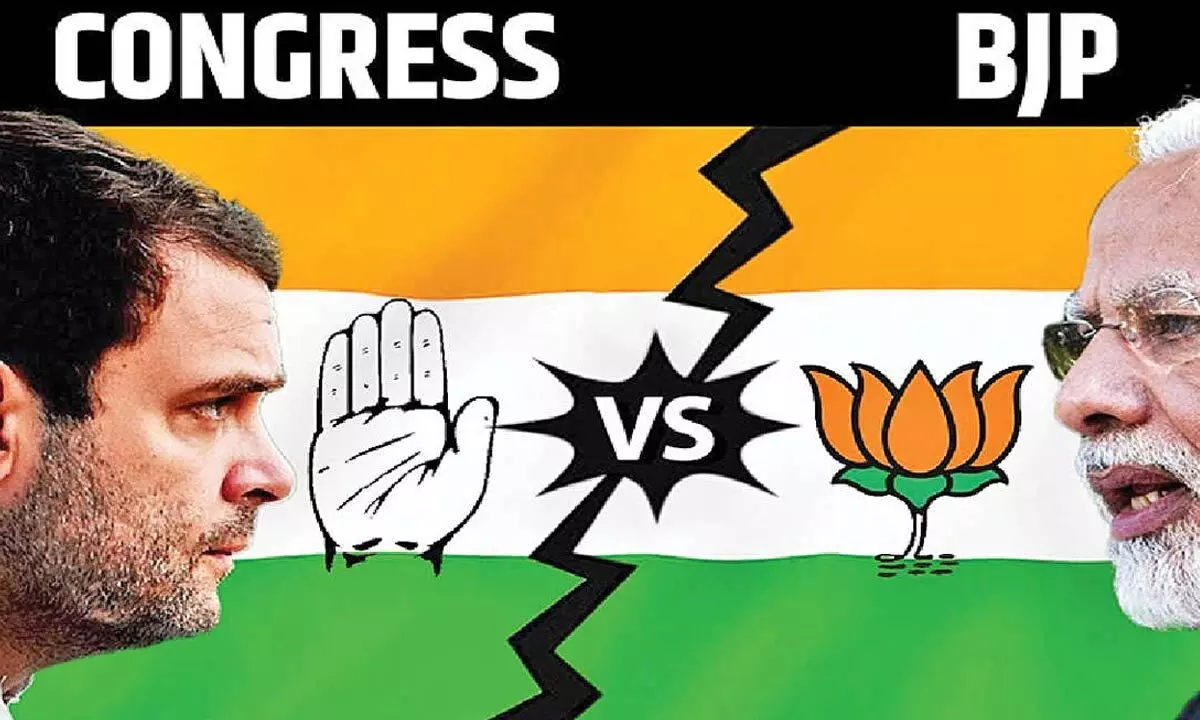
GOP and BJP: A study of contrasts

“Once, under the name of Congress, everyone fought together for the nation. But after becoming a political party, the same Congress is now resting under the shadow of one family merely to retain power. This is not a sign of democracy; it is evidence of a neo-monarchy.” (Ital)
These were the remarks made by C Rajagopalachari on the path Congress was taking after the Nehru era. Not only have things not changed between then and now, Congress has slipped even deeper into family-centric, monarchic tendencies. Veteran Congress leader Digvijaya Singh, who has had decades-long association with the party, revealed through his tweet what is wrong with the Congress and what the BJP’s strength is. He no longer holds influence with the high command—because he spoke the truth. Still, in a democracy, since Congress continues to function in precisely the way it should not, he chose to speak. And he did.
Claiming that it alone brought independence, the Congress party began ruling the country. As long as Nehru’s leadership prevailed, dissenting voices had some space within the party. But after Nehru, especially starting with Indira Gandhi’s era, the high-command culture strengthened. Senior leaders were sidelined, and loyalty alone began to be rewarded. In other words, priority was given only to loyalists. A party that was meant to function democratically revolving around a single family deeply disturbed Rajaji even then.
For Rajaji, democracy meant leaders emerging from the people. But he observed leadership in Congress beginning to pass down through heredity. Just as a king’s son becomes king, he noticed a tendency where only Nehru’s descendants were expected to rule the nation. He described this as a “neo-monarchy.” He believed this went against the ideals of the freedom struggle.
That is why Rajaji founded the Swatantra Party in 1959. His aim was to create an alternative to Congress a party that supported liberal economic policies and respected individual freedom. He consistently warned that without a strong opposition, Congress would turn authoritarian. For the next fifty years, Congress never changed. It continued the same neo-monarchic system. Rajaji’s words proved prophetic: “A party should be a system that works for an ideology, not a private limited company run according to the likes and dislikes of one individual. In a democracy, leadership must be collective, not centralized.”
These remarks by Nijalingappa, another senior Congress leader who fell victim to this neo-monarchic system, are worth recalling today. Every strong leader who challenged family dominance and monarchy was pushed out. Indian political history is full of leaders who split from Congress, built their own bases, and eventually reduced Congress to dust. Leaders who challenged the Delhi-based high-command culture and single-family decision-making emerged as unchallenged regional powers. As Rajaji predicted, those who sought freedom from neo-monarchy succeeded in erasing Congress regionally.
In Maharashtra, Sharad Pawar, the backbone of Congress in the state, walked out in 1999 questioning Sonia Gandhi’s leadership. Opposing the idea of handing party control to someone of foreign origin, he founded the Nationalist Congress Party (NCP). The influence of NCP in Maharashtra needs no explanation.
Along with Sharad Pawar, P.A. Sangma and Tariq Anwar also rebelled. They argued that anyone becoming Prime Minister of India must be born in this country and that Sonia Gandhi, born in Italy, lacked that eligibility. For raising these questions, they were expelled from Congress on grounds of indiscipline. Under Sangma’s leadership, the National People’s Party emerged and became prominent in the Northeast.
In West Bengal, opposing the soft approach of the Congress high command toward the Communists and protesting the sacrifice of grassroots leaders for high-command self-interest, Mamata Banerjee rebelled. The Trinamool Congress, founded by her in 1998, today has pushed Congress into irrelevance in Bengal and shattered the three-decade-long Communist fortress.
In Andhra Pradesh, Congress’s downfall was caused by Y.S. Jagan Mohan Reddy’s rebellion. After his father Y.S. Rajasekhara Reddy’s death, despite widespread support for him, he was denied the Chief Minister’s post. Instead, those preferred by the high command were chosen.
In Northeast India, the leader who shook Congress’s stronghold in Assam was Himanta Biswa Sarma. Questioning Rahul Gandhi’s leadership style and the lack of respect within the party, he bid goodbye to Congress. His exit wiped Congress not only from Assam but across the Northeast. After joining the BJP, he became Chief Minister and successfully realized the vision of a Congress-free Northeast.
Analysing the journeys of all these leaders reveals one clear truth: all of them rose from the grassroots within Congress. But prioritizing public opinion over blind loyalty to the high command, they chose to leave. By disrespecting strong regional leaders and promoting hereditary politics, Congress lost its intellectual capital and popular strength. The neo-monarchic system within the party is the reason its very existence has become questionable in many states today.
“The high-command culture where decisions are taken in Delhi destroys the confidence of regional leaders. Leaders without grassroots strength merely waiting for high-command blessings leads to a party’s downfall,” P V Narasimha Rao once said clearly. That reality stands visible before our eyes today.
The Gandhi family in Congress is no longer just a form of leadership; critics say it has become an unwritten constitution. No matter how capable or popular a leader is, crossing the line drawn by the Gandhi family is taboo. In this process, from the G-23 leaders who sought party reform to the recent case of Shashi Tharoor, all who demanded change were sidelined or pushed out.
The Shashi Tharoor episode once again questioned Congress’s internal democracy. Though he attempted to create a democratic atmosphere by contesting the party presidential election, the ground reality was very different. Despite officially claiming there was no “high-command candidate,” the entire system rallied behind Mallikarjun Kharge. Even a thinker like Tharoor, who sought reforms, was not properly utilised—even as a star campaigner—and was gradually sidelined, not even treated as a party leader. This clearly shows that loyalty matters more than merit.
Today, in any Congress meeting, more time is spent expressing gratitude to the Nehru-Gandhi family. Even without holding the party president’s post, all key decisions happen under the supervision of Rahul Gandhi or Sonia Gandhi. As a result, strong state-level leaderships are forced to wait for signals from Delhi. Any leader who offers even mild criticism of the Gandhi family immediately faces backlash from within the party. Recently, a Karnataka Congress minister who questioned irrational politics over alleged vote theft was summarily dismissed overnight—without even asking for a resignation.
A political party must function democratically, not like a private limited company. This criticism now haunts Congress. Even if a leader fails in elections, the party searches for another member from the same family, preventing new blood and new ideas from entering. Because of this high-command-centric approach, capable leaders like Himanta Biswa Sarma and Jyotiraditya Scindia were forced to leave. Those who try to grow beyond the Gandhi family’s shadow have no place in Congress. By every measure, for decades now, Congress has not functioned democratically.
But the Bharatiya Janata Party functions in a completely democratic manner. The very words spoken by Digvijaya Singh stand as proof of this. No one can deny them. Unlike the Congress party, the BJP emerged on a strong ideological foundation. In the BJP, power is not centralized in one individual; it revolves around the organization. Here, ideology matters, not individuals.
In the Congress party, leadership largely flows from top to bottom. Loyalty to the Gandhi family is the primary qualification for securing positions. But the situation in the BJP is different. The party proudly states that the current Prime Minister Narendra Modi was once a common man, who began his journey as an ordinary party worker and rose to become the Prime Minister of the country.
Similarly, the current Home Minister Amit Shah and party president J.P. Nadda also rose from the grassroots. Leaders like Venkaiah Naidu, Kishan Reddy, Radhakrishnan, Yediyurappa, Pramod Mahajan, Sushma Swaraj, Shivraj Singh Chouhan, and many others rose to high positions. The BJP’s success is rooted in the encouragement of its second-line leadership. This meritocracy, giving importance to capability alone, constantly instills enthusiasm among BJP workers.
The selection of Nitin Nabin Sinha as the new national president of the BJP is a towering example of the party’s internal democracy and its policy of prioritizing merit. Despite having no political legacy or family background, beginning his journey purely as a grassroots worker and ascending to the highest position through dedication and performance highlights the BJP’s uniqueness. This is only the latest example. At every level in the party—from Prime Minister Modi down to the district-level president. leaders are those who have worked within the organization. Unlike other parties struggling under the shadow of hereditary politics, positions in the BJP are awarded solely based on competence and commitment to the party.
This decision not only instills confidence that even an ordinary worker can rise to lead the party, but also demonstrates that the organizational structure is based on systemic processes rather than personal whims and preferences. In Congress, decision-making authority is entirely concentrated around 10 Janpath. Whether it is changing Chief Ministers in states or allocating tickets, approval from the high command is mandatory. This weakens regional leadership.
In the BJP, decision-making is carried out through a system known as the Parliamentary Board, which includes key leaders. All decisions are taken collectively, keeping organizational interests in mind. The BJP has a culture where even a decision taken by an individual can be set aside if it does not serve the party’s interests. Anyone observing contemporary politics clearly understands this reality.
BJP workers remain among the people irrespective of elections. They possess ideological commitment. While Congress workers revolve around leaders, BJP workers revolve around voters. Congress displays activity only during elections; afterward, the system becomes stagnant. Because of this, the BJP always remains one step ahead in election strategy.
In other words, Digvijaya Singh spoke the truth very late. But for decades, history shows that the Congress party has practiced only servitude in the name of democracy. In contrast, the Bharatiya Janata Party moves forward with the true spirit of democracy. Those accustomed to servitude are now coming to terms with reality, but the history of Congress’s servitude cannot be erased, no matter how much one tries.
(The writer is a BJP National Council Member)