




- Bengal: SER takes steps to supply clean water at stations
- TN: Singapennu task force marks 100 days, acts on 4231 complaints
- Punjab CM launches door-to-door election campaign
- Alliance with NC won’t stop Congress from raising public issues: Tariq Karra
- Sikh clergy excommunicates SGPC member Chawla over rape case
- Youth shot dead by friend on moving bike in Bhopal
- Iran Sets Conditions For US Talks, Warns Of ‘Decisive War’ If Demands Rejected
- Met office issues heavy rain warning in West Bengal from Tuesday
Gen Z is being overrated in India
In Short
Generation Z is unlikely to think differently when it comes to voting in the country. They will behave the way other voters behave

Share :
Gen Z is being overrated in India
The political discourse about Gen Z reached such a level in India now as if the country did not have youngsters in the past. That’s surprising. Generation Z is nothing but the youth of this country at this point of time. India had young people in the past. The country will have young people in the future as well. Furthermore, the country is progressing at a faster clip in recent years thanks to the demographic dividend it enjoys
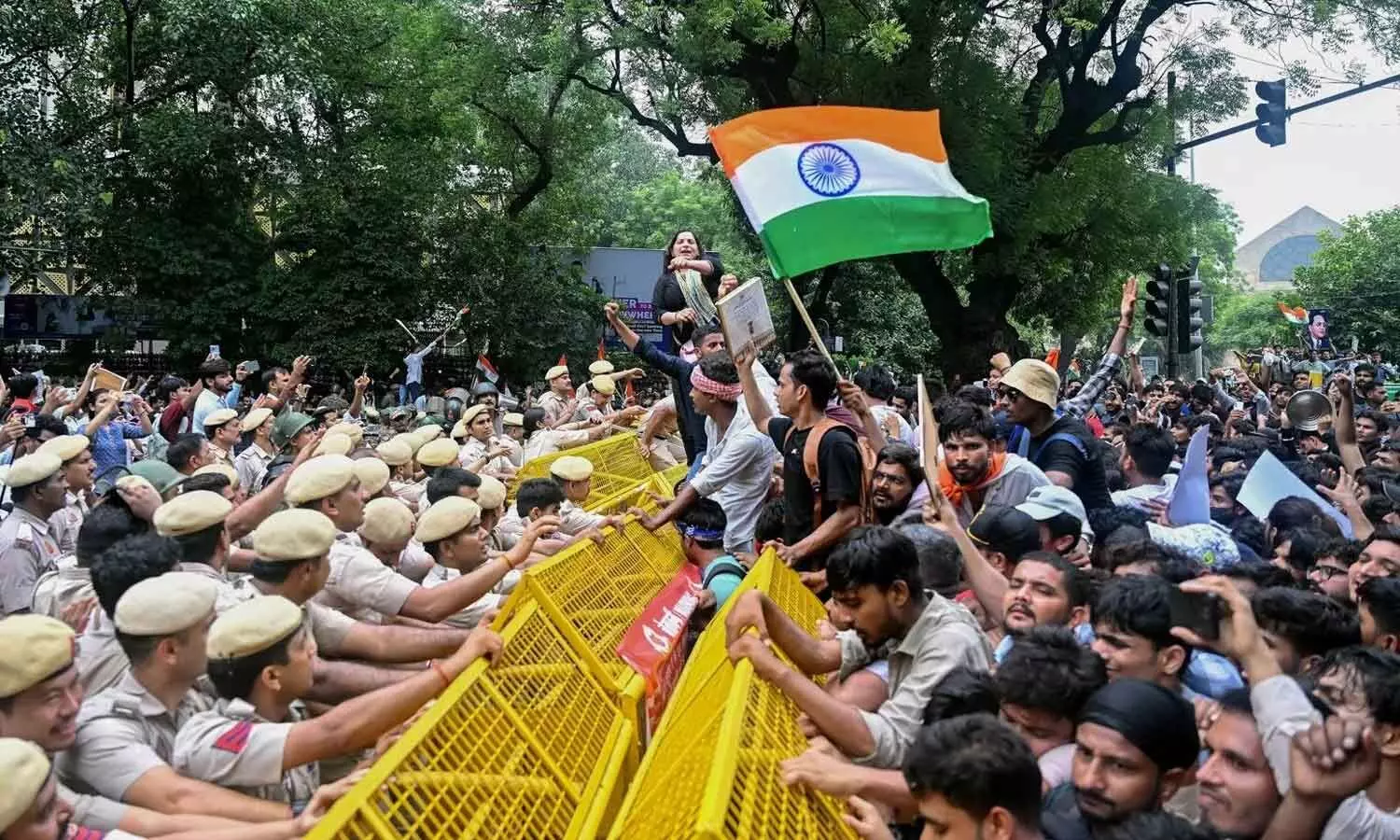
What is the in-thing in India’s political landscape these days? It’s the topic of Gen Z. After the Janta Mantar protest in the national capital in July against NEET paper leakage, which turned violent, everyone is talking about Gen Z now. It is more so in political circles. Rattled by NEET protests that culminated in the resignation of Dharmendra Pradhan as the Union Education Minister on July 25. Prime Minister Narendra Modi, known for his social media savvy, joined Instagram, a photo and short-form video sharing social network from Meta Platforms which also owns another popular social media platform Facebook. It is widely believed that Gen Z, the world’s first digital-native generation, spends most of its time on Instagram. Prior to NEET protests, Modi primarily used X to communicate with people.
The Indian Prime Minister has over 107 million (10.7 crore) followers on X, the fifth highest globally after Elon Musk, Barack Obama, Cristiano Ronaldo and Donald Trump. Modi is known to go for a course correction swiftly if he finds anything challenging. In a similar vein, his shift to Instagram was instant. He started uploading selfie videos on Instagram past midnight in a serious attempt to reach out to Gen Z.
On his part, Rahul Gandhi, the Leader of Opposition from Congress, kicked off his own Gen Z outreach with Chhatron Ki Goonj (Echo of Students) gatherings through which he has been interacting with youngsters across the country. Under his leadership, Congress lost three successive General Elections to the Modi-led Bharatiya Janata Party (BJP) since 2014. The Nehru-Gandhi family scion is leaving no stone unturned to be in the reckoning for the 2029 General Elections. And he seems to be pinning lots of hopes on youngsters to take on Modi, the next time around.
However, the political discourse about Gen Z reached such a level that it appears like India never had any youngsters in the past. That’s surprising. Generation Z is nothing but the youth of this country at this point in time. India had young people in the past. The country will have young people in the future as well. And the country is progressing at a faster clip in recent years; thanks to the demographic dividend it enjoys.
Meanwhile, all political parties have their own student and youth wings. BJP has Akhil Bharatiya Vidyarthi Parishad (ABVP) which is affiliated to Rashtriya Swayamsevak Sangh (RSS), the parent organization of the saffron party. Congress also has its own student wing in the National Student Union of India (NSUI). Apparently, the two major national political parties don’t seem to take their respective student wings seriously. Otherwise, they wouldn’t have any disconnect with the current generation of youngsters.
Frankly speaking, Congress killed the spirit of NSUI long back by encouraging nepotism and allowing offspring and relatives of senior party leaders to corner key positions in it. Now, both BJP and Congress have suddenly woken up to the presence of youngsters in society. Of course, Modi has been interacting with young entrepreneurs for the past several years. With his Instagram selfie videos and other outreach efforts, he seems to be reaching out to other youngsters as well.
Who’s Gen Z?
According to Pew Research Organisation, Gen Z, the short version of Generation Z, is a group of people born between 1997 and 2012. They are now aged between 14 and 29 years. People who were born before that period are called Gen Y (millennials). They were born between 1981 and 1996. Incidentally, Gen Z members are children of Gen Y.
Interestingly, several countries witnessed Gen Z movements against corruption, rising inequality and poor governance in the last couple of years. Rough estimates indicate that 70 countries have seen such movements till now and social media platforms played a key role in these movements. But they were successful only in Bangladesh and Nepal where governments had to bow out. It looks like these movements inspired Indian youth as well and the protests against NEET paper leakage was a manifestation of that. Furthermore, there is palpable anger in a section of youth that is aspiring to enter the government workforce. With the rise in the private sector and the reluctance of the governments to hire more people given the financial constraints and rising salary burden, the growth of employment opportunities in the government sector has drastically come down.
That’s the reason why there is intense competition for government jobs and even highly educated people are applying for attender posts. Of course, government jobs offer stability, financial security, higher comfort levels and steady rise in salaries, irrespective of the performance. Key performance indicators (KPIs) are an alien term when it comes to government jobs. But governments can’t offer jobs to everyone. So, the anger among those aspiring for government jobs is understandable. Not to miss out, the private sector is also offering decent jobs these days. Therefore, youngsters also should opt for private jobs if they fail to get government jobs.
But will India witness Gen Z movement on the lines of Bangladesh and Nepal in future? It is very unlikely given the vastness of the country and its diverse cultures.
Further, I don’t think Gen Z will think differently when it comes to voting. They will behave the way other voters behave. The recent Mood of The Nation survey by a publication also proved that. Moreover, Indian voters, whether young or old, are mature. They know what they want. Neither social media nor any narratives influence their decisions. There may be some impact if there is a see-saw battle in the electoral field. Otherwise, people vote for governance, not anything else. As for social media, voters started developing disdain for it. They also are also taking up campaigns and information push on social media platforms with a pinch of salt.
Anyway, Gen Z is being overrated in India. No political party will win elections if it focuses only on Gen Z. A political party will win elections only if it convinces a majority of voters in its favour. That’s the reality.
Telangana govt. declares Dussehra holidays 2026 for schools from 10 October
Those who made UP 'BIMARU' cannot question govt: Yogi Adityanath
Rahul Gandhi Faces BJP Criticism Over Comedian’s PM Modi Skit At Indore Event
'Congress has become party of comedians and jokers': Kiren Rijiju on Chhatron Ki Goonj mimicry row
Nara Lokesh Emphasises Morality in Education and Reflects on Political Journey
Union Minister Bandi Sanjay Kumar comes to aid of road accident victims in Telangana


