Discrimination against farmers remains the country’s bane

Our ancestors once declared: “Farming is the noblest profession, trade is intermediate, and service is the last resort for survival.” For centuries together, agriculture was considered the backbone of our civilization and the highest calling in life. Even during monarchies, farming was revered as the most honourable profession. Yet today, the situation has reversed entirely.
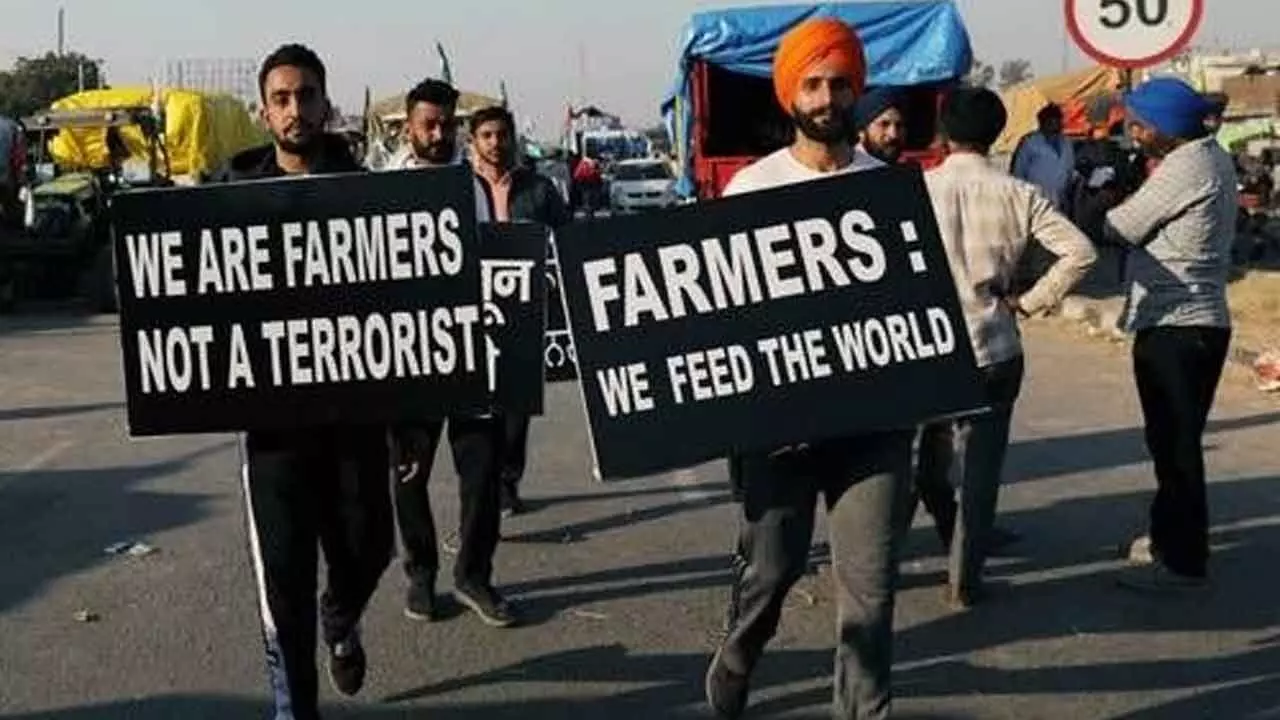
Under democratic governance, led by people’s representatives, the farmer has become both economically and socially marginalized. The community that constitutes the largest section of our population is now facing unbearable hardship. Losing hope in life, thousands of farmers are turning to suicide.
From rich heritage to harsh reality:
Historians remind us that until 1700, India was the richest country in the world. Farmers then enjoyed dignity and stability. But under colonial rule, and later even in democratic India, agriculture fell into neglect. Understanding the reasons for this decline is urgent and essential.
At the time of independence in 1947, the price of 10 grams of gold was just ₹88. With the sale of one quintal of cotton, a farmer could buy 36 grams of gold. A quintal of rice or wheat cost only ₹3.20, and a senior government officer earned about ₹100-105 per month.
Today, the contrast is stark. Cotton, once equivalent to 36 grams of gold per quintal, fetches a maximum of ₹8,110 under the Minimum Support Price (MSP)—an increase of around 337 times. But gold has risen by more than 1200 times. Rice and wheat prices have grown about 720 times, while the salaries of senior government officials have risen by 2000–2500 times. These comparisons show not that employees or traders should not prosper, but that farmers’ incomes have not kept pace with other sectors of the economy.
Institutional bias against farmers:
For government employees, pay commissions periodically revise wages, pensions and allowances, considering inflation, cost of living, and parity with the private sector. For businesses and industries, the government provides generous support—Production Linked Incentives (PLI), tax deductions, subsidized credit, free land, export–import concessions, and more.
But farmers remain excluded from such institutionalized support. Officials from the Commission for Agricultural Costs and Prices (CACP) determine the MSP for crops, even though its very methodology is biased. Currently, it follows the A2+F2 formula, which includes input costs and family labour, but farmer organizations demand the more comprehensive C2+50 per cent profit formula.
Even so, the deeper problem lies in CACP’s mandate: it does not merely assess farmers’ costs but also weighs consumer affordability, market trends, and inflationary impact. Inflation, for instance, is used against farmers—crop prices are restrained to keep food prices stable. But the same inflation is used to justify salary hikes for government employees and workers. This contradiction exposes the structural discrimination farmers face.
No constitutional protection for farmers:
India has statutory or constitutional commissions to safeguard the rights of employees, labourers, traders, women, caste groups, and religious minorities. But for farmers, who make up nearly half the nation’s population, no such permanent legal body exists. The Constitution directs the state to ensure justice for socially and economically weaker sections and, under Article 43, to improve conditions in agriculture. Yet governments have failed to establish a constitutional or statutory body to protect farmers’ interests.
While industries and service sectors receive tax holidays, subsidies, soft loans, and even debt waivers in the name of development and employment generation, agriculture—responsible for the livelihoods of half the population—remains neglected. Unlike other producers who freely set the price of their goods, farmers have no such power. Their produce prices are determined by governments, traders, and consumers. Exports from manufacturing sectors face no restrictions, but farm exports can be curbed at any time—a further injustice.
The human cost of neglect:
According to official statistics, the average Indian farmer carries a debt of about ₹74,000. With inadequate returns on crops, farmers struggle to feed and educate their children, arrange marriages, or repay loans. In despair, many consume the very pesticides meant for their fields, ending their lives in silence.
In a democracy, political parties—whether in power or in opposition—seek to secure or retain public support. Workers, employees, and businesses achieve this through their collective bargaining power. Farmers, however, remain fragmented: when northern farmers protest, Maharashtra farmers remain silent; when southern farmers agitate, the movement stays confined to their states.
This lack of national unity weakens farmers’ voices and allows governments to continue discriminatory policies without accountability.
The way forward:
The truth is clear: farmers cannot break free from this cycle of discrimination until they unite across regions and states. Only through a strong, organized, nationwide movement can they exert real pressure on political parties and governments. The day farmers join hands across India, raising a collective fist against injustice, will be the day they finally break free from decades of neglect and discrimination. Until then, the farmer—the backbone of our nation—will remain bent under the weight of unfair policies.
(The writer is President of Kisan Jagaran, a registered farmers welfare organisation)