




- Congress govt committed to advocates’ welfare, protection: Ministers
- Ponnam lays foundation for Rs 3.22-crore Uppal bus terminal
- Govt medical colleges pip private institutions in MBBS 1st yr results
- West Bengal team studies rural development works in Krishna dist
- Jagan’s Letter To Sharmila: YSRCP accuses Chandrababu of exploiting family dispute
- Good response to hmtv’s Innovative Hackathon-2026
- The three qualities that shape our everyday life
- This Diwali, trade fireworks for a sky full of stars in Kenya
Delimitation, federal equilibrium and Telangana’s representation
In Short
The Justice Kurian Joseph panel on Union-State Relations recommended freezing interstate seat allocations till 2126

Share :
Delimitation, federal equilibrium and Telangana’s representation
In a nation, the state recognises two entities, the sovereign state and the individual citizen, where homogeneity is presupposed, representation is individualistic and universalism is preferred such as one person, one vote over particularism by rejecting internal differences.
In a democratic federal system, the republic functions as a constitutional compact between the Union and its constituent states. Consequently, political equality operates at both the individual and territorial levels: differences among states are accommodated, and representation combines the interests of citizens with those of constituent units. This hybridity is reflected in structures such as disproportionate representation in the European Parliament, equal representation in the US Senate, protection of minority rights in South Africa or Tribal Councils in India. In a diverse country such as India, recognition of hybridity is essential for full realisation of civil society. Therefore, the constituency is not stagnant or proportionate geography, but represents a structure, with purpose, to achieve balance and equity among different regions, groups, and people.
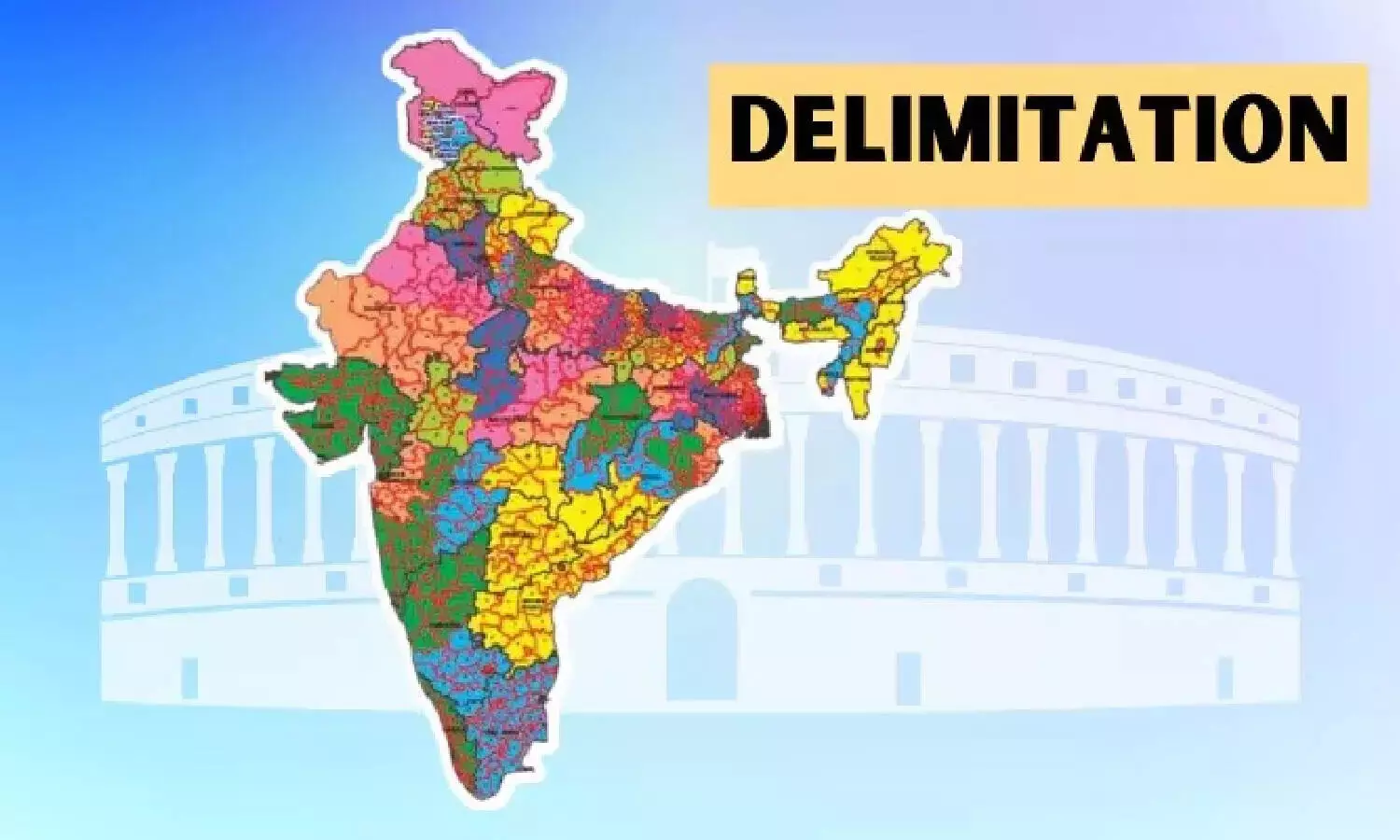
In a representative federal democracy, the principle that every citizen’s vote carries roughly equal weight requires periodic adjustment of political boundaries to reflect demographic shifts. In India, this is known as delimitation, and it is mandated by Articles 81, 82, and 170 of the Constitution, which dictate that the composition of the Lok Sabha and State Legislative Assemblies be readjusted after every census through an independent statutory delimitation commission. Historically, India has constituted four such commissions. However, following the 1971 Census, the 42nd Constitutional Amendment in 1976 froze interstate seat allocations to support national population control policies till 2001 census, and the 84th Constitutional Amendment extended this freeze until 2026.
The current anxiety over delimitation lies in reconciling demographic representation with federal equity. Because population growth rates have diverged significantly across states since 1971, the current distribution of seats creates stark representation disparities. Highly populous states feature higher population per elected representative, such as Rajasthan with roughly 2.74 million people per Lok Sabha seat, Bihar with 2.60 million, Haryana with 2.53 million, and Uttar Pradesh with 2.50 million, compared to southern states like Telangana with 2.06 million, Andhra Pradesh with 1.98 million, and Tamil Nadu with 1.85 million. If parliamentary seats are reallocated strictly on a proportional population basis, states with higher fertility rates stand to gain substantial political power, while states that successfully implemented national population control measures face reduced relative weight in the Parliament. This may result in a clash between political equality and federal fairness. The freeze in 1976 was explicitly introduced to ensure that states effectively executing national policies related to socio-economic and family planning measures were not politically penalised. India’s federal architecture was designed and practised as a system that relies on regional non-dominance and consensus-building rather than simple majoritarian rule.
To address representation imbalances without stripping seats from lower-growth regions, proposals have emerged to expand the Lok Sabha significantly, to 816 seats on a proportional basis (1+50% for all states) by the Union government. Under proposed proportionate expansion of the Lok Sabha to 816 seats for elected members, southern states’ seats are set to increase by 66, of which Telangana’s seats are projected to increase by nine seats. While such an expanded Parliament prevents an absolute loss of seats for any state, it fundamentally alters the voting mechanisms, legislative business, and the equilibrium between the Lok Sabha and the Rajya Sabha. As the Rajya Sabha is capped at its current strength, expanding the Lok Sabha alters the balance of power during joint sittings and constitutional procedures. The ratio of seats between Lok Sabha and Rajya Sabha changes from 2.2:1 to 3.3:1.
The expansion of the Lok Sabha strength reshapes the federal covenant. While routine legislative business and budget approvals continue under standard simple majorities, joint sittings would see an expanded Lok Sabha easily overwhelm the Rajya Sabha. As the Rajya Sabha was specifically established to safeguard state interests and preserve federal balance, leaving its numerical strength and representation unchanged while expanding the Lok Sabha shifts the legislative tilt sharply toward the Lok Sabha. For states, this dilution in relative legislative weight raises concerns over fiscal autonomy, state-list protection, and national policy influence leading to centralisation. Therefore, alternatively, experts have suggested extending the freeze indefinitely, disproportionate representation, equal power for all the states in the Rajya Sabha, new representation recognising demographic performance, and so on.
Under the current delimitation proposals, southern states face a significant restructuring of their electoral boundaries and federal political weight. Faced with these structural choices, policy experts and high-level committees have proposed several potential pathways.
The Justice Kurian Joseph high-level committee on Union-State Relations recommended freezing interstate seat allocations till 2126. Various voices argue that keeping interstate seat allocations stable is necessary to prevent demographic shifts from undermining the cooperative ethos of Indian federalism. Conversely, advocates of compromise models suggest adopting principles of ‘degressive proportionality’ such as the one used in the European
Parliament. Under this approach, larger states still receive additional seats as population grows, but at a discounted rate or through a floor-plus formula that guarantees minimum representation for every state. However, any expansion threatens to reduce southern states’ relative weight in the Parliament. The diluted southern presence in an expanded Lok Sabha could undermine states’ fiscal rights, state-list autonomy, participation in parliamentary committees, or legislative influence in Union governance.
With an average of roughly 2.06 million electors per Lok Sabha seat, Telangana currently holds 17 parliamentary constituencies. While the expansion allows creation of new constituencies, particularly in rapidly urbanising corridors like Hyderabad, Medchal-Malkajgiri, and Ranga Reddy and leads to increasing presence of parliamentarians, the solution for the current representation deficit lies in expanding State Legislative Assemblies too. As the delimitation proposals are unfolding, achieving federal fairness is a
foundational prerequisite to prevent Telangana and other southern states from becoming a passive, marginal voice and to ensure they possess relative weight in actualising their broader development goals while contributing to the nation’s progress. Therefore, any change in states’ representation amounts to disturbing a sensitive balance.
(The writers are from Centre for Economic and Social Studies)


