Constituent Assembly debates

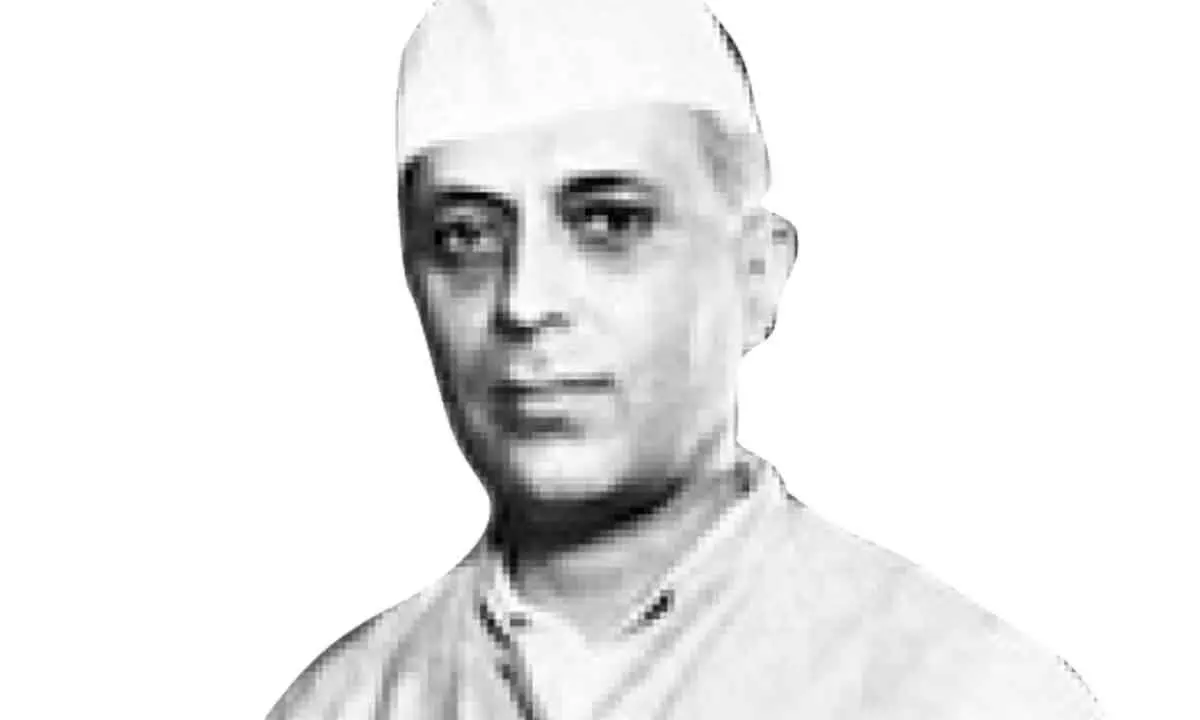
Jawaharlal Nehru was born on 14 November 1889 in Allahabad to a Kashmiri Pandit family.
Jawaharlal Nehru
Jawaharlal Nehru was born on 14 November 1889 in Allahabad to a Kashmiri Pandit family. His father, Motilal Nehru, was a wealthy barrister a prominent figure in the Indian national movement. Nehru was educated at a number of elite institutions including the Harrow School and Trinity College, Cambridge. He trained in law at Inner Temple, London where he encountered Fabian Society scholars. Later, Nehru would be known for his advocacy of fabian socialism. After his return from London in 1912, Nehru enrolled himself as an advocate of the Allahabad High Court.
Role in India’s Independence Movement
Nehru began working for the Indian National Congress after returning from London and soon moved up the party ranks. He led the Non-Cooperation Movement and the Kisan Movement in the United Provinces in 1920, participated in the protest against the Simon Commission in 1928, moved the Purna Swaraj Declaration in 1930, led the Civil Disobedience Movement in the United Provinces in 1930 and participated in the Quit India Movement in 1942. He was arrested and imprisoned by the British multiple times and cumulatively spent close to 9 years in prison.
He held the post of the President of the Indian National Congress many times and was the Prime Minister of the interim Indian Government between 1946 and 1950.
Contribution to Constitution Making
Nehru was elected to the Constituent Assembly from the United Provinces on a Congress Party ticket and held important positions on various committees. He actively participated in the Assembly debates on several key issues, including his landmark speech on the Objectives Resolution.
Later Contributions
Nehru served as India’s first Prime Minister for 17 years, from 1947 to 1962. As Prime Minister, he played a critical role in the Indian economy: he was instrumental in the adoption of import substitution and the development of the heavy industries sector. He established many academic institutions including the All India Institute of Medical Sciences, the Indian Institutes of Technology, the Indian Institutes of Management and the National Institutes of Technology.
Many attribute the survival of India’s constitutional democracy to this first 15 years of leadership that was marked by his adherence to constitutional norms in politics and governance.
Nehru played a key role in India adopting an independent foreign policy through its support and membership of the Non-Alignment Movement. However, his handling of the India-China relationship during the late 1950s and early 1960s was considered a failure.
As a tribute to Nehru, his birthday is celebrated as Children’s Day across India. He advocated for children’s rights and considered children as the real strength of a nation and the foundation of society.
He died on 27 May 1967 in New Delhi due to coronary thrombosis.
Key writings
Nehru’s notable works include Towards freedom; the Autobiography of Jawaharlal Nehru (1936); The Discovery of India (1946); and Glimpses of World History (1934).
1. On 13 December 1946, four days after Assembly’s first session, he moved the ‘Objectives Resolution’ that would inform the constitution-making process.
2. In response to the Hindi enthusiasts, Nehru argued for resolving the national language issue through democratic principles rather than an authoritarian approach.
3. Defending India’s decision to join the Commonwealth of Nations, he put forward both pragmatic and idealistic reasons for the same.
4. On the eve of Independence Day, he addressed the Assembly and the nation with his famous ‘Tryst with destiny’ speech.
The Constituent Assembly of India met in the Constitution Hall, New Delhi, at Eleven of the Clock, Mr. Chairman (The Hon’ble Dr. Rajendra Prasad) in the Chair.
RESOLUTION RE: AIMS AND OBJECTS
Pandit Jawahar Lal Nehru will now move the Resolution which stands in his name.
Mr. Chairman, this Constituent Assembly has not been in session for some days. It has done much formal business, but more is yet to be done. We have been cutting our way and clearing the ground on which we intend to erect the edifice of a constitution. It, however, seems proper that before we proceed further we should clearly understand where we are going and what we intend building. It is apparent that on such occasions details are unnecessary. In building, you will, no doubt, use each brick after mature consideration. Usually, when one desires to construct a building, one must have a plan for the structure that one wishes to erect and then collect the material required. For a long time we have been, having various plans for a free India in our minds , but now, when we are beginning the actual work, I hope, you will be at one with me when I say, that we should present a clear picture of this plan to ourselves, to the people of India and to the world at large. The Resolution that I am placing before you defines our aims, describes an outline of the plan and points the way which we are going to tread.
You all know that this Constituent Assembly is not what many of us wished it to be. It has come into being under particular conditions and the British Government has a hand in its birth. They have attached to it certain conditions. We accepted the State Paper, which may be called the foundation of this Assembly, after serious deliberations and we shall endeavour to work within its limits. But you must not ignore the source from which this Assembly derives its strength. Governments do not come into being by State Papers. Governments are, in fact the expression of the will of the people. We have met here today because of the strength of the people behind us and we shall go as far as the people not of any party or group but the people as a whole–shall wish us to go. We should, therefore, always keep in mind the passions that lie in the hearts of the masses of the Indian people and try to fulfil them.
I am sorry there are so many absentees. Many members who have a right to come and attend the meeting are not here today. This, in one sense, increases our responsibility. We shall have to be careful that we do nothing which may cause uneasiness in others or goes against any principle. We do hope that those who have abstained, will soon join us in our deliberations, since this Constitution can only go as far as the strength behind it can push it. It has ever been and shall always be our ardent desire to see the people of India united together so that we may frame a constitution which will be acceptable to the masses of the Indian people. It is, at the same time, manifest that when a great country starts to advance, no party or group can stop it. This House, although it has met in the absence of some of its members, will continue functioning and try to carry out its work at all costs.
The Resolution that I am placing before you is in the nature of a pledge. It has been drafted after mature deliberation and efforts have been made to avoid controversy. A great country is sure to have a lot of controversial issues; but we have tried to avoid controversy as much as possible. The Resolution deals with fundamentals which are commonly held and have been accepted by the people. I do not think this Resolution contains anything which was outside the limitations laid down by the British Cabinet or anything which may be disagreeable to any Indian, no matter to what party or group he belongs. Unfortunately, our country is full of differences, but no one, except perhaps a few, would dispute the fundamentals which this Resolution lays down. The Resolution states that it is our firm and solemn resolve to have a sovereign Indian republic. We have not mentioned the word ‘republic’ till this time; but you will well understand that a free India can be nothing but a republic.
On this occasion, when the representatives of the Indian States are not present, I desire to make it clear how this Resolution will affect the Indian States. It has also been suggested, and the suggestion may take the form of an amendment laying down that since certain sections of the House are not present, the consideration of the Resolution may be postponed. In my opinion, such an amendment is not in keeping with the spirit of the times, because if we do not approve the first objective that we are placing before ourselves, before our country and before the world at large, our deliberations will become meaningless and lifeless, and the people will have no interest in our work. Our intention regarding the States must be early understood. We do desire that all sections of India should willingly participate in the future Indian Union but in what way and with what sort of government rests with them. The Resolution does not go into these details. It contains only the fundamentals. It imposes nothing on the States against their will. The point to be considered is how they will join us and what sort of administration they will have. I do not wish to express my personal opinion on the matter. Nevertheless I must say that no State can have an administration which goes against our fundamental principles or gives less freedom than obtaining in other parts of India. The Resolution does not concern itself with what form of government they will have or whether the present Rajas and Nawabs will continue or not. These things concern the people of the States. It is quite possible that the people may like to have their Rajas. The decision will rest with them. Our republic shall include the whole of India. If a part within it desires to have its own type of administration, it will be at liberty to have it.
I do not wish that anything should be added to or subtracted from the Resolution. It is my hope that this House will do nothing that may appear in papers, so that, at no time, should people, who are concerned with these problems but who are not present here, be able to say that this House indulged in irregular talk.