
Bharat Ratna Vajpayee – The jewel who nurtured India

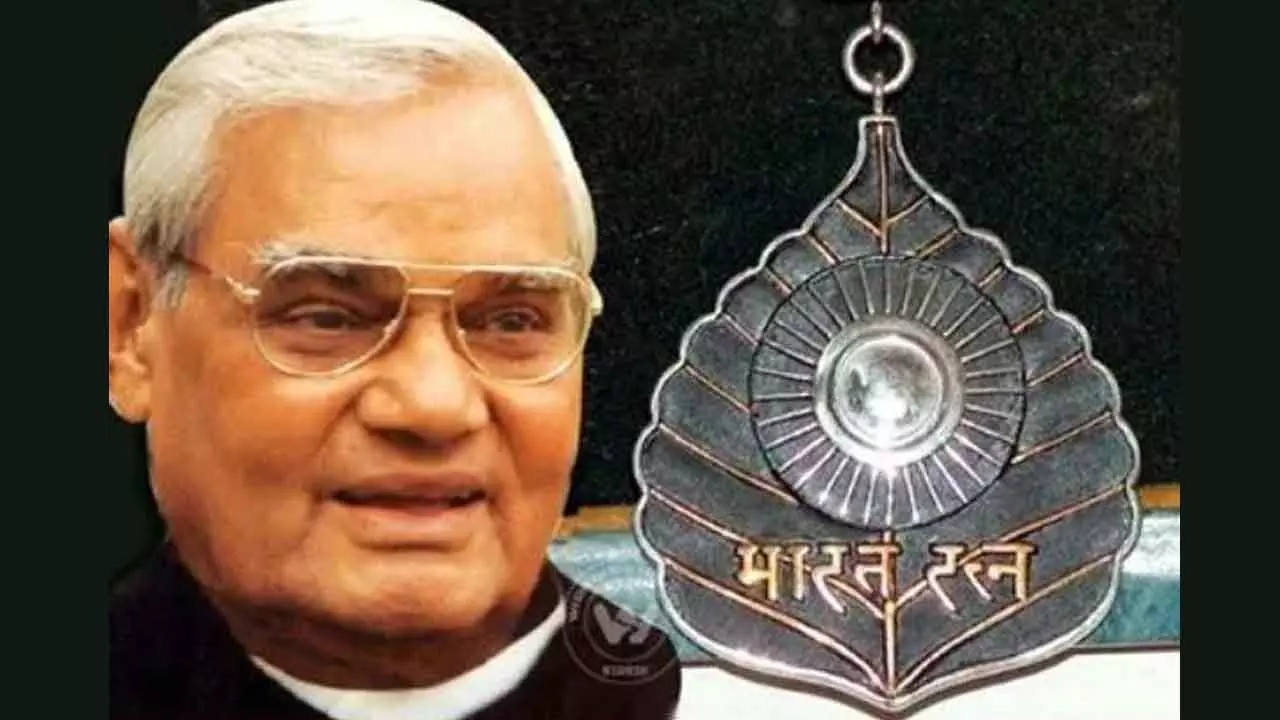
Today is the former Prime Minister’s birth anniversary
“Governments will come and go. Parties will be formed and will perish. But this nation must remain forever. The democracy of this country must live eternally.”
These pearls of wisdom often poured from Bharat Ratna Atal Bihari Vajpayee and in them lie his inspirational life. He was born for the nation. He breathed for the nation. He lived his life for the nation. The people of the country were his family. He was a true-blue Bharat Ratna.
His 100th birth anniversary (December 25) is a festive day for people of the country.
Vajpayee was an extraordinary orator, poet, journalist, tireless patriot, and an undefeated political leader of whom India can be proud of for eternity. He was a leader who enhanced values in politics. He proved that stable and effective governance can be delivered even in coalition politics without compromising on values. Vajpayee was not just a political leader; he was a great culture. Leaders of rival parties would also sit silently in Parliament waiting to listen to his thought-provoking speeches.
In 1996, when his government fell within 13 days of coming to power, he did not think of safeguarding power by resorting to inducements. “Even if I fall short by one vote, I will not step back on values,” he said and resigned with dignity. When he was in the opposition, he would wholeheartedly appreciate the good decisions taken by the government. In 1971, when Indira Gandhi achieved victory in the Bangladesh liberation war, he praised her as “Durga”, displaying his political maturity.
The courage and determination shown by Vajpayee in conducting Pokhran-2 nuclear tests showcased India’s self-respect on the global stage and established the country as a world power. On May 11 and 13, 1998, the Pokhran region in the Rajasthan desert shook as India successfully conducted five nuclear tests, declaring itself a nuclear weapons nation. The real architect behind this bold decision was Vajpayee, the then Prime Minister.
When the previous government attempted nuclear tests in 1995, American spy satellites detected the preparations, forcing the tests to be abandoned. This time, Vajpayee maintained utmost secrecy. Top scientists, including A P J Abdul Kalam, moved in disguise wearing military uniforms to conduct the tests. Calculating the times when American surveillance satellites did not pass over Pokhran, work was completed within those brief minutes. When the tests were conducted, the world was stunned.
Countries like the United States and Japan expressed severe anger. The US imposed strict economic sanctions on India, pressured the World Bank to stop assistance, and warned that foreign investments would halt and the rupee would depreciate. Vajpayee did not bow to international pressure. He thundered in Parliament that India would not depend on others for its defence.
“Our nuclear weapons are not meant to frighten anyone; they are only a self-defence shield”. By declaring the policy of not using nuclear weapons first, he proved to the world that India is a responsible nation.
To Lal Bahadur Shastri’s slogan “Jai Jawan – Jai Kisan,” Vajpayee added “Jai Vigyan.” He believed that science and technology were the future of the nation. Despite economic difficulties due to sanctions, he united the people and overcame the challenge. He demonstrated that India is not a weak nation, but a strong democracy capable of taking its own decisions. Later, through negotiations with the United States, the Vajpayee government not only got the sanctions lifted but also laid the foundation for the India–U S civil nuclear agreement. It was after the Pokhran tests that the world began to view India as a powerful nation.
The period from 1998 to 2004, when Vajpayee served as the Prime Minister, stands as a milestone in India’s infrastructure history. He was among the few leaders who believed that infrastructure was the economy’s lifeline. The reforms he introduced in the transportation, communication and power sectors transformed the country’s profile. The foundations he laid ensured that the benefits of development reached remote villages, serving as a guiding light for modern India.
When one mentions Vajpayee, the Golden Quadrilateral immediately comes to mind. This 5,846-km national highway project connecting the four metros Delhi, Mumbai, Chennai and Kolkata brought a revolution in the country’s transportation system. Along with this, road connectivity was enhanced from Kashmir to Kanyakumari through the North–South and East–West corridors. Vajpayee earned the distinction of undertaking the largest road project in the country after the British era.
Implementing Mahatma Gandhi’s words that “India lives in its villages” in true spirit, he launched the Pradhan Mantri Gram Sadak Yojana (PMGSY). Through this scheme, thousands of villages that previously struggled with mud roads received their first paved roads. This strengthened the rural economy and brought markets closer to farmers and schools closer to students.
Once, telephones were limited only to the rich. Vajpayee’s National Telecom Policy – 1999 transformed the communication sector. By introducing a revenue-sharing model in place of fixed license fees, call charges were drastically reduced, and mobile phones reached the hands of the common man. Thanks to the seeds he sowed, India has now become the world’s second-largest telecom market.
His government modernised major airports, encouraged private participation, and expanded the aviation sector. Through the Electricity Act – 2003, transparency was brought into the power sector, and rural electrification was given priority. The support he extended to the IT sector in states like Andhra Pradesh placed Hyderabad on the global map. Atalji did not view infrastructure development merely as concrete construction; he saw it as the engine of national development. The roads and connectivity he created continue to improve the living standards of millions of Indians today.
In 1999, he firmly repelled Pakistan’s covert war through ‘Operation Vijay’ and drove out the enemy. Even after winning the war, he sought peace. Believing that “we can change friends, but not neighbours,” Atalji undertook the Lahore Bus Yatra to build cordial relations with Pakistan. His foreign policy has propelled India as a global leader. Vajpayee was an exceptional poet. Even amid political turbulence, the poet within him lived on. His poems were inspirational. “Main haar nahi maanunga, main raar nahi thaanunga” — meaning I will not accept defeat, I will not stop the struggle — is a powerful message for today’s youth. Through his poetry, he spread the spirit of nationalism and human values.
As a statesman without enemies and a visionary leader, he elevated India’s stature internationally. By taking bold decisions like the Pokhran nuclear tests and the Golden Quadrilateral beyond party lines and with national interest as the sole objective, the towering symbol of India’s democratic values became a living example worthy of the Bharat Ratna.
We celebrate Atal Bihari Vajpayee’s birth anniversary as Good Governance Day. A leader who believed only in development and values beyond caste and religion, he remains the pinnacle in Indian politics.
On this centenary occasion, walking the path he showed is the truest tribute we can offer him. Centenary salutations to the beloved son of Mother India.
(The writer is a member of BJP National Council)


