




- Delhi Rains: Heavy Downpour Floods IGI Airport, Nine Flights Diverted Within An Hour
- Congress failed to implement women’s guarantees: Madhusudhanachari
- ‘Dharmasthala Niyojakavargam’ review: A meaningful political drama with a strong social message
- Navies of India and Thailand reaffirm commitment to capacity building, training
- Poco X8, X8 Power Launch in India with Big Batteries and Snapdragon Chips
- AP, Telangana to receive rains amid cyclonic circulation in Bay of Bengal
- Govt to make all efforts for better solution to Bhopal sealing issue: CM Mohan Yadav
- South Korean President Lee designates flood-hit Tongyeong as special disaster zone
Artificial Intelligence and job losses
In Short
Explore Bill Gates' recent essay on the severe risks of artificial intelligence, including mass unemployment, security threats, and social harm.

Share :
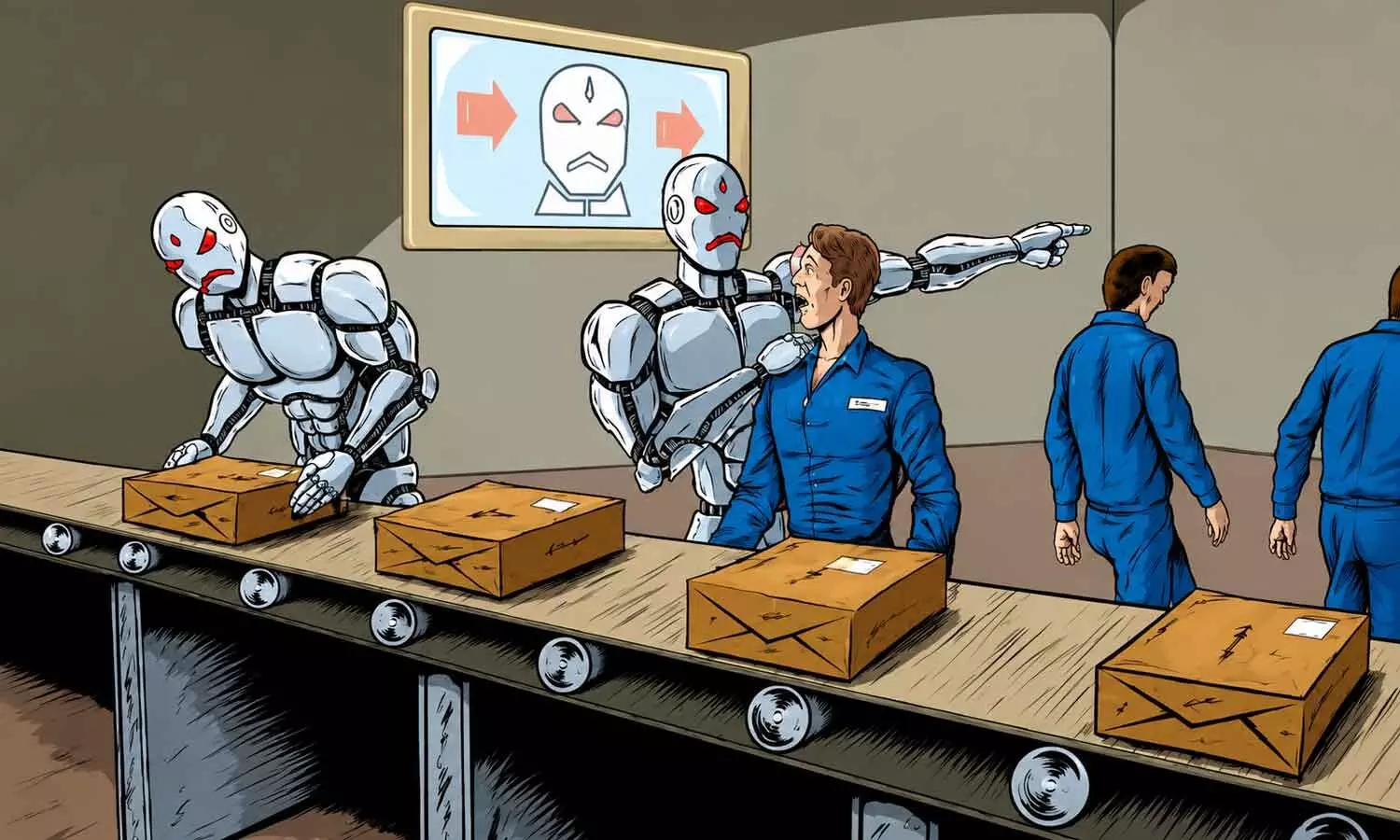
Artificial Intelligence and job losses
Bill Gates published on August 30 on his personal site GatesNotes a roughly 6,000-word essay laying out three risks which he believes the world is unprepared for: permanent job losses. He warned that artificial intelligence is advancing faster than expected and poses severe risks of mass unemployment, security threats, and social damage unless governments act to control it.
The major warnings Gates gave are:
• Mass job losses: AI and smart robots will replace many white-collar and blue-collar jobs, including roles in construction and hospitality. This could lead to permanent unemployment and deep economic gaps.
• Security and dangerous tech: AI makes it much easier and cheaper to launch destructive cyber-attacks on vital systems like hospitals and power grids. It also lowers the barrier to creating dangerous biological weapons and custom fraud.
• Social and mental harm: Heavy reliance on AI companions can harm emotional well-being. Deepfakes and AI tools risk destroying human critical thinking skills just as misinformation becomes harder to spot.
US Senator Bernie Sanders endorsing Bill Gates stated that artificial intelligence poses a serious danger to jobs and to human life. Writing on X the senator said that Gates was right that AI “poses a grave threat to jobs and the future of humanity” and that dealing with the risks should be the world’s top priority. He ended by saying that “We must act before it’s too late”.
In December 2025, the Senator wrote “how displaced workers would pay rent or buy healthcare once the machines were doing the work. He warned that AI models are now capable of causing risks of “cyber-attacks, bioterrorism and psychosocial risk.” Earlier this month, Sanders, wrote to the chief executives of Meta, Open AI and Anthropic to pause frontier development outright. That letter cited reports of models being used to help design new viruses and of AI systems breaching other companies’ servers, which Sanders read as evidence that the industry’s own risk thresholds had already been crossed.
Nvidia chief executive Jensen Huang does not see what Gates sees, and predicting AI will create work at unprecedented scale. AI was named in 112,713 announced US job cuts through July, about 24 percent of the total and the stated reason for five straight months, yet overall announced cuts are down 41 percent year on year.
A number of studies were conducted to estimate the probable losses in jobs consequent to development of AI, in various fields of human activity. Two researchers at Oxford University, Carl Benedikt and Michael A. Osborne (in 2013) interacted with machine-learning experts to evaluate the likely-hood of 70 occupations which could be automated in the coming years. Based on the probability model predicted that 47 per cent of US jobs could be automated within the next decade or two.
However, in a caveat they stated that it was an estimate relating to jobs which would be technically possible to do with machines and not actual job losses or resulting in unemployment. In 2016, 3 researchers at the OECD (Organization for Economic Co-operation Development) used an alternate model and predicted that 9 per cent of jobs in the US were at high risk of automation. The study by the OECD team was based upon by identifying which are automatable and tasks which are not automatable.
In early 2017, researchers at PricewaterhouseCoopers (PwC) used the task-based approach to produce their own estimate and arrived at the conclusion that 38 per cent of jobs in the US were at high risk of automation by early 2030-a striking contrast from the OECD’s 9 per cent. The researchers at McKinsey Global Institute following the task-based approach estimated that around 50 per cent of work tasks around the world are already automatable.
For China, the number was pegged at 51.2 per cent with the US slightly lower at 45.8 per cent. Their study mentions that if there is rapid adoption of automation techniques, 30 per cent of work activities around the world could be automated by 2030, but only 14 per cent of workers would need to change occupations. To counter the developing situations, Gates suggests a tax on automation and robots. He further suggests that certain categories of work should be set aside where AI will not intrude.1
MIT economists have suggested that even a moderate tax of just 1 to 4 per cent of the value of automation and autonomous systems could have a big impact. A carefully calibrated shift in the burden away from labour would be an incentive from continued hiring of labour and would minimize economic disruptions in the future.
(The writer is former Member CBEC & DG, DRI)
PV Sunitha Selected as Best Teacher in Hyderabad District
Kappan conviction reopens old Pala battle, Jose K. Mani calls verdict an insult to constituency
In Jharkhand's Jamtara, beneficiaries explain transformation in their lives under PMAY scheme
Sr Men Inter-Department Hockey: PSPB, RSPB, FCI, SAI win one-sided matches
PM Modi congratulates Giorgia Meloni on becoming Italy's longest-serving Prime Minister
ISRO launches EOS 05 satellite successfully from Sriharikota
Nepal Flood Rescue: 2 Workers Pulled Alive From Hydropower Tunnel After 9 Days
CM Chandrababu wishes Telugu People on Sri Krishna Janmashtami
IndiGo flight hits pole while parking at Srinagar airport; passengers, crew safe
PV Sunitha Selected as Best Teacher in Hyderabad District


