A pragmatic look at India’s evolving labour law reforms

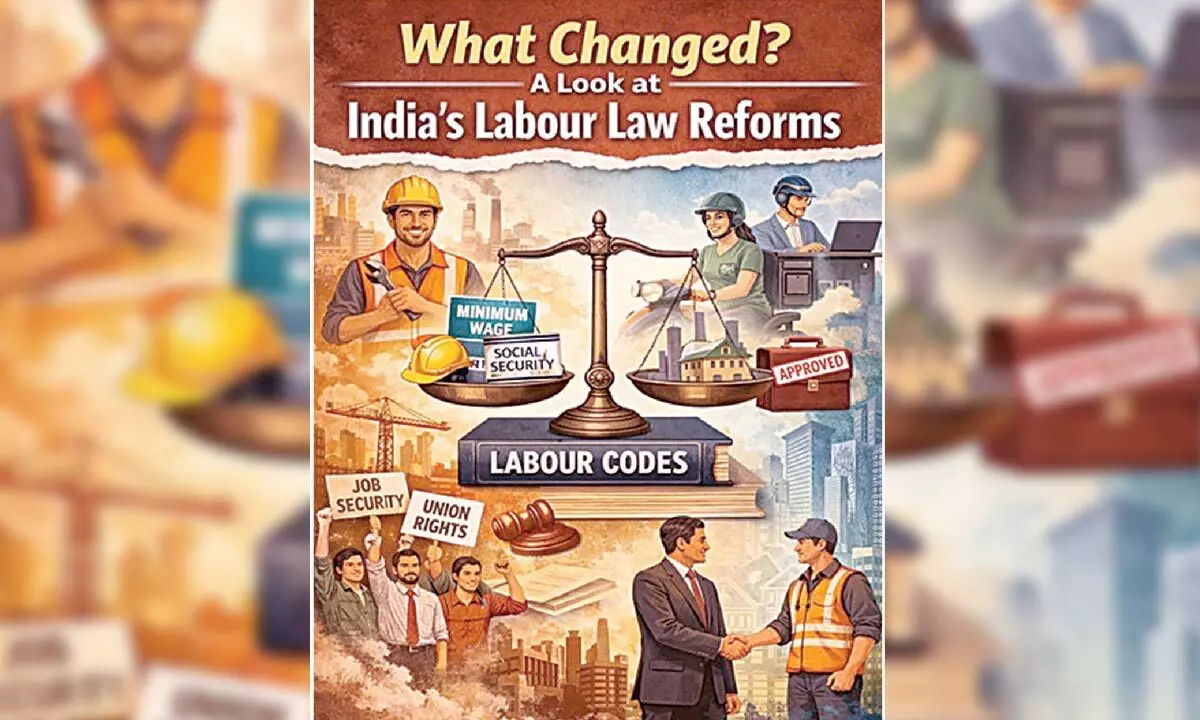
Labour laws quietly shape the rhythm of everyday life in India. They determine how much a worker earns, how safe the workplace is, how long one can work, and what happens when employment suddenly ends. From factory floors and construction sites to delivery apps and home-based work, labour laws influence the dignity, security, and well-being of millions of Indian families.
The country’s workforce is remarkably diverse. It includes organised sector employees, informal and migrant workers, contract labourers, domestic workers, and a rapidly growing group of gig and platform workers. Recognising this changing reality, the Centre introduced one of the most ambitious labour reforms since Independence by consolidating 29 central labour laws into four comprehensive Labour Codes.
This reform marks a decisive shift in how work is regulated in India. Yet the crucial question remains: what has really changed, and why does it matter to workers, employers, and society as a whole?
Why were labour laws reformed?
For decades, India’s labour law framework was marked by complexity and fragmentation. Different laws governed wages, industrial relations, social security, and workplace safety, often with overlapping provisions and inconsistent definitions. Employers faced difficulty in compliance, while enforcement agencies struggled with administrative burdens. Most importantly, workers found it hard to understand their rights or seek remedies.
Despite having many protective laws, enforcement remained weak. A significant portion of the workforce—especially in the unorganised sector—remained outside effective legal protection. Migrant workers, contract labourers, and casual workers often lacked access to minimum wages, social security, and safe working conditions.
Economic changes further highlighted these gaps. Liberalisation, global integration, and rapid industrial growth transformed employment relationships. Contractual work increased, informal employment expanded, and the gig economy emerged as a major source of livelihood. Many labour laws, drafted in the mid-twentieth century, were ill-equipped to address these modern realities.
The reforms were therefore driven by several objectives: simplifying compliance, improving enforcement, encouraging investment, promoting formal employment, and extending social security to a wider section of workers. At the same time, the challenge was to ensure that worker protection and social justice were not diluted in the pursuit of economic growth.
The new labour code framework:
The reform resulted in the consolidation of 29 central labour laws into four broad Labour Codes. Instead of navigating multiple statutes, labour regulation is now organised under four clear categories. These include laws relating to wages, industrial relations, social security, and occupational safety, health, and working conditions. The objective is to bring uniformity in definitions, reduce duplication, and create a simpler and more transparent legal framework. By grouping related laws together, the new system aims to make labour regulation easier to understand and administer, while ensuring that basic worker protections remain intact.
What changed for the workers:
One of the most important changes is the introduction of a national floor wage under the Code on Wages. Earlier, minimum wages varied sharply across states and sectors, often failing to keep pace with living costs. The new approach seeks to ensure a basic minimum standard of living for workers, while allowing states the flexibility to fix higher wages depending on local conditions.
Another landmark shift is the formal recognition of unorganised, gig, and platform workers within the social security framework. For the first time, app-based drivers, delivery workers, construction labourers, and informal workers are explicitly acknowledged in law. This recognition enables the extension of benefits such as health insurance, maternity support, old-age protection, and accident coverage to millions who were previously excluded.
Workplace safety and health standards have also been strengthened through a unified code. Industries such as construction, factories, and hazardous sectors are now governed by clearer safety obligations. The law also allows women to work in all sectors and during night hours, subject to consent and safety measures, reflecting a progressive move toward gender inclusion in employment. However, these reforms can be effective only if workers are aware of their rights and can access grievance redress mechanisms. Legal awareness and outreach remain essential.
What changed for employers:
From the employer’s perspective, the labour reforms promise simplified compliance. The consolidation of laws reduces the number of licences, registrations, and returns. Increased use of digital platforms for registration and reporting is expected to enhance transparency and reduce bureaucratic delays.
The Industrial Relations Code introduces changes relating to strikes, layoffs, retrenchment, and closure of establishments. Higher thresholds for seeking prior government permission aim to provide flexibility to employers, reduce regulatory uncertainty, and encourage industrial growth.
Supporters argue that a simpler and more predictable regulatory environment can attract investment, improve productivity, and generate employment. At the same time, critics caution that flexibility must be balanced with adequate worker safeguards to prevent arbitrary job losses.
Concerns and criticisms:
Despite their stated objectives, the labour law reforms have generated widespread debate. Trade unions and labour rights groups argue that the reforms tilt the balance in favour of employers. Increased thresholds for layoffs and closures may, they fear, weaken job security and discourage collective bargaining.
Implementation poses another major challenge. Extending social security benefits to unorganised and gig workers requires effective registration systems, adequate funding, and robust monitoring. Experience shows that welfare laws often fail due to lack of awareness, administrative inefficiencies, and weak enforcement.
Federal implementation is also critical. Labour being a concurrent subject, the effectiveness of the reforms largely depends on how state governments frame rules and enforce the codes. Uneven implementation across states could dilute the intended benefits.
Impact on society and the future of work:
Labour laws are not merely economic instruments; they are tools of social justice. They influence income equality, workplace dignity, industrial peace, and social stability. The new labour codes reflect an attempt to adapt India’s legal framework to a modern economy while preserving the core objective of worker welfare.
If implemented responsibly, these reforms can encourage formal employment, improve working conditions, and promote inclusive growth. If poorly implemented, they risk widening inequality and insecurity. For workers, awareness of rights is crucial. For employers, ethical compliance will shape long-term industrial harmony. For the state, continuous dialogue, monitoring, and responsiveness are indispensable.
What lies ahead:
India’s labour law reforms signal a transition from a fragmented and rigid regime to a unified and contemporary framework. If implemented with transparency, accountability, and sensitivity, these reforms have the potential to protect workers, promote employment, and support sustainable economic growth.
However, reform cannot end with legislation alone. Strong institutions, effective enforcement, social dialogue, and active participation of trade unions and civil society are essential. Laws must evolve with experience and ground realities.
India’s labour law reforms mark a defining moment in the regulation of work. These laws affect livelihoods, families, and human dignity, not just businesses or balance sheets. Understanding what has changed is the first step toward ensuring that India’s future of work is built on both growth and dignity, moving forward together.
(The writer is Assistant professor of Law, Dr B R Ambedkar Law college, Hyderabad and research scholar at K L University, Vijayawada)
Printed & Published by K. Hanumanta Rao on behalf of M/s Hyderabad Media House Pvt.Ltd and Printed at Aamoda Press, H.No. 5-9-287/10 & 11, Plot No. 53 & 54, Prashanth Towers, Rajeev Gandhi Nagar, Moosapet, Kukatpally(M), Kukatpally Municipality, Medchal-Malkajgiri District. and published from Hyderabad Media House Ltd, Plot No.1042, Road No. 52, Jubilee Hills, Hyderabad-500033, TELANGANA.Chief Editor:P Madhusudhan Reddy. RNI No: TELENG/2011/38858