Skill Vs Education Debate In Focus
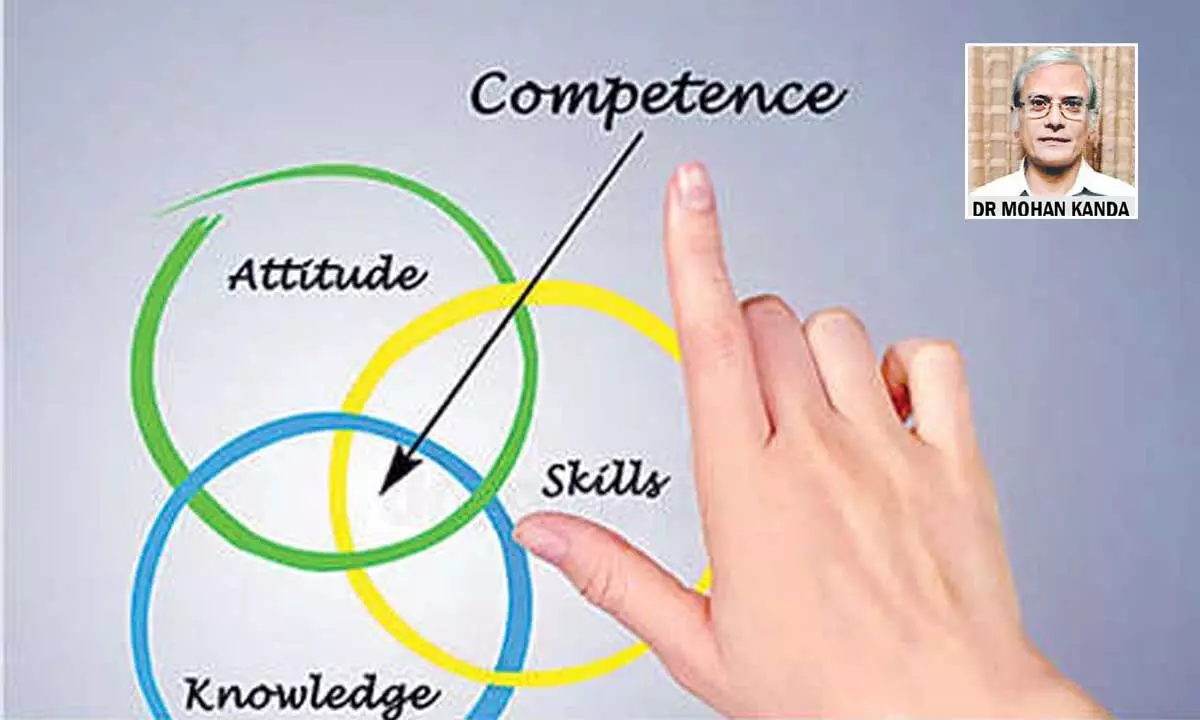
Education does not necessarily exclude skill development. For example, many programmes now incorporate skill building components that create a bridge between theory and application.
Education does not necessarily exclude skill development. For example, many programmes now incorporate skill building components that create a bridge between theory and application. There is no one-size-fits-all answer in the skill versus education debate. Much depends on the individual goals, the employment market and the circumstances in which a person is placed. Students can strike a balance, by enhancing skills, while pursuing formal education
The environment of the world in which we are living today is changing rapidly. On the one hand, the advent of the digital era, and the emergence of the phenomenon of Artificial Intelligence (AI) have brought with them extraordinary opportunities in many spheres; from health, and education, through sports and games, travel, adventure, and entertainment, to employment and scientific research. Those very developments, however, are also posing challenges requiring approaches hitherto unknown to mankind, coupled with emerging threats to global security, such as inequity in access to the benefits of development in the social and economic fields, terrorism, climate change, and conflict.
In this piece, this week, we shall take a look at how education, and the development of skills required for leading a productive and rewarding life, are assuming new dimensions. An exciting discourse is on about the advantages of exploring the nuances, advantages, and potential synergies, between these two pivotal aspects of personal and professional growth. The age-old debate between skills and education has gained renewed vigour. And the question, as to which to prioritise, skill development or formal education, has become increasingly pertinent. Globalisation and automation have transformed the job market and many traditional careers are evolving, or disappearing, while new, and specialized, roles are emerging, with the shift placing a premium on adaptability and skill diversification.
For one thing, there is a growing emphasis on the development of skills, focusing, as it does, on what is important for success in the extant job market. Focus is on skills, such as critical thinking, problem-solving, communication and transferable skills that can be applied to any job, rather than those that are relevant to a given field or subject. The worn out cliché, about education being a process of drawing out rather than one of putting in, is finding a new meaning, in terms of learning the importance of how to learn, rather than merely gathering information, and knowledge, of a generic nature. Acquiring the ability to be adaptable and flexible in a career, helps better navigate the uncertain terrain of the job market.
For example, a person with a background in computer science and coding, can, which the job market changes, easily transit to a job in data science, an interdisciplinary academic field that uses a range of subjects, from statistics to algorithms, to extract knowledge from unstructured data or, to put it in a more pithy form, information from noise.
Time was when formal education was revered as the primary gateway to success. A college degree, for example, symbolised knowledge and qualification, opening doors to coveted careers. The landscape, however, is shifting. Skills are being increasingly recognised as the building blocks of innovation and productivity, as differentiators that set individuals apart.
Education does not necessarily exclude skill development. For example, many programmes now incorporate skill building components that create a bridge between theory and application. Professions, such as medicine and law, also require extensive formal education. Fields, such as technology and the creative arts, on the other hand, often prioritise skills over degrees. Students can strike a balance, by enhancing skills, while pursuing formal education. There is, in other words, no one-size-fits-all answer in the skill versus education debate. Much depends on the individual goals, the employment market and the circumstances in which a person is placed.
The central government has been showing many signs of being au fait with contemporary developments, around the world and across various spheres. From expanding the scope of activities such as exploration of space and the Antarctica continent, promoting games and sports, through socio-economic fields, such as education, health, welfare measures, and employment generation policies, to defence and external affairs, many initiatives have been undertaken that can claim to be among the best practices in the world. Not to be found lagging behind, in the context of skill development, the government has launched several programmes including the Skill India mission 2015, and the components thereof known as, the National Promotional Apprentice scheme, the Jan Shikshan Sansthan, and the Pradhan Mantri Kaushal Vikas Yojana.
The very idea of bringing into existence a new Ministry of Skill Development and Entrepreneurship, as well as the incorporation of not-for-profit, public limited company, the National Skill Development Corporation are initiatives that speak volumes of the importance, which the Government of India is attaching to the idea of promoting skill development.
After my retirement from service, I have been rather selective in agreeing to be associated with institutions. Though several offers came my way, those which I accepted have been few and far between. Ranking among the best choices I have made is the position of being a Member on the Board of Governors of the Centurion Universities of Technology and Management (CUTM) at Bhubaneswar, as well as Visakhapatnam. CUTM, Bhubaneswar, has emerged as a leading institution renowned for its innovative educational approach. It offers a diverse range of programmes, which focus on practical learning and industry integration. It has done a spectacularly successful job, of first identifying the quality and pattern, of the demand for skills in the market, and then formulating tailor-made courses prepare to students to respond to those opportunities. The incredible precision, with which the matching is done, with practically every student being guaranteed a job, far in advance of leaving the university is truly amazing. And the activities of the hiring companies cover a dazzling range, from the manufacture of heavy duty trucks to establishing and running restaurants with an international brand, such as Café Coffee Day.
Industrial Training Institutes (ITIs) and Polytechnics are among the important institutions, which train persons for employment in specified areas. The Polytechnics offer diplomas while the ITIs offer certificates. Diplomas offered by polytechnics cover areas such as civil engineering, mechanical engineering and electrical engineering, while ITIs offer certificates in specified trades, such as pipefitters, carpenters, surveyors, draftsman.
The central government has a scheme for setting up 300 new Polytechnics by State governments and Union Territories, assist in construction of Women’s Hostels in a few selected Polytechnics, upon extend assistance for upgradation of selected Polytechnics, and provision of non-formal, short-term employment oriented skill development programmes, through some approved Polytechnics, under a scheme called the Community Development through polytechnics.
Another commendable initiative of the Government of India is the setting up, in collaboration with the Tata group, of the Indian Institute of skills at Mumbai to empower India’s youth. Here is an amusing incident from my early service days to end this piece on a light note.
As a Sub Collector at Ongole, in Prakasam district of Andhra Pradesh, I had a driver called Raman. One day, upon hearing a very unhealthy sound, as Raman changed from one gear to another, I admonished him to drive more carefully, Raman haughtily pointed out that he had more than 10 years of experience of driving that jeep. Not wanting to be rude, but unable to resist the opening his remark offered, I smilingly told him that he appeared to have perfected the art of defective driving!
Experience, after all, can have more than one consequence, over time!
(The writer was formerly Chief Secretary, Government of Andhra Pradesh)