Old machines, new faces: Tamil Nadu’s electoral puzzle
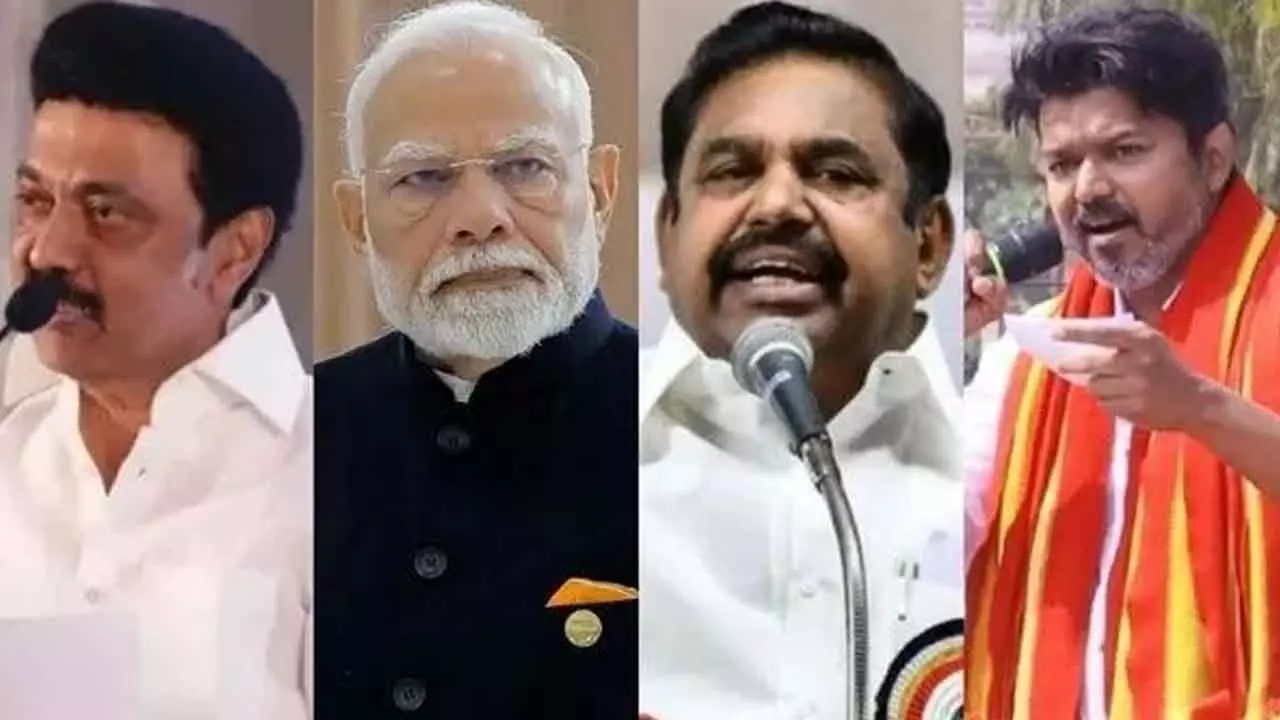
The Dravidian duopoly faces a new challenge
Tamil Nadu politics, long defined by the dominance of two Dravidian giants, is set to face one of its most intriguing phases in decades as the state moves towards the 2026 Assembly election., With the absence of charismatic leaders like J Jayalalithaa and M Karunanidhi the political field is wider than before.
Beneath the noise, a careful reading of the ground suggests that while new forces are emerging, the winds are not blowing as dramatically as many would like to believe.
Tamil Nadu politics has entered a transitional phase where organisational strength rather than personality cults is increasingly determining electoral fortunes.
Today, the ruling DMK led by Chief Minister M K Stalin appears structurally stronger than its rivals. The government claims to have spent the last few years consolidating welfare schemes and strengthening its political networks across districts but as of now it cannot be asserted that it would bring them back to power.
Programs such as free bus travel for women, expanded social welfare measures, and targeted assistance to marginalised groups have reinforced the DMK’s traditional social justice narrative. However, people prefer to keep their cards close to their chest.
In Tamil Nadu’s political culture, welfare politics carries enormous electoral weight. Stalin has sought to project a calm administrative image, contrasting himself with the confrontational styles seen elsewhere in national politics. For a significant section of voters, particularly in rural areas and among women beneficiaries, the perception remains that the government is stable and predictable.
However, this does not mean that the DMK will enjoy a smooth ride. Anti-incumbency is visible in several pockets. Rising prices, allegations of corruption against some ministers, and criticism over law and order issues have provided ammunition to the opposition. Yet the critical question is whether this dissatisfaction is intense enough to translate into a statewide swing. At present, the signals are mixed.
The opposition’s main pillar remains the AIADMK under Edappadi K Palaniswami. The party still retains a durable base in western Tamil Nadu and sections of the rural electorate that once rallied behind Jayalalithaa. Palaniswami has been trying to rebuild the organisation after years of internal turbulence following the leader’s death in 2016.
Despite these efforts, the AIADMK’s challenge lies in its diminished aura. Without Jayalalithaa’s charismatic authority, the party has struggled to present a compelling statewide narrative. Its internal factionalism, including disputes involving leaders such as O Panneerselvam, has weakened the perception of unity that voters once associated with the party.
The AIADMK’s alliance with the Bharatiya Janata Party (BJP) is another variable in the equation. The BJP, led nationally by Prime Minister Narendra Modi, has been trying to expand its footprint in Tamil Nadu. While the party has made incremental gains in vote share over the past decade, it still faces structural limitations in a state where Dravidian identity politics remains deeply entrenched.
For the BJP, the strategy appears twofold: expand urban support while leveraging alliances with regional caste-based parties such as the Pattali Makkal Katchi (PMK) in northern Tamil Nadu. Whether this coalition arithmetic can produce a decisive electoral breakthrough remains uncertain.
Into this already complex landscape has entered a new and unpredictable player: actor Vijay and his party Tamilaga Vettri Kazhagam (TVK). His political foray has electrified large sections of the youth and his enormous cinema fan base. In Tamil Nadu’s history, film personalities have repeatedly transformed into political leaders — from M G Ramachandran to J Jayalalithaa. So was the case in the past in Andhra Pradesh when N T Rama Rao stormed to power within eight months of launching his party-Telugu Desam Party (TDP). But of late, an actor-turned-politician, despite a tremendous fan following, had to wait for 10 years to enter the Legislative Assembly.
History also shows that charisma alone does not guarantee electoral success. Building a booth-level organisation across 234 constituencies is a monumental task. At present, Vijay’s party appears to be in the early stages of political mobilisation. While it may not immediately translate its popularity into large numbers of seats, its impact could be significant in another way — by fragmenting votes.
This is the factor that makes the 2026 election particularly unpredictable. If Vijay draws substantial support from younger voters and urban constituencies, he could disrupt traditional voting patterns. The question is: whose votes will he primarily cut into?
Initial indications suggest that the new entrant may attract voters disillusioned with both the DMK and the AIADMK. However, analysts believe that the fragmentation could hurt the opposition more than the ruling party, particularly if anti-incumbency votes split between AIADMK alliance and TVK.
Another important feature of Tamil Nadu elections is alliance stability. In this respect, the DMK-led front currently appears more cohesive. Its partnership with the Indian National Congress and Left parties remains intact, providing the ruling coalition a wider social base.
Ultimately, the voters tend to deliver decisive mandates rather than fractured verdicts. Even when multiple players enter the fray, the electorate often gravitates towards one dominant alliance.
The DMK begins the race with organisational strength, alliance stability and the advantages of incumbency. The AIADMK-led alliance retains pockets of influence but has yet to generate the momentum necessary to convert dissatisfaction into a statewide wave. Vijay’s entry adds excitement and unpredictability, but it may take several election cycles before his movement matures into a formidable electoral machine.
Tamil Nadu’s political history is full of surprises. One needs to wait and watch how things ultimately take shape.
(The author is former Chief Editor of The Hans India)