Engineering students develop AI Chatbot to support parents of autistic children

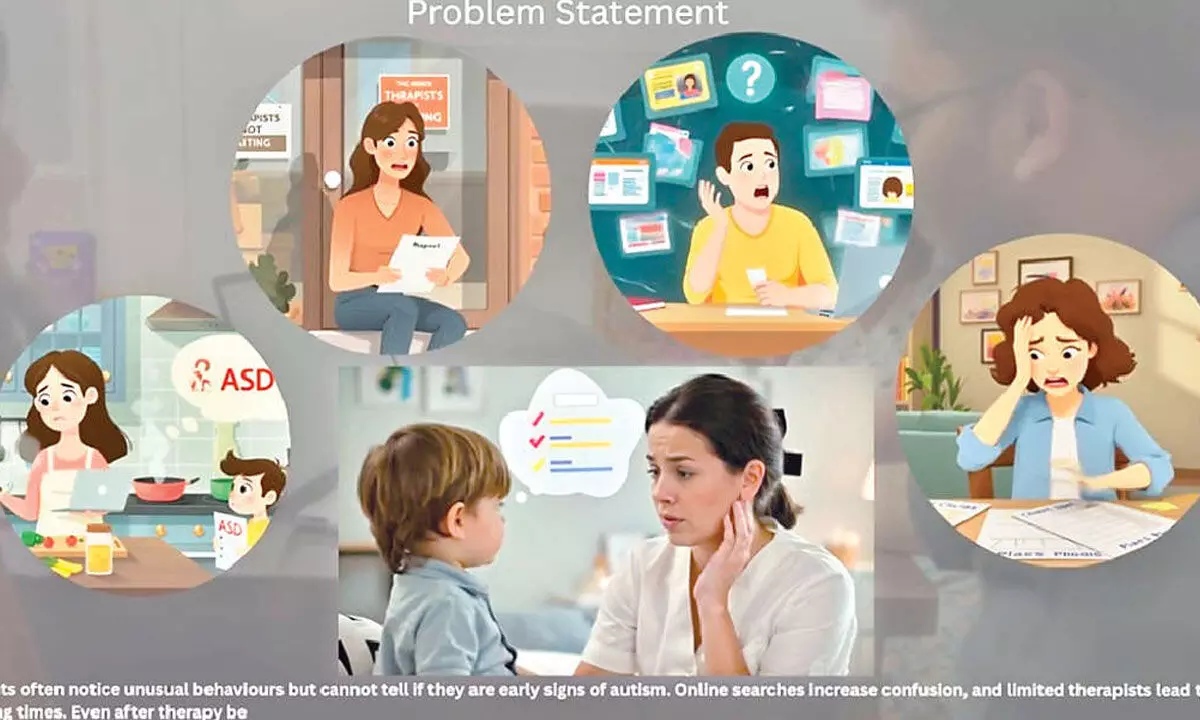
A team of final-year engineering students has developed an artificial intelligence-powered chatbot aimed at supporting parents of autistic children with real-time guidance and structured behavioural monitoring. Designed as a supplementary support system, the tool seeks to bridge the gap between clinical consultations by offering evidence-based suggestions and organised progress tracking.
The project has been created by Team Neurostars—Vaishnavi Rajkumar Patil, Abhishek Shivprasad Patil and Ganesh Ramchandra Mahadik, all 21-year-old B.Tech students from the Computer Science and IT Department at the Rajarambapu Institute of Technology. The idea was developed as part of their participation in the KRUU & ASME GRASP 2026 AI Hackathon under the “AI for Social Good” category.
From concept to community-focused innovation
The students said the concept emerged after they began researching autism in greater depth. During their exploration, they connected with an NGO working in the autism domain and interacted with families to understand their day-to-day challenges. They observed that while awareness about autism is gradually increasing, many parents still struggle to access immediate, reliable guidance for everyday behavioural situations.
The team recognised that therapy sessions, though essential, are often periodic. In the time between appointments, parents may encounter uncertainties about behavioural changes, emotional responses or learning patterns. The chatbot was conceptualised to provide structured, evidence-based assistance during those intervals.
“It doesn’t replace therapists,” the team explained. “It fills the silence between appointments with behavioural strategies parents can use in real time. It acts as a therapeutic companion that is always available.”
How the system functions
The AI chatbot interacts with parents through five simple daily questions focusing on common fluctuations autistic children may experience. Parents respond to these prompts, and the information is securely stored in Firestore. Based on the collected inputs, the system generates structured weekly reports that summarise patterns, highlight progress and indicate potential areas of concern.
These weekly summaries allow families to monitor behavioural trends more systematically. The reports can also serve as a helpful reference during consultations with therapists or healthcare professionals, enabling more informed discussions.
The chatbot is built using a Retrieval-Augmented Generation (RAG) model trained on curated, expert-reviewed material. The dataset includes references recommended by doctors specialising in autism as well as frequently asked questions provided by DreamUdaan Foundation, an organisation that supports autistic individuals and their families. By grounding its responses in verified resources, the team aims to ensure that the guidance provided remains accurate and responsible.
Clear disclaimers are incorporated within the system to remind users that the chatbot is not a substitute for professional medical advice or diagnosis.
Addressing emotional and practical challenges
Parenting a child with autism can involve significant emotional commitment and continuous decision-making. The students believe that structured monitoring combined with empathetic AI responses can reduce this uncertainty. By encouraging organised observation and reflection, the chatbot aims to help parents make informed caregiving decisions. Over time, consistent data tracking may build confidence and improve communication between families and healthcare providers.
Anticipated challenges and safeguards
The team acknowledges potential challenges, including limited digital literacy among some users, possible misinterpretation of AI-generated suggestions and the risk of over-dependence on the system. To address these concerns, they plan to maintain a simple and intuitive interface, continuously update their expert-reviewed database and strengthen personalisation features tailored to individual needs.
They emphasise that the tool is designed to complement—not replace—professional therapy. The long-term goal is to create a supportive, accessible system that empowers parents while maintaining appropriate medical boundaries. As artificial intelligence continues to expand into healthcare and social support systems, initiatives like this demonstrate how student-led innovation can address real-world concerns through responsible technological application.
•AI-based support system:The chatbot functions as a round-the-clock digital companion, offering real-time, evidence-based responses to parents’ questions between therapy or clinical appointments.
•Structured daily check-ins:It prompts parents with five guided daily questions about behavioural patterns, emotional responses, and routine changes, ensuring consistent monitoring of the child’s progress.
•Secure data storage and analysis:Parents’ responses are securely stored in Firestore, allowing the system to analyse inputs over time while maintaining data organisation and privacy.
•Automated weekly progress reports:Based on daily inputs, the chatbot generates structured weekly summaries that highlight behavioural trends, improvements, and areas that may need attention.
•Expert-grounded AI model:Built using a Retrieval-Augmented Generation (RAG) framework trained on curated, specialist-approved resources and NGO-supported FAQs, ensuring that responses remain responsible, accurate, and supportive rather than diagnostic.