‘Only Love Is Real’: Listening deeply, creating without resistance

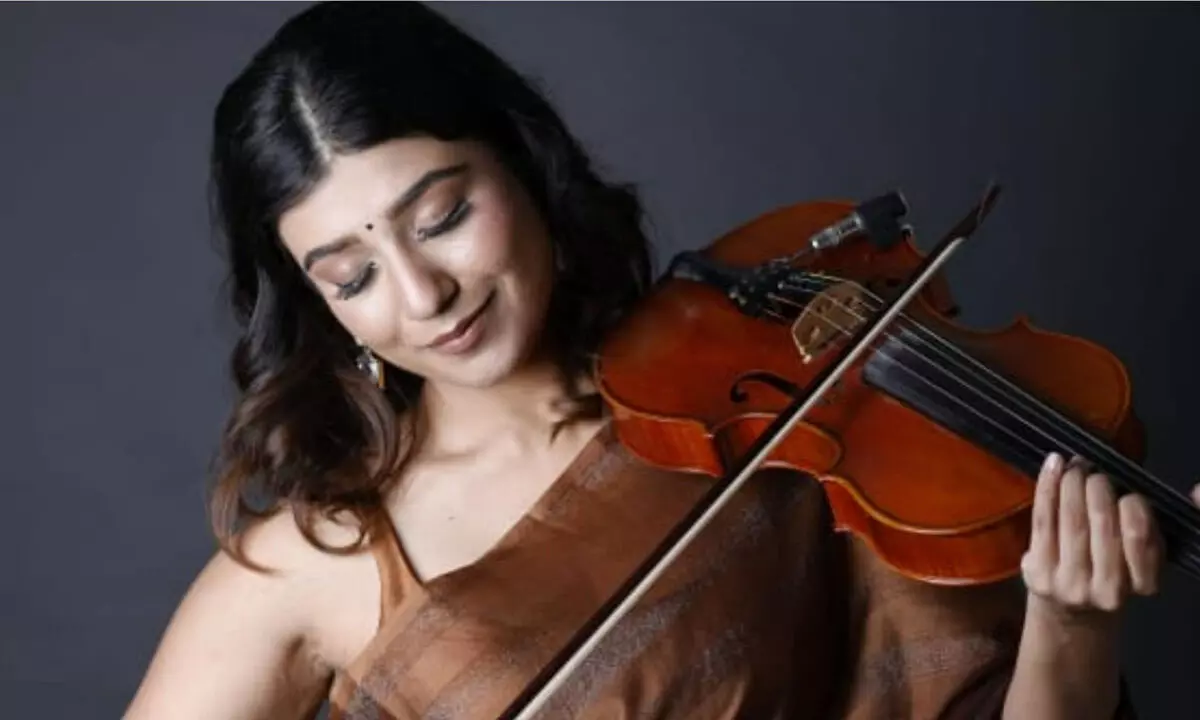
For violinist and composer Apoorva Krishna, ‘Only Love Is Real’ is not an experiment in genre-blending or a deliberate attempt to push musical boundaries. It is a deeply personal offering shaped by stillness, presence, and emotional truth. The new album from Universal Music India, created by violinist Apoorva Krishna and vocalist Vijay Prakash, transcends genre labels—rooted in Carnatic tradition while resonating deeply with contemporary global audiences.
Now being pitched for Grammy consideration, the album reflects Krishna’s journey through love, faith, grief, surrender, and acceptance. Its meditative quality feels intuitive rather than designed, shaped by lived experience rather than concept.
“I didn’t approach the album with the intention of creating something daring,” Krishna says. “I just allowed myself to feel everything fully, without resistance. Every note came from a lived emotion—love, grief, faith, confusion, acceptance.”
That vulnerability, she believes, is what gives the music its resonance. For Krishna, sound is inseparable from energy, and authenticity is something listeners sense instinctively.
“When you create from a place of truth, listeners feel that,” she reflects. “What enabled this album to become emotionally resonant was simply presence—being completely open to whatever the music wanted to express, without judgment or control.”
While ‘Only Love Is Real’ moves fluidly across Carnatic, jazz, and global soundscapes, its foundation remains deeply rooted in Indian classical tradition. Tracks like ‘Merging Parallels’ and ‘Sacred Roots’ echo that grounding—not as reverence frozen in time, but as a living lineage.
“Tradition has never been something that restricts me—it liberates me,” Krishna says. “My grounding in Carnatic music gave me discipline and devotion. Once that language becomes part of who you are, it starts to evolve naturally.”
She resists the idea of consciously balancing tradition and innovation, viewing them instead as inseparable forces.
“I don’t consciously try to balance the two,” she explains. “The reverence is always there, but so is curiosity. Innovation becomes meaningful only when it grows organically from respect, not rebellion.”
That philosophy shaped the album’s collaborative process as well. Despite working with internationally acclaimed, Oscar- and Grammy-winning musicians, Krishna says the music was never built around genre or structure.
“It unfolded completely naturally,” she says. “We never sat down and said, ‘Let’s mix this with that.’ The sound emerged from genuine connection and shared emotion. When the intention is honest, genres dissolve—what remains is pure expression.”
Much of ‘Only Love Is Real’ deals with abstract inner states—faith, grief, surrender—yet Krishna approaches composition intuitively rather than analytically.
“I’ve always felt emotions have frequencies,” she says. “Faith might emerge as a sustained note holding tension and release, grief as silence between phrases, and surrender as a melody that dissolves into stillness.”
The violin, she adds, has long been an extension of her inner voice.
“When I trust the feeling fully, the translation happens on its own.”
At its heart, the album carries a single, unifying message—one Krishna hopes listeners will feel rather than intellectualise.
“Love, in its purest form, is the essence of everything,” she says. “It’s the constant beneath all change and uncertainty. I hope people feel unity and peace, that they’re reminded of the beauty of being present.”
For Krishna, the measure of the album’s success isn’t awards or global recognition, but emotional impact.
“If even one person walks away with a softened heart or renewed sense of hope,” she says, “that means everything.”
Apoorva Krishna