Odissi dance enchants the audience

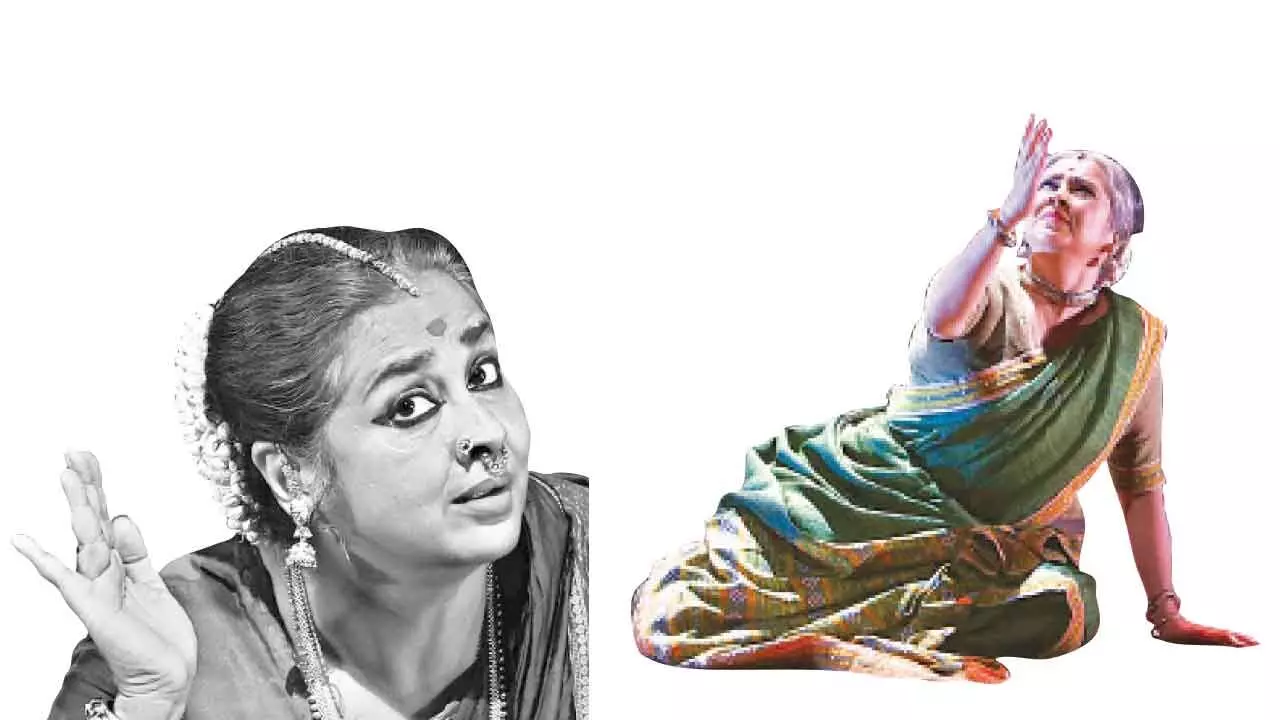
An evening of sublime Odissi unfolded as part of the 13th annual festival organised by Our Sacred Space Environmental and Cultural Centre. The performance featured the renowned Guru Sharmila Biswas and her disciple Raaginni Hindocha, who captivated the audience with their artistry and emotional depth. Their presentation beautifully blended tradition, innovation, and devotion, offering a memorable celebration of classical dance
As part of their 13th Annual Festival, the Our Sacred Space Environmental and Cultural Centre organised an entrancing evening of Odissi dance at Chaurah Auditorium, Secunderabad, recently.
Senior Guru Sharmila Biswas is a leading dancer, choreographer, and teacher of Odissi. A prominent disciple of the legend Kelucharan Mohapatra, she is the founder of the 'Odissi Vision and Movement Centre' in Kolkata, which has been instrumental in the research of traditional folk-art forms as well as the Mahari or Devadasi tradition of Odisha. She delves into these for innovation in her productions, which have been presented at dance festivals worldwide. Her creative changes in content, technique, and costumes are a considerable contribution, recognised by the conferment of the Sangeet Natak Akademi Award. Demanding excellence, dedication, and discipline from her students, she has been instrumental in grooming a talented younger generation of Odissi dancers.
Raaginni Hindocha is a budding disciple of Sharmila Biswas and has performed in many festivals in India and abroad as part of her Guru's repertory. Two compositions were showcased by Raaginni and one by Sharmila Biswas. The 'aharya' of Raaginni was in electric blue, standing out well on the lit-up stage.
‘Ramashtakam’ in 'misra raga' was a treat with its lilting music. The young dancer entered the stage starting with her back to the audience in the characteristic stylized Odissi looping movements full of grace. The tempo built up with slow and steady movements flowing into vigorously agile 'angika abhinaya' as the attributes of Lord Rama were brought out. Raaginni's honed gestures were full of both delicacy and solidity, indicating an apt student who has imbibed the knowledge imparted meticulously by her Guru while inserting a considerable flair of her own. This was a tribute to Sharmila's considered opinion that a student must display originality without merely copying identically an age-old choreography.
After performing a 'Pranam', she went on to delineate, while being in precise synchrony with every trill of music, the refrain — salutations to Rama, to whose feet all gods prostrate, born in the dynasty of the Sun, whose beautiful face is decorated by 'Chandan'. Then comes the young prince fixing his arrows to the bow to destroy the demon disturbers of the sages’ sacrifices and the redeeming of Ahalya. The dainty fluttering of her hands exactly mirrored the exuberant footwork, creating a thrilling effect. Hara's bow broke in Rama's hands, and he went to the forest for the cause of truth and justice. The golden deer was brought down with a single arrow after the dancer depicted its bounding playful movements. The King of Eagles, Jatayu, was given 'moksha' by the Lord, who slew Vali, the King of Monkeys. The peerless prince who controlled and had the ocean bridged, conquered Lanka by destroying Ravana and his armies — is bowed down to in humble reverence.
The second piece, ‘Gativilas’ in 'jog raga', was full of exquisite 'nritta' movements and expressions where, one by one, several animals were brought to life by their natural interpretation through the strides which give the horse its power, the regal lion whose stamp is its majestic stance, the peacock with its glorious fantail who dances effortlessly in its forest environment, the cuckoo whose body reverberates with the powerful vibrance of its melodious singing, and the hawk whose telescopic gaze enables it to swoop down on its prey like lightning.
The finale was ‘Vilasini’ by Guru Sharmila Biswas herself. This piece was inspired by Sharmila's meeting with, and immense regard for, the last Maharis of the Jagannath Temple. Filled with overpowering 'abhinaya', it created a palimpsest of emotions where the artiste revelled in her own mastery of layers of intricate imagery to bring 'rasa' to the audience. The simple scene of an aged Mahari or temple dancer remembering the old days — despite seeing her wrinkled reflection, being unable to control her urge to decorate herself and get dressed up in the morning — was turned into a masterpiece of imaginative choreographic creativity.
Every minute movement, faithfully reproduced visually, built up the character in rich detail to a subtly picaresque perfection brimming with an earthly vitality in every pore. The sleeping dancer stirs and awakens; she knots her hair into a bun, fastening it with flowers, dots her forehead with 'Sindoor', places 'Kajal' in her eyes. Earrings for her ears are fastened, a garland is hung around her neck, forehead and body daubed with 'Chandan'. A brocade jacket covers her chest; adorned with necklaces, she wears a saree with a temple motif border. Bangles and armlets are worn; feet gaily coloured red with 'Alta' and decked with anklets. Being peered upon, she uses the curious observers to have her toe ring put on as she cannot reach it herself. After her dressing up is finished, she runs eagerly to the mirror to see and admire herself; it was as though the artiste had vanished and a real Mahari was on stage going through her toilette — a stunning 'trompe l'oeil' effect translated flawlessly to dance with surpassing skill.The conclusion witnessed the appreciative applause of the spellbound audience.