Grace and devotion mark Akshara Iyer’s arangetram

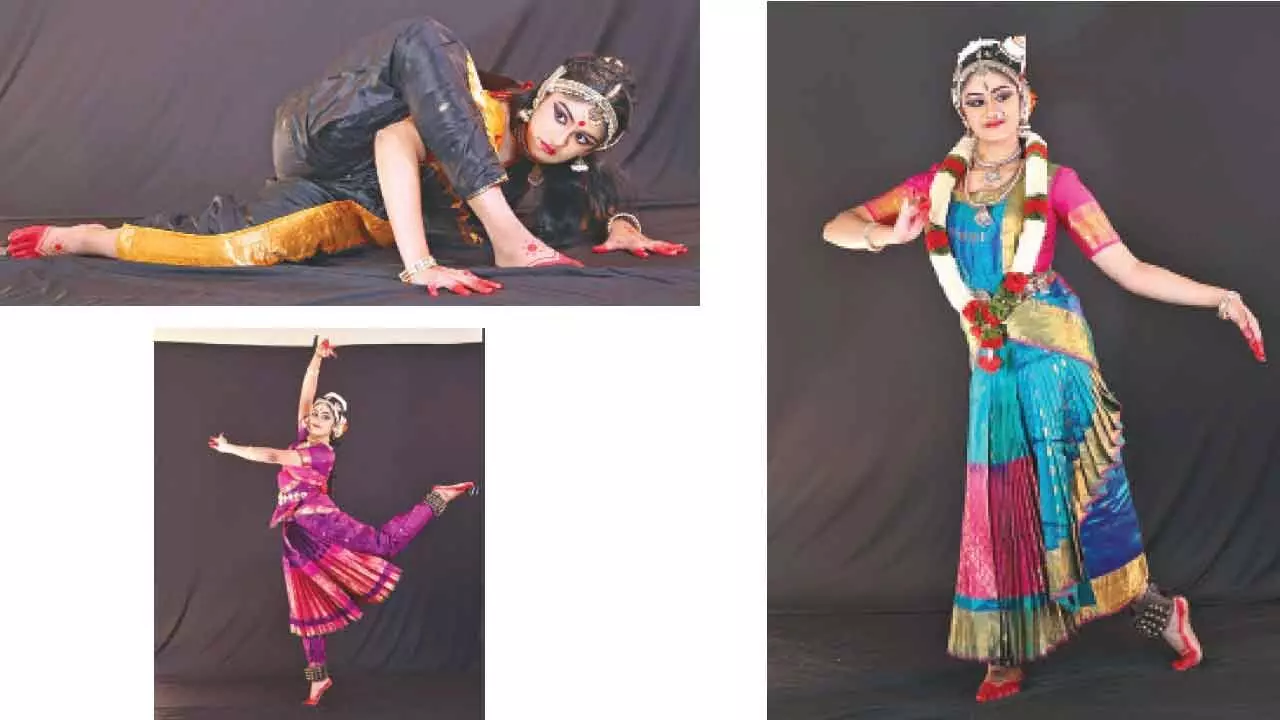
Akshara Iyer’s Bharatanatyam Arangetram, presented on Sunday at Ravindra Bharathi by Vyshnavie Natya Centre, was a treat to watch.
Senior Guru Dr. Rajeswari Sainath, a Kalaimamani awardee, is an internationally renowned performer, scholar, teacher, and administrator with five decades of experience. Fifteen-year-old Akshara is a student at Sadhu Vaswani International School. She has received a gold medal in her English Olympiad. Blessed with a charming and expressive countenance, Akshara has been chiselled by her gifted Guru to heights of perfection in dance. She looked fetching in well-designed costumes of rose, multicolor, and beige.
The program started by invoking Lord Ganesha, the remover of obstacles, to bless the performance. The kriti in the raga gambhira nattai, composed by Oothukadu Venkata Subbaiyer, stands as a splendid representation of the depth and elegance of Carnatic music. The lyrics, vividly depicted by Akshara, explained the glory of Lord Ganesha.
The inaugural dance of a Bharatanatyam recital, ‘Alarippu’, symbolizes a blossoming flower. ‘Alarippu’, spoken in pure sollu kattu and accompanied by the resonant beats of the mridangam, is an offering to the divine and was an exquisitely done prelude to the ensuing dance performance.
‘Jathiswaram’ is a foundational, pure dance (nritta) piece in Bharatanatyam that combines intricate rhythmic patterns (jathis) with melodic musical notes (swaras). In Abhogi, it showcased Akshara’s technical skill as she essayed complex footwork, body postures, and graceful movements.
The central ‘Varnam’ combines the three main aspects of Bharatanatyam—bhavam, ragam, and talam. Akshara’s competence and skill in all three were of a high level, as her expertise in footwork, facial expression, and imagination was demonstrated.
‘Senthil Mevum’, composed by Lalgudi G. Jayaraman in the enchanting Neelambari, is a musical masterpiece that captures the essence of profound devotion. Akshara beautifully portrayed, with deep internalisation, a poignant dialogue between a young maiden and Lord Muruga. The maiden begins by extolling the divine attributes, charm, and valour of Lord Muruga, expressing her deep admiration and reverence for him. She paints a vivid picture of his radiant form, comparing his face to the luminous full moon. Using the endearing term “Shiva bala,” meaning “O son of Shiva,” she implores Lord Muruga to shower his mercy and compassion upon her.
The maiden’s emotions were palpable in the young dancer’s toned abhinaya as she questions the Lord’s apparent distance and asks if there is something amiss in her devotion that keeps him away. She fervently implores Lord Muruga to grace her with his presence, wearing a warm smile and radiating compassion from his face like the full moon, acknowledging him as her supreme refuge and saviour.
The cosmic dance of Lord Shiva, called ‘Tandava’, in Gauri ragam, symbolises the celestial cycles of creation and destruction, as well as the daily rhythm of birth and death. ‘Tandava’ is the manifestation of eternal universal energy, where Shiva embodies both matter and antimatter. The entire space is his stage, the stars and lightning provide the illumination, thunder acts as the sound effects, the Vedas constitute the music, and his feet dictate the pace of the cosmos. He has the river Ganga trapped in his locks, wears tiger pelts, holds the damru (drum) in his right hand, and fire in his left. Akshara was splendidly measured, emanating sattvika abhinaya in these staccato stanzas.
Marathi abhangs express love, devotion, and surrender to the Supreme Being. The rhythmic patterns of the abhang in Bhimpalas by Sant Bhanudas were lent an ethereal simplicity by the artiste’s poise. This culmination of rhythms and deep meaning, elegantly conveyed, created a harmonious and spiritually uplifting mood for the audience.
Describing the beauty of the melody of Lord Krishna’s flute, which begets harmony even between the cow and the tiger, Akshara was alluring as she elucidated the charm of Lord Krishna.
‘Mohana Kalyani Thillana’ showcased the dancer’s exploration of strong kinetics. This style requires exemplary skill in rhythm, timing, and synchronisation in order to radiate in full splendoured nritta. The melodious Annamacharya kriti, ‘Ksheerabdi Kanyaku’ in Gambhira Nattai, worshipping and offering harathi to Goddess Lakshmi seated on a lotus flower, was emoted with beautiful dignity.
The ‘Snake Dance’ in Punnagavarali was a wonderful performance, deftly and fluidly combining the elements of yoga and Bharatanatyam. Akshara’s slithering, sinuous flexibility in arresting poses drew forth rapturous applause. The orchestra, headed by Dr. Rajeswari Sainath herself on the nattuvangam, with Sri Ram Jonnalagadda (vocals), Chandrakanth (mridangam), Chander Rao (violin), Srikant (tabla), and Venkatesh (flute), gave bravura support. Guests Dr. Chakravarthy, Ms. Aparna Kanda, and Ms. Arpitha graced the occasion.