




- Constable sells seized bikes for personal gains
- Bottle buyback, digital pay rules paralyse sales from Nov 1
- Battery storage policy of state to make it country’s premier green energy hub
- Nayanthara seeks blessings at Kalikambal temple ahead of her new film release
- Passport Mela at RPO Hyderabad on November 21
- Price rise, poor governance will bring down TVK govt: Dhinakaran
- We were always Ek Bharat, Ek Sanskriti
- CM sips tea, shares heartwarming moments
Exploring dance traditions of temples and royal courts
In Short
An evening of dance and discourse at Secunderabad explored the rich artistic traditions of temples and royal courts through the lens of Shakta philosophy, the Gita Govinda and rare classical compositions. Dr Anupama Kylash and Acharya Kalakrishna brought these heritage traditions alive through insightful talks and captivating performances by Satwika Penna

Share :

SATWIKA PENNA
ANUPAMA KYLASH
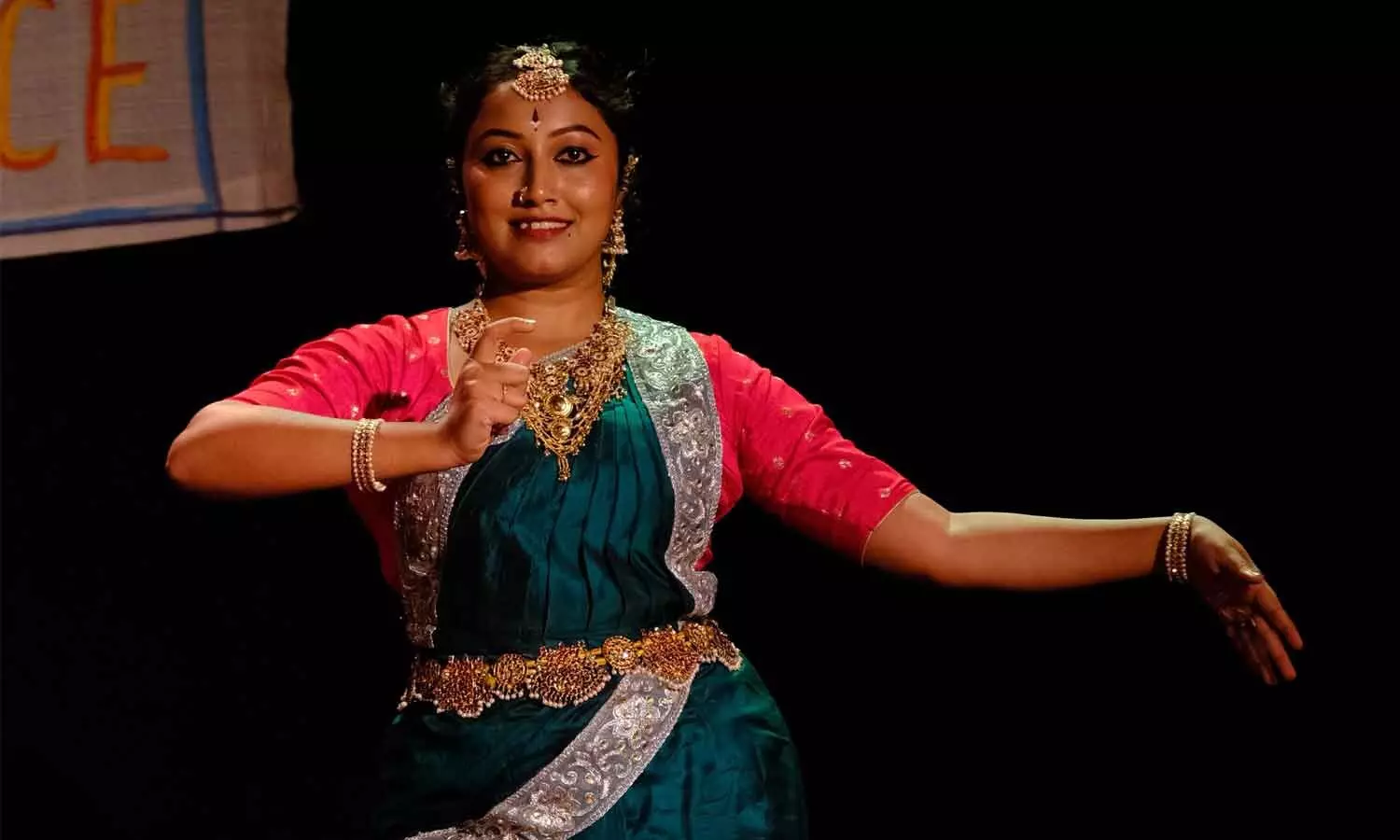
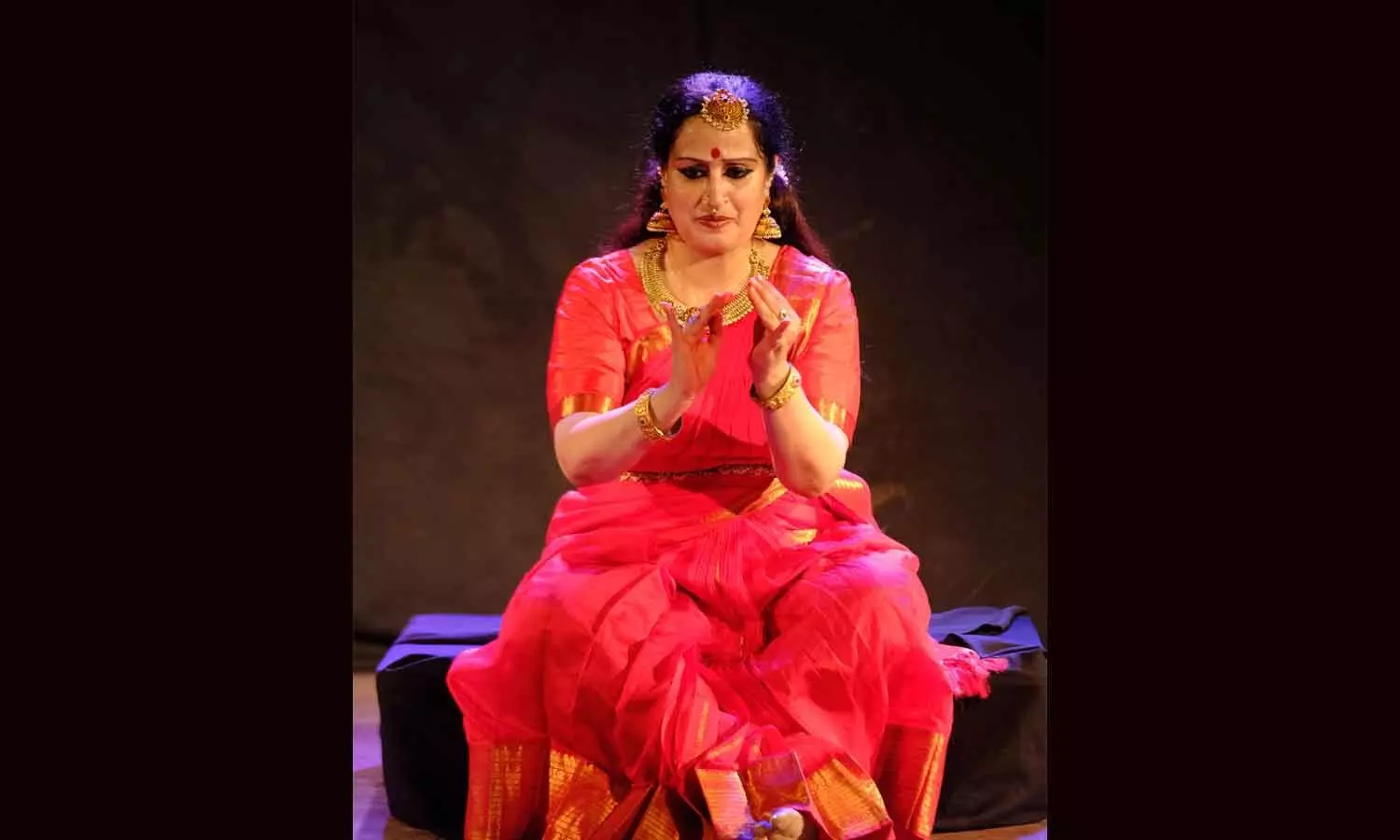
An evening of performance talks exploring the dual contexts of temples and royal courts was presented at Our Sacred Space Auditorium, Secunderabad, last Saturday. The programme featured discussions on the esoteric aspects of Shakta and Tantrapasana in relation to the ‘Gita Govinda’ by Dr Anupama Kylash, and rare sabdams in court literature by Acharya Kalakrishna.
The live orchestra featured veteran maestro Renuka Prasad on the mridangam, Ajeissh Menon, a brilliant vocalist and dancer, and the talented Pramod Kumar on the flute. Dr Anupama Kylash, a senior academic and performer of Kuchipudi and Vilasini Natyam, created a unique blend of fascinating discourse drawn from diverse sources, interspersed with exquisitely rendered abhinaya recitals of remarkable sophistication. In her opening remarks, Dr Anupama focused on Radha as Paradevata and Shakti in Jayadeva’s ‘Gita Govinda’. She explained that although later references equate Radha with the primordial Shakti from whom all energies emanate, it was this work that first brought her to the fore and elevated her to a position of equal importance with Krishna. In verses depicting their longing for each other, she pointed out, hidden layers of Shakta thought are embedded within the text.
Referring to the Radhika Tantra, she explained that Padmini or Padmavathi is one of the garlands adorning Tripura Sundari, which fell in Vrindavan and incarnated as Radha. This, she noted, may explain the subsequent connection between the names.
Dressed in striking scarlet aharya, Anupama elaborated on three important verses that address Radha or Radhika as Chandi. The visualisation was exquisitely delineated, matching the lively descriptions through pure abhinaya performed in a seated posture.
The culminating piece-de-resistance was the 24th Ashtapadi, ‘Kuru Yadunandana’, presented in intricate detail. As dawn arrives, a beautifully dishevelled Radha finds herself exhausted, with her makeup smudged and ornaments loosened after a night of conjugal union with Krishna. Secure, cherished and sovereign in Krishna’s absolute love, she commands him to adorn her once again.
In a playful reversal of roles, the Lord of the Universe humbly submits to her wishes. He is asked to paint decorative designs on her breasts, arrange flowers in her unruly curls, refresh her facial cosmetics, reapply kohl to her eyes, place a tilak on her brow, paint her feet, fasten her anklets and retie the jewelled girdle around her waist. The poem concludes with Jayadeva’s assertion that listening to this song of Radha’s bliss grants emancipation. The concluding ‘Radhika Sahasranamam’ resonated with the panchaupachara offerings of gandham, pushpam, dhupam, deepam and naivedyam to Radha.
The second performance talk featured expositions and nattuvangam by Acharya Kalakrishna, senior guru and primary custodian of the Perini and Andhra Natyam traditions, carrying forward the legacy of the renowned Dr Nataraja Ramakrishna. The performance was presented by his student Satwika Penna, who was recently awarded the Bismillah Khan Yuva Puraskar by the Sangeet Natak Akademi, Delhi.
Kalakrishna explored court literature, highlighting the similarities and differences between sabdams composed in praise of kings and deities. He explained the transition of the word ‘Parak’ to ‘Johar’. Kaivarams, too, were described as compositions performed in praise of God in temples.
A composition on Lord Shiva exemplified ‘Parak’, while the transition was illustrated through a piece on Radha and Madhava, whose lyrics described the Rasleela in the evening. Sabdams, performed through the storytelling tradition of kelika dancers, were discussed in relation to the Bharatanatyam margam and the dance traditions of the Telugu-speaking regions. He then turned to the items performed by court dancers in the sabhas of rulers, explaining the distinctive manner in which performances commenced. Flowers held in the hands were offered with the palms facing different directions to indicate whether the offering was intended for a deity or a king.
These Raja sabdams were followed by a rare sabdam depicting Satyabhama as a virahotkantita nayika.
Acharya Kalakrishna’s nattuvangam was as delightful to witness as the engaging interaction between the orchestra and the dancer.
Satwika began with ‘Gangadharavara’, originally choreographed by Naidupeta Rajamma, the court dancer of the Raja of Kalahasti, who had the privilege of performing both before the ruler and before Lord Sri Kalahasteeswara in the form of the Vayu Lingam. The composition describes the Lord as the bearer of Ganga in his locks, the one whose vehicle is Nandi, who burns Cupid and wears a serpent.
‘Sandhya Samayamu’ depicted Radha and Madhava dancing with the gopis, while ‘Dharani Rathamai’ portrayed the battle scene in which Shiva sets out to destroy the Tripuras. The Pithapuramsabdam, traditionally performed by court dancer Pendyala Satyabhama, eulogised the glory of Maharaja Gangadhara Rama Rau of Pithapuram. He was praised as the ornament of his clan and the epitome of an illustrious ruler.
The ‘BhoginiDandakam’ celebrated the renowned Telangana ruler and scholar Sarvagna Singha Bhupala, praising him as a benevolent patron of poets and scholars and an ideal king.
The final composition portrayed Krishna’s exploits as the son of Devaki and Vasudeva, including his slaying of Kamsa, the rescue and enthronement of Ugrasena, and his role in securing victory for the Pandavas.
Satwika’s performance throughout was crisp and vigorous in its nritta. Her dancing abilities shone through the challenging poses and intricate movements. Her transitions between postures were fluid and effortless, while her angika abhinaya was crystalline, marked by impeccable angashuddhi.
These vintage treasures were brought to life through her interpretation under the able guidance of her guru.
Sri B V Papa Rao, IAS (Retd.), and Sri Uday Bhaskar, former Director of IOC, were the guests
of the evening.


