Classical dance ballet brings Alluri Sitaramaraju’s heroism alive

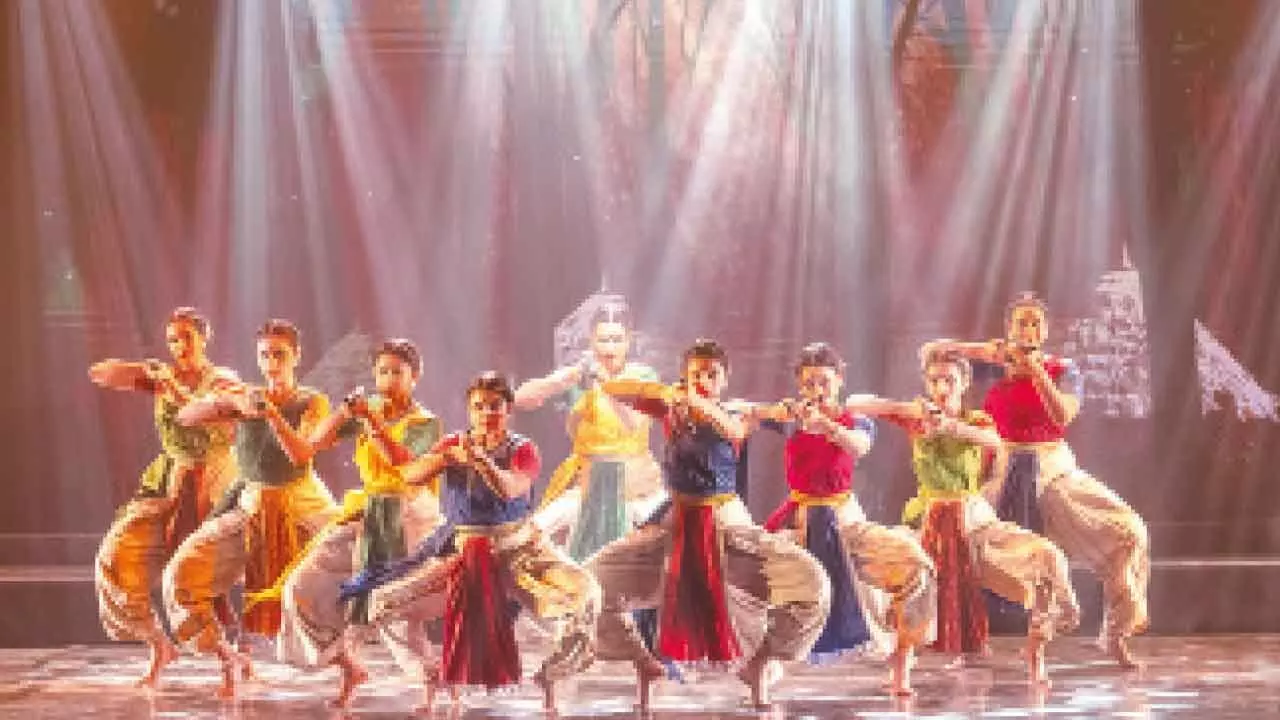
Orissa Dance Academy, Bhubaneswar, supported by the Ministry of Culture, presented “Manyam Veerudu – Alluri Sitaramaraju” at Ravindra Bharathi recently. Choreographed by Dr Ananda Shankar Jayant, the ballet traced the legendary freedom fighter’s courage, sacrifice, and love for the Motherland. Through powerful dance, stirring poetry, and evocative visuals, the production celebrated a timeless saga of resistance and patriotism
Orissa Dance Academy, Bhubaneswar, supported by the Ministry of Culture, Government of India, presented a Shankarananda Kalakshetra Classical Dance Ballet on Thursday at Ravindra Bharathi — “Manyam Veerudu – Alluri Sitaramaraju.” It was the first part of Rasabhiva — bringing together the historical and the eternal.
The production brought alive the extraordinary bravery, inspiring life, and incomparable love for the Motherland of Alluri Sitaramaraju — one of India’s greatest freedom fighters. Dr Ananda Shankar Jayant, in her original choreography with her signature refined sense of aesthetics, envisioned a heroic odyssey of a commanding warrior who struck terror into the hearts of the colonial forces with just a handful of followers and scripted a unique chapter in India’s freedom movement.
His rebellion, which countered the atrocities of the British through continuous armed struggle, took two long years to quell — even for a mighty Empire with limitless resources. “The Monarch of the Clouds marshals his followers in the skies with his leadership; Ramaraju, of boundless valour, commands his forces on earth.” This was the description of contemporary writer Radhakrishnamurthy, whose book was banned. Venkat Gadepalli’s stirring Telugu poetry was animated in a rousing soundscape by Sweta and Renuka Prasad, alongside a sonorous English narration by Jayant Dwarkanath. Research support was provided by Krishnaprasad and Padmavathi. The performance by 21 dancers was succinct (41 minutes), dwelling on the main highlights of this hero’s brief but illustrious life of just 26 years. Lighting by Surya Rao was mind-blowing, as the range of visual effects suited the mood of every scene impressively.
The opening scene of breaking dawn featured a projection of the rosy sun in amber hue, rising on a screen divided into a recessed central rectangular lunette flanked by smaller ones — a unique touch by designer Gunjan Ashtaputre to dispel monotony. Iridescent mother-of-pearl imagery captured the early morning sky, resembling frosted glass.
In this bucolic environment, located in the Eastern Ghats, tribal people living in tune with nature engaged in Podu, a form of jungle cultivation. A rusticized series of movements, idealized by grouped Bharatanatyam dancers clad in simple earth tones with sfumato colouring and minimal silver-toned jewellery, set the opening tableau.
The British authorities, led by Kuchipudi artiste Surendranath playing their commander, burst into the scene to impose the Madras Forest Act — outlawing this form of subsistence cultivation by every ruthless method in their armoury. In gorgeous gold, red, and white uniform, Surendranath and his soldiers emoted the diabolical necessity that any transgression would be countered with brute force.
Onto this melancholic environment appeared Mithun Shyam as Sitaramaraju — arriving in lightning speed as though out of thin air. His tremendous presence, picture-perfect as Sitaramaraju in ochre aharya with bow in hand, transfixed the spectators. His handsome, dignified countenance radiated majesty in a heroic pose.
Perturbed by the plight of the simple tribal people, whose sylvan forest land had been turned into forbidden territory, Mithun’s gravity-defying leaps throughout the ballet electrified the audience. As he counters and vanquishes the British, he also trains the tribals to take up arms such as spears and rise in rebellion.
The soldiers are lulled and tricked into futility by clever means, comically depicted en deshabille, displaying their complacence and early defeats. However, realising that simple spears and arrows would not always suffice, Ramaraju devises the idea of purloining guns to modernize their arsenal. Police stations are raided successfully, and a small but formidable force is raised.
In the midst of this training, a brief idyll with Sita is poignantly portrayed. When Ramaraju loses her, he commemorates his immense affection by adding Sita to his name. This dazzling pas de deux by Neha Sathanapalli with Mithun was stunning to behold, as they appeared to levitate effortlessly across the stage. The duels of sword, stick, and gun fights occurring simultaneously gave the scene a chiaroscuro effect, adding visual richness and depth resembling a neo-classical painting. A raised narrow platform at the back of the stage enabled viewers to discern multiple layers of action clearly. An interlude featuring dancers spinning long multicoloured ribbons in kaleidoscopic patterns was equally entrancing.
When the British, regrouped with overwhelming reinforcements, finally surrounded Sitaramaraju, he attained glorious martyrdom. Yet the question remained — did he succumb, or did he live on in the hearts of his followers and all those inspired to continue the struggle for freedom? For it is not possible by mortal means to destroy the immortal ideal of independence.
Thus, through dance, the saga was told of how a hero transmitted the fragrant essence of freedom to future generations — to succeed in attaining it, and to cherish it forever.