A striking dual-solo recital of classical dance

Classical dance unfolded as both poetry and provocation at the third edition of the DVI Dance Festival in Hyderabad. Through striking solo performances by Bharatanatyam dancer Divya Ravi and Kuchipudi exponent Archana Raja, the evening explored feminine expression across time, myth, and lived experience. Intimacy and intensity converged on stage, offering audiences a deeply immersive artistic encounter
The recent third edition of the DVI Dance Festival at Bharatiya Vidya Bhavan, Koti, curated by Sravya Subramanyam—Kuchipudi dancer, visual designer, curator, and arts educator—was a true treat for art connoisseurs. The vision of bringing powerful, narrative-rich performances that honour tradition while embracing contemporary artistic expression to Hyderabad was beautifully continued. The festival envisions quality, aesthetics, and artistic sensibility, placing classical dance in the space of respect and visibility it deserves in society.
Two globally esteemed female soloists—Divya Ravi and Archana Raja—presented compelling and creative artistic visions in Bharatanatyam and Kuchipudi respectively.
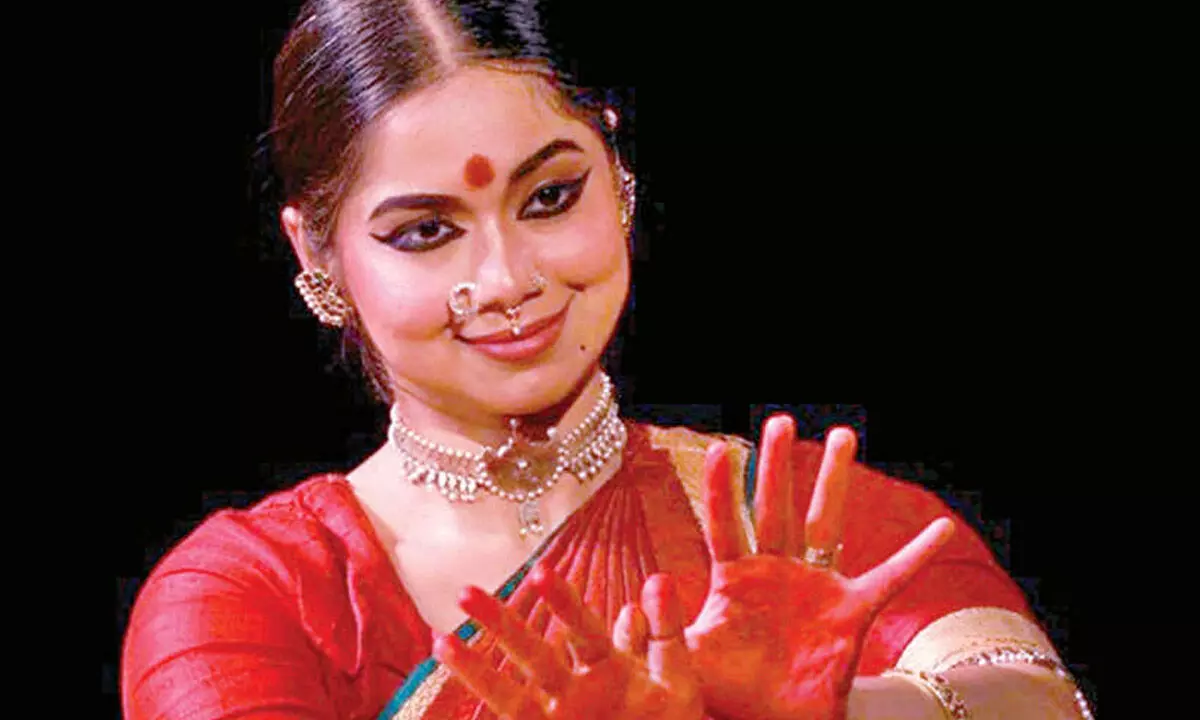
Divya Ravi, based in the U.K., is celebrated for her compelling abhinaya, nuanced choreography, and meticulously researched presentations. In ‘Sahaja – Innately Poetic’, an experiential exploration of multilingual poetry authored by women across time and geography, she invited the audience into a world where feminine voices take centre stage—intimate, courageous, and profoundly human.
Divya looked charming in her Bharatanatyam solo, dressed in orange and red with a gold-toned aharya. She began with verses in Manipravalam from Swathi Thirunal’s Utsava Prabandham, interspersed into a Mallari in Panthuvarali. She was enchanting as she etched an engraved scene of the Brahmotsavam at the Anantha Padmanabhaswamy Temple. As the procession leading to the famed ‘Aarattu’ ceremony unfolds, the Utsavamurthi atop the Garuda Vahana, along with the murthis of Narasimha and Krishna, are taken to the river for the holy bath. The sounds of the flute, cymbals, nadaswaram, and mridangam pervade the space, while kettledrums boom like thunder. Women carry oil lamps, and galloping horses resembling ocean waves move through the scene.
In Behag, the varnam ‘Vanajakshi Ninne Namiti’ became a lyrical outpouring of love—verses drenched in tenderness, where complete faith is placed in the lotus-eyed Lord. Divya’s forte in abhinaya shone powerfully as she beseeched the Lord for grace, likening Him to a rain cloud that nourishes the Chataka bird and to water essential for the survival of a fish, with whom she compares herself. He is the stable tree trunk upon which the twining vine depends. His lips and palms, delicate as lotus petals, are yearned for. Filigreed imagery depicted the matchless beauty of the Lord, imagined expertly through expressive nuance.
A playful Gujarati poem by Dayaram followed, picturising the leela where Radha and Krishna exchange attire. Divya luxuriantly enacted the tapestried scene of the divine couple wearing each other’s ornaments and clothes, brimming with laughter in a romantic yet humorous cross-dressing episode. The finesse displayed suggested microscopically detailed scenes reminiscent of miniature paintings.
Archana Raja, who lives in the U.S., is trained extensively in both Kuchipudi and Bharatanatyam and is known for her commanding stage presence, technical precision, and dramatic sensitivity. ‘The Accidental Goddess’ was a riveting reinterpretation of the myth of Renuka–Yellamma, tracing betrayal, survival, ascension, and the fierce emergence of the divine feminine.
The recital resembled stream-of-consciousness literature—Joyce and Proust translated into dance—featuring the protagonist’s reactions conveyed through continuous frenetic gestures when required, interspersed with strongly hammered cadences of movement. The art of Kuchipudi was stretched within its idiom to accommodate Archana’s concentrated intensity.
The work drew from a simple folk tale from North Karnataka, tracing Renuka’s metamorphosis from a dutiful princess into the fierce and defiant Goddess Yellamma. Rough-hewn and passionate in its experimental approach, the piece used brief, staccato, chant-like voice-overs in English to narrate the story of Parashurama beheading his mother for her transgression, at the behest of Sage Jamadagni, his father.
The anguished torment of Rama of the Axe was vividly moving as he prepared to carry out this repugnant task. Renuka’s severed head gains revived life through a boon bestowed by a pleased Jamadagni upon his dutiful son, transforming her into the folk goddess—the Grama Devata. Kasi Aysola was stellar as the starkly detached head, delivering striking abhinaya while wearing a tall, glittering crown. With minimal appearance, he conveyed a towering presence. Archana’s nritta was overpowering—like a fiery blaze coruscating on stage with blinding radiance.
Her aharya was simple: a sombre dull crimson-ochre costume with brass-coloured borders and minimal ornamentation, allowing greater emphasis on the sweepingly contoured movement vocabulary. A geegi pada with Arabic undertones and a recurring lullaby that shifted from soothing to haunting were seamlessly woven into the score.
Thus, in an evening of contrasts and convergences, two powerful thematic universes—one intimate, lyrical, contemplative, and innately poetic, and the other intense, raw, mythic, and transformative—together offered a richly immersive celebration of the feminine spirit in its many forms: fierce, tender, intuitive, wounded, awakened, and whole.
Both recitals received enthusiastic applause, signifying the satisfying and successful conclusion of the festival.