A Confluence of Jazz and Bharatanatyam

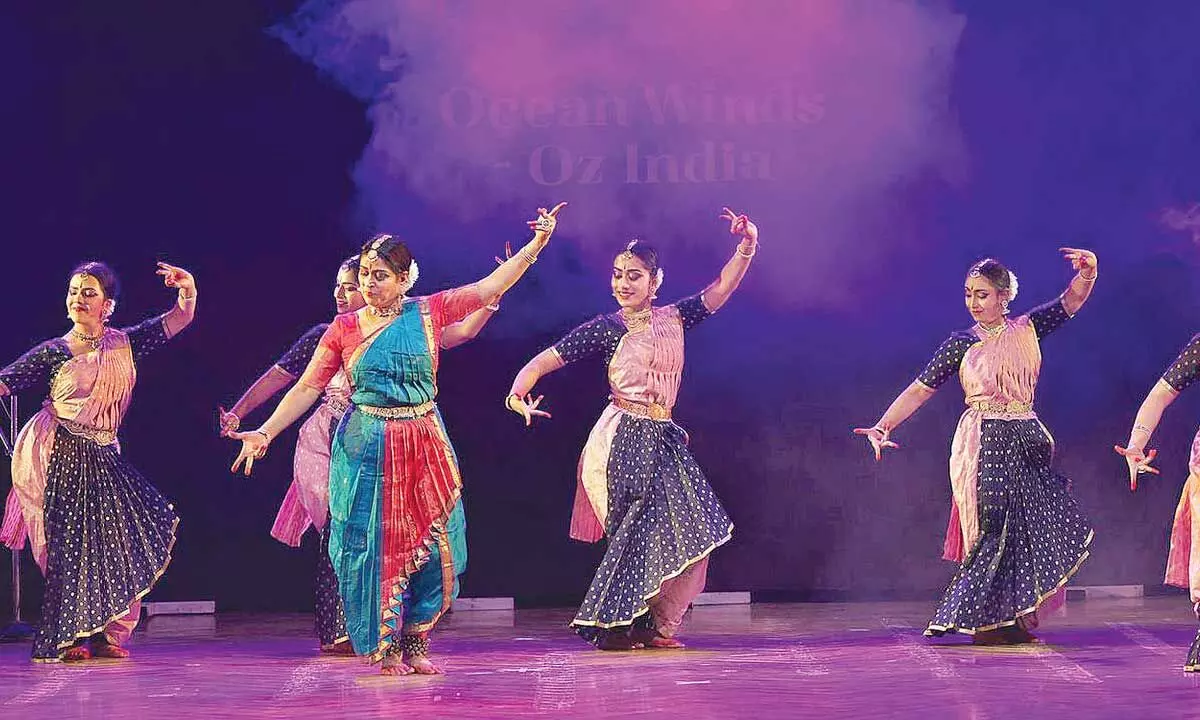
‘Raga’ by Vaaradhi and Chaitanya Art Theatres presented a unique creative confluence of classical Carnatic instrumental music, Bharatanatyam, and Australian jazz music in Hyderabad at Ravindra Bharathi. ‘Ocean Winds – Oz India’ was conceptualized by Dr. Rajeswari Sainath and Vyshnavie Natya Centre as a special treat for her city.
Dr. Rajeswari Sainath has been dancing for five decades and teaching for four, and is one of the well-known luminaries of classical Indian dance in Hyderabad. The event was presided over by Dr. Mohan Kanda, with the Chief Guest being L. V. Subramanyam—both former Chief Secretaries.
Aparna Kanda, the Master of Ceremonies, remarked that on a night where sound becomes language and movement becomes meaning, the audience gathered as one community, connected through the timeless and borderless language of music and dance. She dedicated the concert to the spirit of humanity, empathy, and oneness.
The recital was a unison, transcendently celebrating global artistry. This Indo-Australian collaboration unleashed a fusion experience of rare and profound depth, which was heartily enjoyed by the audience. The program was presented in two segments—one dedicated to the orchestra alone, and the second incorporating dance.
The first item was ‘Ananda’, set in Charukesi and composed by Suresh Vaidyanathan (inspired by lyrics composed by Ganapati Sacchidananda Swami on Anjaneya). Suresh Vaidyanathan was on the ghatam and percussion. A range of melodies blended seamlessly as the percussion boomed and a cavalcade of musical notes unfolded. The Son of the Wind God was aptly serenaded by wind instruments, infusing an atmospheric audio impact.
‘Pentacle’, authored by Adrian Sheriff—who played the shakuhachi (the Japanese flute traditionally used by monks in Japan to solicit alms) and trombone—was set in five ragas. The plaintive notes of the flute led the composition, sounding like a distant breeze, while the second flute imparted a rich tonal duality. The trombone’s trumpeting notes added depth, and the saxophone and percussion, including the reverberating ghatam, fused into symphonically majestic waves of sound that reached out and enveloped the audience.
Tony Hicks, on the saxophone and clarinet, penned ‘Sho Far Sho Good’. Here, the ghatam took off first, brilliantly handled, with clarinets interspersed to create an interlaced framework. Other instruments wove a parade of swaras into a rich tapestry of layered vibrancy. Staccato sounds alternated with piping tunes, while plangent notes from the mandolin created a delightfully haunting melody.
‘Three Nine’, composed by Balasai, the bamboo flute player, was a powerful merging of sounds in Mishra Tilang. The rattling cadence of the percussion, punctuated by blaring interjections of the saxophone, resembled fiery blazes alternating with oceanic serenity. Notes were tossed from one musician to another, forming strikingly original patterns. Raju played the mandolin, Chandrakanth the mridangam, and Srikanth the tabla. Nattuvangam was ably handled by Vyshnavie Sainath Prabhu.
The second segment commenced with Guru Karaikudi Mani’s Thani Avarthanam, played in its original recording. The dancers—a student group comprising Geetha, Sangeetha, Meenakshi, Keerthi, Gayathri, and Nishika—led by their Guru Dr. Rajeswari Sainath, entered with a flourish as a brief alaap preceded predominantly tala-based rhythmic explorations.
Dr. Rajeswari appeared in green and red aharya, while the students were dressed in black and pink costumes adorned with gold spangles. Mirroring the music, the dancers intersected and formed tableaux in a startlingly fluid fashion.
‘Vasantha Pravaham’ or ‘Into the Fire’, the signature piece of the performance set in Bahudari and Ranjani and adapted into jazz, was particularly engaging. Dr. Rajeswari depicted a veena player articulating “Sa Ri Ga Ma,” while the other dancers cupped their ears as if listening intently.
‘Nava Vatsalyam’ beautifully delineated a grandmother’s joy upon the arrival of a grandchild. The poses depicted her eagerly watching the enchanting child in a cradle, playing with the baby, fondling it, and anxiously searching for it—eliciting applause for the precise abhinaya of the senior maestro. The students danced gently with soft steps, and a pair adorned with peacock feather fans swayed gracefully in a stylized manner.
The concluding piece, ‘Manasa’ (Peace), was a fitting finale that emphasized the message “Lokahitam Mama Karaniyam”—Our duty is to do good to humanity. It was lyrical and spellbinding as Dr. Rajeswari danced at the center, surrounded by students holding lamps, creating a mellow and serene mood. Visual imagery of soft hues emerged as pastel skirts flowered with swirling movements.
During this piece, the orchestra stood in unison to underscore the urgent need to embody, in both action and intention, the verses from the Rig Veda that formed the thematic core of the performance.