Where nature meets nuance – Exploring Japan’s layered beauty

On a recent visit, what I saw was far beyond my expectations, as Japan revealed itself to me in vivid pockets of experience. Our first halt, Tokyo, rose first — a modern city shimmering atop an island country that constantly negotiates with tsunamis and earthquakes. It amazes me how a place so persistently shaken can stand so assuredly. From afar, the Tokyo Tower gleamed like a Japanese retelling of the Eiffel Tower, familiar in silhouette yet distinctly its own. And towering above it all, the Tokyo Skytree pierced the sky at 634 metres, a slender needle threading the clouds.
At night, the Rainbow Bridge stitched the city’s lights together in a quiet sweep of brilliance. Shibuya Crossing was its own theatre. By 5.30 PM, darkness had already settled like a curtain, and then with a single signal, the world seemed to spill into an intersection—three thousand people flowing past one another effortlessly, a human tide that never felt chaotic. Watching that movement from the sidelines felt like observing a well-rehearsed dance that Tokyo performs every evening without fail.
One of the unforgettable moments remains wearing the famous Japanese kimono — the fabric holding me with a kind of structured grace — as we entered the Senso-ji Temple in Asakusa. Following ritual, we washed our hands and feet, letting the cool water run over our palms, rinsing not just the skin but something quieter within us. The path leading to the temple, where guardians stood imposingly, was alive with shopfronts, warm lanterns, soft chatter and the glow of food stalls — a busy, joyful prelude to the calm temple grounds.
On our way out, we paused at a pond rippling with enormous and expensive koi fish moving like jewelled shadows beneath the water. I joked, “If you manage a good catch, you can proudly say ‘Koi Mil Gaya’ (I found someone).” The pun lingered — half about fish, half about fate — and for a moment the whole pond seemed to sparkle with amusement.
Then there was Ginza, Japan’s polished stage for luxury and style. Its branded stores stood like sculptures of glass and light, and the iconic Uniqlo flagship — floor after floor of colour, fabric and people — felt like a vertical city of its own. It was another reminder of Japan’s quiet genius: how even the smallest spaces are stretched, shaped and coaxed into maximum purpose. Minimal space and maximum spirit — a design philosophy found not only in architecture but in daily life. The Indian Embassy in Tokyo was a beautiful space with its Ganesha and Lakshmi idols beautifully placed, and the Indian National Flag flying high, bringing forth a surge of patriotism.
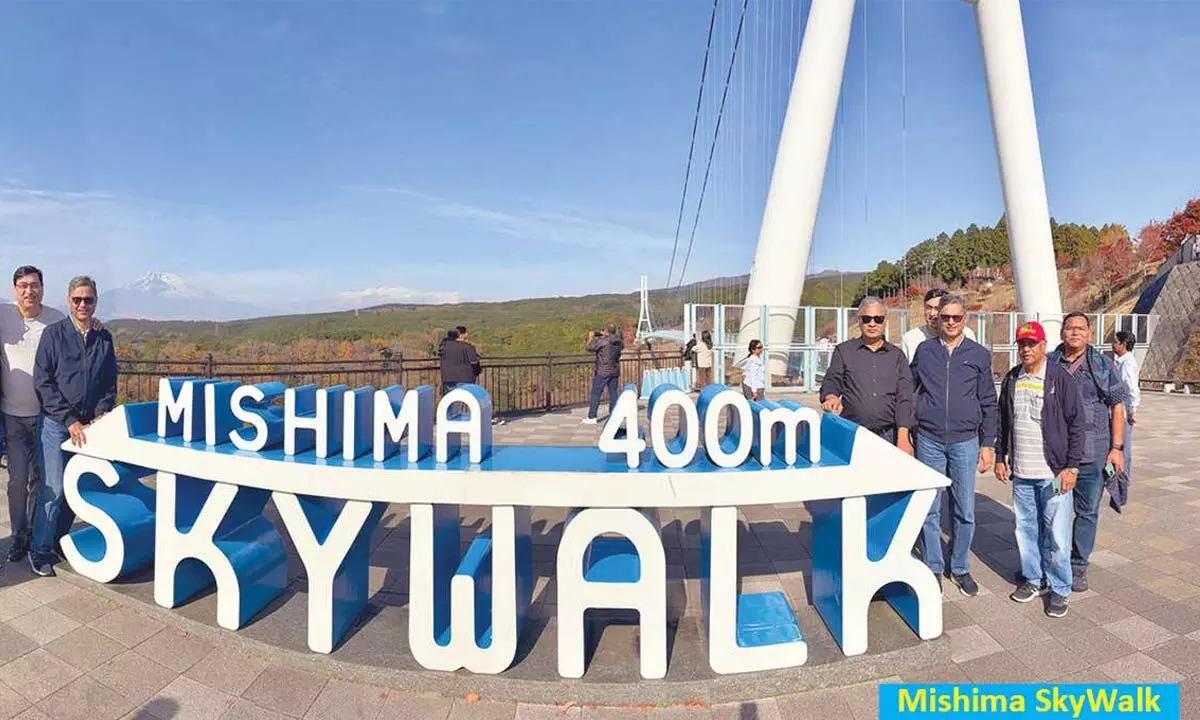
Beyond the cities, Japan moved into a different register. The bus ride to Mount Fuji felt like travelling towards a secret. We had been told that the mountain reveals itself rarely, preferring to hide behind its misty veils. But fate was kind — Fuji appeared in full splendour, its snow-capped cone sharp and regal against the sky. A hush settled in the bus, the kind that rises only when one sees something extraordinary. At the Mishima Skywalk, a long suspension bridge stretched across a wide valley, the forest below spreading itself in folds of green. As we walked across, the vastness unfolded beneath our feet. Creamy soft ice cream at the far end of the bridge tasted even more delicious after a walk through the clouds.
The Todai-ji Temple, which houses the largest bronze Buddha statue in Nara, established by Emperor Shomu during Japan’s Nara period and known as Nara Daibutsu; feeding rice crackers to oversised deer; the lovely countryside in Kyoto where our hotel rooms offered an awesome view of a huge lake with a tree-lined avenue; bamboo forests with huge bamboo trees on both sides forming a green arch; our time at the Mazda factory where a thousand cars are readied on the assembly line each day; the disturbing visuals at the Hiroshima memorial where an original building ruined in the Second World War has been preserved; the museum that showcases horrific images of destruction; and the Osaka Palace with its tales of royalty and famous samurai costumes — all reveal different facets of a country whose citizens make maximum use of time, a resource that cannot be replenished.
The sit-down Zen meal at a Michelin-starred restaurant and the smooth ride on a bullet train that arrives at its scheduled time without fail are memories that refuse to leave you long after your visit. All of these impressions and more weave themselves together when I think of Japan: children scribbling notes diligently at memorials and automobile factories; autumn leaves in brilliant hues — yellow, crimson red and rust — blazing along manicured paths and beautiful gardens; strangers bowing with soft-spoken warmth; spotless public spaces cared for with collective pride. The country lives in its grand gestures, in its natural bounty, its Sakura flowers radiating beauty, and in its quiet moments of grace.Its silence is eloquent.