When words shape futures

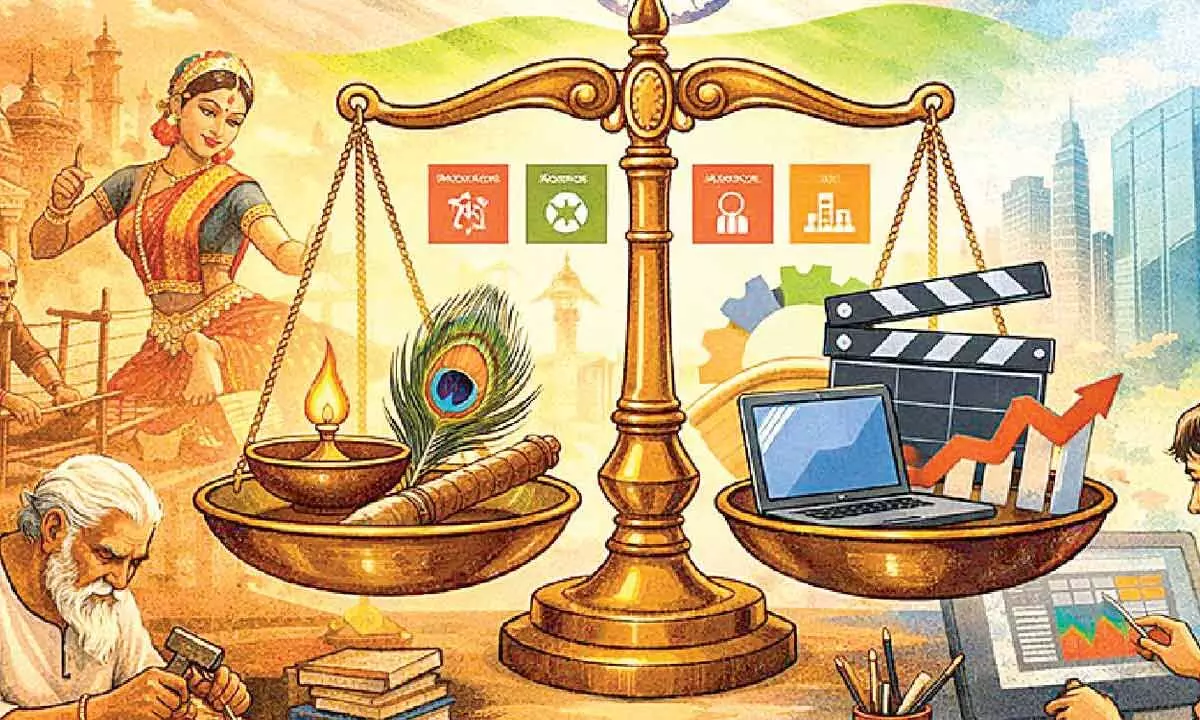
We often believe that words are neutral. They are not. Words carry histories, worldviews, and assumptions. When we borrow them without reflection, they quietly reshape how we think, design policies, and imagine the future.
This becomes particularly important today as the country speaks confidently about the creative economy, skill development, and sustainable growth. Beneath these promising agendas lies a deeper question: Are we using the right words and more importantly, do we understand their meanings?
When synonyms are not the same
Modern policy language relies heavily on Western dictionaries and frameworks. Over time, we began assuming that translated words are equivalent in meaning. They are not.
Consider the phrase Indian Knowledge System. The word “system” suggests something fixed, structured, and closed. Indian knowledge was never that. It was always a living process which is evolving through dialogue, observation, experimentation, and lived experience. To call it a system is to limit its nature.
The same confusion appears in everyday policy vocabulary:
•Rashtra is translated as nation, but rashtra includes shared values, ethical responsibility, and civilisational continuity not just territory.
•Kala becomes art, but kala includes discipline, refinement, and practice.
•Vidya becomes knowledge, yet vidya transforms the learner; it is not mere information.
These are not linguistic errors. They are conceptual mismatches and they affect how policy is framed.
Creativity was never just an industry
In global discourse, creativity is treated as an industry which is measurable through output, revenue, exports, and jobs. India has adopted this framing too, often with good intentions.
But in the Bharatiya context, creativity was never only economic.
It was how communities solved problems, passed on wisdom, healed bodies, educated minds, and sustained livelihoods. Storytelling, crafts, architecture, food traditions, health practices, and music were all creative processes embedded in daily life.
When creativity is reduced to an “industry,” policy begins to focus only on products and markets, not on people, processes, or purpose.
What the numbers tell us—and what they don’t
Official data already shows the strength of the creative economy.
The creative industry in Bharat is estimated at $30 billion and employs nearly 8% of the country’s working population.
Creative exports grew by 20% recently, generating over $11 billion in export revenue.
Creative sectors contribute significantly to employment and exports, and they employ a large share of young people and women. Creative occupations often pay better than average wages and contribute disproportionately to value creation.
Yet numbers alone do not tell the full story.
Many creative livelihoods especially in crafts, folk arts, traditional health practices, and community knowledge remain undercounted because they do not fit neatly into formal definitions. What is not measured is often ignored. What is ignored is rarely supported.
This is where meaning becomes a policy issue.
Learning from health: A useful analogy
Ayurveda offers an important lesson. In allopathic medicine, treatment is often fragmented—heart, lungs, brain, symptoms. Ayurveda looks at the human being as a whole: body, mind, habits, environment, and emotional state.
Policy design today often resembles fragmented medicine.
Skill development is separated from wellbeing. Employment is separated from identity. Productivity is separated from purpose. Creative workers are trained for markets, but not supported as whole human beings.
A creative economy rooted in Bharatiya perspectives would design policies that recognise this interconnectedness.
SDGs, skill India, and creative livelihoods
The Sustainable Development Goals speak of decent work, inclusive growth, gender equality, sustainable communities, and responsible production. These goals align naturally with creative sectors especially when creativity is seen as a community-based, culturally rooted process.
Similarly, Skill India has focused on scale—training millions. But skills without cultural context, dignity, and livelihood pathways lead to frustration, not empowerment.
Creative skills are not just technical. They are:
•Intergenerational
•Practice-based
•Place-specific
•Identity-linked
Recognising this can help Skill India move from certification-driven training to meaningful livelihood creation.
Knowledge holders, not just creators
Bharat has always had open platforms of knowledge—sabhas, gurukuls, workshops, village spaces. Thinkers and practitioners discussed society, health, ethics, governance, and life itself. They were not merely “philosophers” in the modern sense; they were knowledge holders and transmitters.
Creative economy policy must learn to see artisans, storytellers, healers, and cultural practitioners not as informal workers waiting to be formalised, but as repositories of living knowledge.
Reclaiming meaning before measuring value
Bharat’s creative future will not be shaped only by platforms, exports, or intellectual property filings. It will be shaped by whether we reclaim the meanings of our own words.
• When words regain depth, policies gain direction.
• When meanings are aligned with culture, growth becomes sustainable.
• When creativity is seen as a way of living, not just earning, the economy becomes humane.
• Before we count creativity, we must first understand it.
(The writer is a Creative Economic Expert)