When poetry turns dark: Inside ‘Nocturnal Frights’

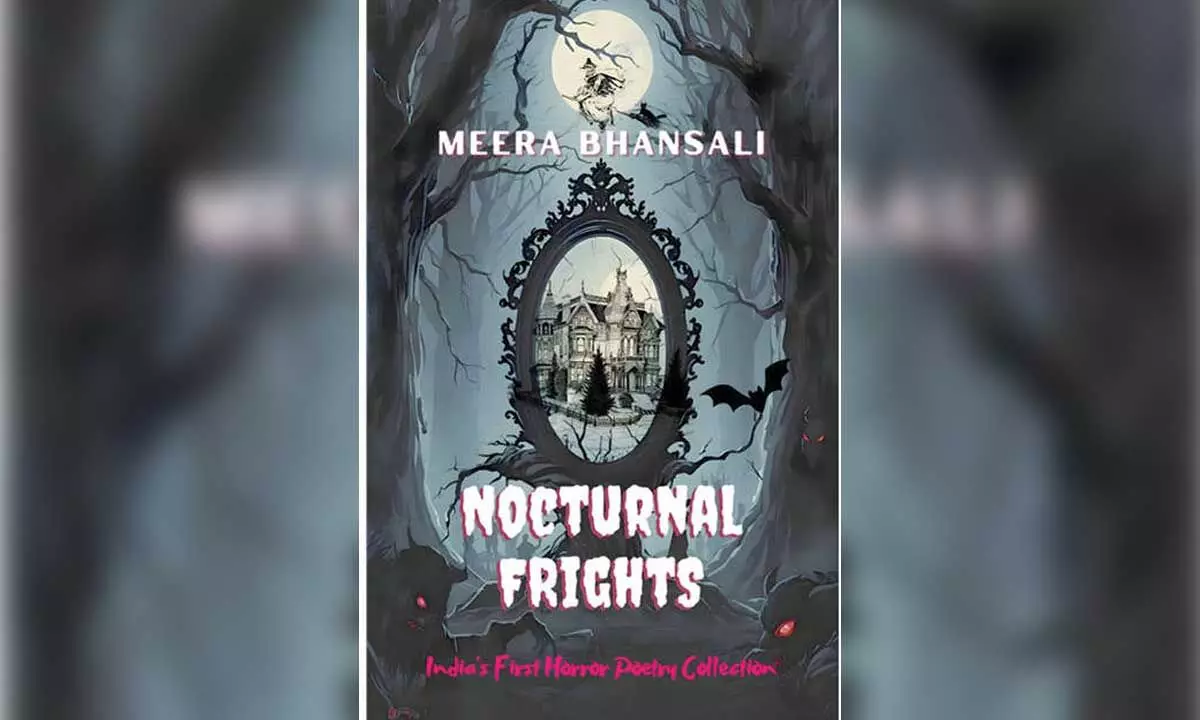
In the evolving landscape of Indian English poetry, where romantic lyricism, political commentary, and confessional narratives dominate, ‘Nocturnal Frights’ by Meera Bhansali arrives as a deliberate rupture. Positioned as India’s first paranormal poetry collection, the book ventures into the rarely charted territory of dark poetry, merging poetic form with the psychological intensity and atmospheric depth of horror literature.
Rather than relying on isolated moments of shock, ‘Nocturnal Frights’ is conceived as a sustained immersion. Bhansali treats the Gothic not as an ornamental aesthetic but as a structural and emotional framework. Fear here unfolds slowly, demanding patience and participation from the reader, much like the experience of lingering in darkness rather than fleeing from it.
The collection’s most distinctive feature lies in its precise and intentional structure. Bhansali curates thirteen paranormal entities, sourced from extensive research into global folklore, mythology, and anomalous human experiences. Each entity is explored through a sequence of five poems, lending the book a measured rhythm and a sense of continuity that transforms it into a series of interconnected hauntings rather than a scattered anthology.
Adding further complexity to this structure is Bhansali’s use of fictional storytelling within select sequences. Some poems move beyond atmospheric suggestion and develop into fragmentary narratives, introducing implied characters, shadowed settings, and unfolding events. These pieces read like compressed horror stories rendered in verse—lives interrupted, encounters survived or surrendered to, and realities irrevocably altered by the supernatural. This narrative layering blurs the boundary between poetry and short fiction, allowing the reader to momentarily inhabit the world of the poem rather than merely observe it.
Despite its spectral subject matter, ‘Nocturnal Frights’ is ultimately concerned with the human mind. Bhansali employs the paranormal as metaphor, exploring mental health, suppressed trauma, and the darker recesses of consciousness. The creatures that inhabit the collection often function as external manifestations of internal unrest, suggesting that fear is not merely something encountered, but something carried. The darkness of the poems feels psychological before it feels supernatural.
Stylistically, Bhansali’s work is shaped by rhythm and rhyme, drawing on the sing-song cadences of childhood verse. This familiarity is deliberately subverted through disturbing imagery and unsettling conclusions. The poems often sound deceptively gentle, even melodic, while unfolding images of dread and disquiet. The contrast heightens the impact, making the horror feel intimate rather than theatrical.
Theemotional intensity of the collection suggests a writer deeply immersed in her subject. The poems feel less imagined than observed, carrying the weight of prolonged engagement with fear, introspection, and vulnerability. There is restraint in the execution—an instinctive understanding of when to pull back rather than overexplain—allowing silence and implication to do much of the work.
As a literary work, ‘Nocturnal Frights’ marks an important moment for Indian writing in English. It reclaims the Gothic genre—often dismissed as a Western import—and situates it within a global yet culturally resonant framework. The collection does not seek to shock for novelty’s sake; instead, it invites readers into a space where fear, spirituality, and introspection quietly intersect.
This is not a book meant for light or casual reading. It speaks to readers who are drawn to introspection, to those who find meaning in silence, and to anyone who has felt that the night carries more than darkness. Bhansali does not explain horror or attempt to resolve it. She allows it to unfold, patiently and persistently. The result is a haunting collection that lingers long after the final page, like a presence sensed but never fully seen.