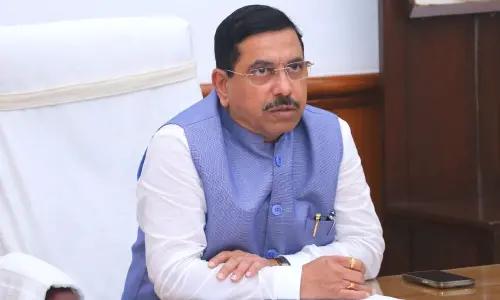
We will encourage private sector participation in coal mining: Union Minister Kishan Reddy


Union Minister for Coal and Mines, G. Kishan Reddy, spoke exclusively to The Hans India about India’s ambitious coal and mineral production targets. He highlighted that private sector’s share in coal production should increase to 50% in coming years from 15% now. The Minister also shared insights on critical minerals, displacement issues, and initiatives to make mining sustainable and people-friendly
Union Minister for Coal and Mines,G. Kishan Reddy, in an exclusive freewheeling interview withThe Hans India, shared insights into the performance of the coal and mineral sectors in the country, along with the plans and measures being undertaken by the Centre. He emphasized the government’s focus on the welfare and livelihoods of displaced communities and its commitment to advancing the critical minerals sector. Kishan Reddy also highlighted how the Centre is fostering healthy competition between state-owned PSUs and the private sector to ensure India meets its coal and mineral demands efficiently.
India has set a target to produce 1.5 billion tonnes of coal by 2030. Experts say it’s very difficult to achieve this target. What steps is your government taking to achieve the target within the time limit?
We are increasing coal block exploration and auctions. Currently, 85% of coal is produced by public sector undertakings (PSUs). We are encouraging the private sector, which currently contributes 15%, to increase its share to 50% in the coming years. The targets are set based on the country’s energy needs. We cannot overproduce coal due to limited space for stockpiling, which could also pose unforeseen risks.
The production strategy depends on demand projections. If the share of green energy grows substantially, the demand for coal may not be as high as it is today. At present, we are in a position to export coal if any country requires it.
I have urged the private sector to step forward, as the country should be prepared to export coal. Accordingly, we are developing plans to improve both the quality and quantity of coal production.
The previous BRS government expressed its willingness to buy the central government’s stake in Singareni. If the Telangana government comes forward, will the Centre sell its stake?
A. The earlier BRS government made a significant mistake regarding Singareni Collieries. I had allocated the Naini coal block in Odisha to them, but they did not come forward to bid and acquire it. We are now allocating coal blocks only through auctions to entities like Coal India, Western Coalfields, NTPC, and NMDC. The idea is to ensure that public sector companies compete with the private sector.
Singareni Collieries refused to participate in the auction process, which is why coal block allocations in Telangana remain pending. They are requesting direct allotment of coal blocks, but the Supreme Court has ruled that coal is a national asset. It cancelled the allocation of 204 coal blocks to both public and private entities and directed that all future allocations be made through transparent auctions.
Since Prime Minister Narendra Modi’s government took office, we have taken all necessary measures to ensure that coal block allocations are done transparently and without error. We have successfully auctioned the previously cancelled 204 coal blocks, along with new ones. Both public and private sector entities are actively participating in these auctions, acquiring coal blocks, and developing them.
You are auctioning coal blocks in the private sector, and increasingly, the issue of displacement—particularly in tribal-inhabited areas—is coming to the fore. How are you going to address it?
It is definitely a challenge for us. We must stand by the people, and the Centre is serious about addressing this issue through the implementation of the Rehabilitation and Resettlement Package (RRP). Based on the land acquisition policies of the respective states, benefits have been extended to affected individuals. Where necessary, employment opportunities are also being provided.
Additionally, under the District Mineral Fund, ₹1.20 lakh crore has been earmarked for the development of these areas. Directions have been issued that the royalty, premium amounts, and taxes received by the state governments should be spent on the welfare of these regions. Whether it’s displacement, housing, employment, or infrastructure, the Centre is extending full cooperation.
The core issue is that 74% of the power generated in the country comes from coal-based thermal production. This makes coal an essential resource for sustaining power generation. We must ensure justice for displaced communities while also meeting the country’s energy needs. In today’s competitive world, coal has become as vital as food grains—it’s a reality we cannot ignore.
That’s why, in nearly 200 locations where coal has been extracted across the country, we are initiating mine closure activities—whether in the public or private sector. In fact, there are 142 coal blocks in the public sector alone that were never closed after independence. We are now adopting newly available scientific methods to implement mine closures.
Prime Minister Narendra Modi has directed that, regardless of the cost, mine closure activities must be carried out and made beneficial for local communities. The goal is to improve livelihood opportunities for them. It is a shared responsibility, but the state governments must play an active and accountable role. This is because nearly 99% of coal-related revenue goes to the states. Under GST, the Centre receives 50%, but beyond that, it does not receive any direct revenue. States receive the premium amount during auctions, royalty payments, and the District Mineral Fund allocations. They also receive 50% of the GST.
That’s why, over the past year, in several meetings and interactions with state chief ministers, we have emphasized that coal blocks—whether in the private sector, state government, central PSUs, or other ministries like NMDC or the Ministry of Steel—must prioritize the welfare of local communities.
You are talking about the District Mineral Fund. However, if we take the case of Chhattisgarh for instance, the funds were reportedly diverted through the Seed Corporation of that state and misappropriated. Has your ministry taken note of such incidents?
The oversight of the District Mineral Fund (DMF) lies with the respective state governments. Our role at the Centre is to prepare the guidelines, while implementation is the responsibility of the states. Taking all factors into account, we made a conscious decision not to appoint politicians as chairpersons of the DMF. Instead, the District Collector is entrusted with managing and disbursing the funds.
Politicians may hold office today and be gone tomorrow, and they may be subject to political pressures. For example, funds from Singareni Collieries, which were meant to be spent in areas where coal is extracted, were diverted to Siddipet—simply because it was the constituency of the former Chief Minister of Telangana. That was wrong and should not have happened.
There have been occasional reports of such incidents in various parts of the country. That’s why the ministry has taken a firm decision: whether it’s granite, limestone, iron ore, coal, or any other mining activity that generates DMF revenue, the District Collector will head the fund and ensure that spending is focused within a 25-kilometre radius of the mine.
We are in the process of bringing legislation to formalize this framework and ensure accountability.
Despite India being endowed with vast natural resources suitable for mining, the sector’s productivity remains low and contributes less to the GDP than expected. Why is that?
There are two key issues. First, there is a shortage of iron ore. We are preparing for auctions, and within the next two to three months, a new Iron Ore Policy will be introduced to replace the existing one. Similarly, a new Steel Policy is also in the works, as both sectors are interlinked. We have already initiated discussions with stakeholders, and a committee has been constituted to deliberate on these matters. A new Coal Policy is also being formulated. Additionally, the NMDC Act of 1957 is undergoing a complete overhaul.
You are right—during the current financial year, we have reduced coal imports from 19 per cent to 11 per cent. However, one of the challenges is that many steel-making boilers in the country are designed to consume imported coal. We are encouraging industries to gradually redesign their boilers to suit domestic coal, with support through bank loans.
Domestic coal is of lower quality compared to imported coal from countries like Australia and Thailand. To address this, we are promoting the development of coal washeries to improve the quality of domestic coal for industrial use. Industries are now blending domestic coal with imported coal, which has led to a reduction in overall imports.
Currently, we are producing more coal than the country’s demand. For instance, in places like the Mahanadi coal block in Odisha, we are even holding back production. Power generation companies typically maintain coal stocks for about 12 days, but this has now increased to 20–25 days. They lack the space to store additional coal.
Coal stocks are held at mines, in transit, and at the stockyards of power generation companies. Ideally, the overall coal inventory should be maintained at 15–17 days. Daily reports are generated on coal production, transit, and consumption to ensure smooth operations. This is crucial because natural calamities like heavy rains can disrupt coal supply and, in turn, power generation.
That’s why the Prime Minister continues to monitor the situation closely. There is no issue on the coal production front, and we plan to increase output further in the coming days.
During the 2025–26 budget, there was a proposal to incentivize coal gasification. How is it progressing?
We have initiated meetings on this subject. There are two types of coal gasification—surface and underground—and we are currently formulating policies for both. In upcoming meetings, we will finalize the framework. Whenever we prepare 20 to 25 coal blocks for auction, we conduct roadshows to present detailed information. These include the total coal availability, its quality, the extent of exploration (G4 level), road infrastructure—how many kilometres are available or need to be laid—and the number of villages and population in the coal belt area. All this data is made public during open auctions.
We organize roadshows in cities like Mumbai, Chennai, and Delhi, where we engage with traders, companies, and stakeholders. We inform them about the base price, premium, and other auction details. Whoever comes forward during the open auction is allocated the blocks. A dedicated roadshow on coal gasification was also held in Hyderabad.
One key issue we must consider is the global decline in coal consumption due to the Net Zero 2070 guidelines, which India has also signed. Therefore, we aim to utilize our coal reserves efficiently and explore opportunities for export. We are bringing in new technologies to diversify coal usage—for power generation, cement, steel, sponge iron, and even methane gas production, which can be converted into green energy.
Currently, global experiments are underway to explore underground coal gasification. To stay competitive, we are also conducting research in this area. One or two companies have achieved success in China and the USA. Our ministry officials have visited those sites, and we plan to auction coal blocks specifically for gasification in the near future.
After your government came to power, you introduced the State Mining Index to track performance, along with the Mining Surveillance System, satellite monitoring, and a star rating system to promote sustainable mining practices and curb illegal mining. How is it progressing?
There are several components to this initiative. The system tracks whether mining entities have achieved their targeted production levels, the welfare activities carried out for affected communities, the utilization of District Mineral Fund (DMF) resources, CSR fund spending, worker welfare measures, product quality, and safety standards. Each component is assigned a score, and those with the highest scores receive star ratings and are incentivized accordingly.
This has led to healthy competition among mining entities, significantly improving performance. Previously, the average performance was around 60%, but it has now reached nearly 90% as companies strive to improve. We offer exemptions, financial incentives, and tax benefits to encourage better practices.
The core objective is to make mining a people-friendly and sustainable activity.
Despite winning 8 MP seats (50 per cent) in Telangana in the 2024 elections, the BJP has not been able to consolidate its position or emerge as a strong alternative to the Congress. Why is the BJP not proactive enough in Telangana?
If you look at the political landscape in Telangana, there is no future for the BRS due to a leadership crisis and a lack of public trust. The conduct of its leaders has failed to earn the confidence of the people. As for the Congress, they are struggling to deliver on their promises. Mere statements won’t buy them time, and their inability to act is evident.
The Congress is facing serious challenges. Allegations of corruption and poor leadership have distanced them from all sections of society—be it the poor, students, women, industries, or even government employees. They are unable to release employment notifications or pension benefits, which has led to widespread dissatisfaction.
In this context, if Telangana is to progress, people increasingly view the BJP as the only viable alternative. Otherwise, the state risks falling into deeper trouble. Intellectuals, the educated class, and various other sectors in Telangana are beginning to reflect on this reality—even without any aggressive campaigning by the BJP.
This public discourse has already begun, and there is growing sentiment to give the BJP an opportunity to lead the state under the leadership of Prime Minister Modi. Such a shift would benefit Telangana. The momentum is building toward bringing change, and we are actively working to strengthen the party’s presence in the state.
If we don’t give our 100 per cent to stand by the people, the state may face injustice. That’s why we are committed to being a responsible and proactive force in Telangana.