The philosopher as cultural bridge

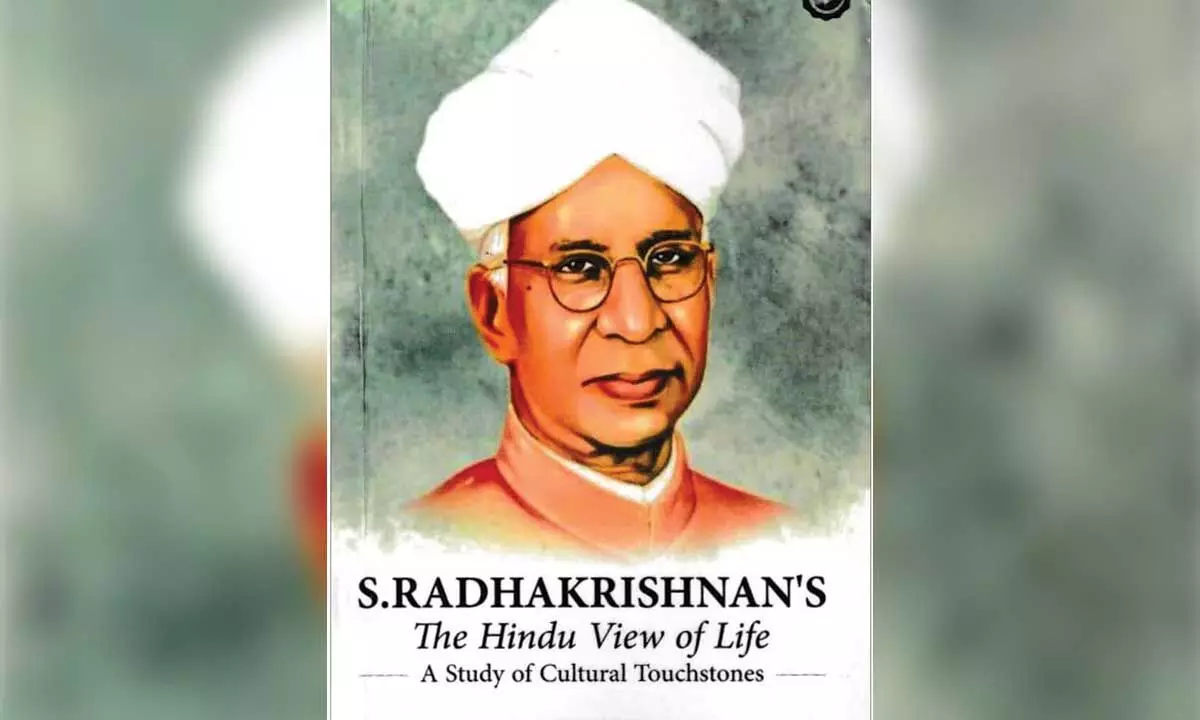
Dr P V Laxmiprasad’s ‘S. Radhakrishnan’s The Hindu View of Life: A Study of Cultural Touchstones’ is a thoughtful homage to India’s philosopher-president and his timeless vision of spiritual humanism. The book reinterprets Radhakrishnan’s ideas with philosophical depth, cultural sensitivity, and contemporary relevance
When Sarvepalli Radhakrishnan delivered his Oxford lectures in 1926—later published as ‘The Hindu View of Life’—he was not merely defining Hinduism but articulating the metaphysical rhythm of India’s civilization. In ‘S. Radhakrishnan’s The Hindu View of Life: A Study of Cultural Touchstones’, Dr. P. V. Laxmiprasad revisits that seminal text with the patient insight of a philosopher-critic. His reading is both homage and an interpretative re-engagement with one of India’s greatest minds.
Laxmiprasad begins with a lucid biographical account, tracing Radhakrishnan’s ascent from the scholarly precincts of Madras Christian College to the presidency of the Indian Republic. The narrative presents him as a moral-intellectual symbol—a thinker who transformed philosophy into civic service. Radhakrishnan’s writings, Laxmiprasad observes, were attempts to translate Indian spirituality into a universal human idiom, bridging East and West through the grammar of tolerance.
The book’s early chapters map the terrain of Hinduism as both faith and philosophy. Here, Laxmiprasad shows an admirable command of cultural history. Hinduism, he writes, is less a codified religion than a “way of being,” a dialogue between ethics, devotion, and metaphysical inquiry. He situates Radhakrishnan’s philosophy in the Advaitic tradition, which perceives the self (Atman) and the absolute (Brahman) as one. This non-dualism, as Laxmiprasad reminds us, does not negate diversity but sanctifies it—an idea urgently relevant to contemporary India.
The author’s discussion on Hinduism versus Hindutva is particularly striking. Without polemic, he distinguishes between the inclusive spiritual humanism of classical Hinduism and the exclusivist, politicised rhetoric of Hindutva. Citing Swami Vivekananda, Sri Aurobindo, and Gandhi, Laxmiprasad argues that India’s strength has always lain in its moral pluralism. In doing so, he restores to Radhakrishnan the moral voice of balance and empathy that has too often been drowned in ideological noise.
The philosophical core of the study lies in Laxmiprasad’s analysis of Radhakrishnan’s epistemology. Drawing on the ‘Internet Encyclopaedia of Philosophy’ and Vedantic sources, he explores intuition (anubhava) as the highest form of knowledge—an inner illumination that unites intellect and experience. This conception, Laxmiprasad suggests, anticipates modern discussions in phenomenology and consciousness studies. Intuition for Radhakrishnan was not mystic fancy but creative awareness—the bridge between the individual and the universal.
An elegant interlude, ‘Master Quotes from Master Thinkers’, brings together reflections from Gandhi, Vivekananda, Besant, and others, creating a polyphonic meditation on India’s moral imagination. The section stands as both testimony and texture, affirming the plural voices that nourish Hindu philosophy.
Laxmiprasad’s prose is measured and scholarly, yet touched by lyricism. His sentences move with deliberation, balancing reverence with critical distance. What emerges is less an academic monograph than a cultural reflection—an exploration of how Indian thought continues to offer a vocabulary of coexistence in an age of discord.
In the end, ‘S. Radhakrishnan’s The Hindu View of Life: A Study of Cultural Touchstones’ is not merely an interpretative exercise but an ethical appeal. Dr. Laxmiprasad invites readers to rediscover the philosophical India that Radhakrishnan embodied—rational, humane, inclusive, and ever questing. In doing so, he reaffirms philosophy’s noblest vocation: the reconciliation of reason and faith, tradition and modernity, self and world.