Reviving millets, restoring cotton: Sustainability champions from Andhra Pradesh & Telangana spotlighted at Delhi art exhibition

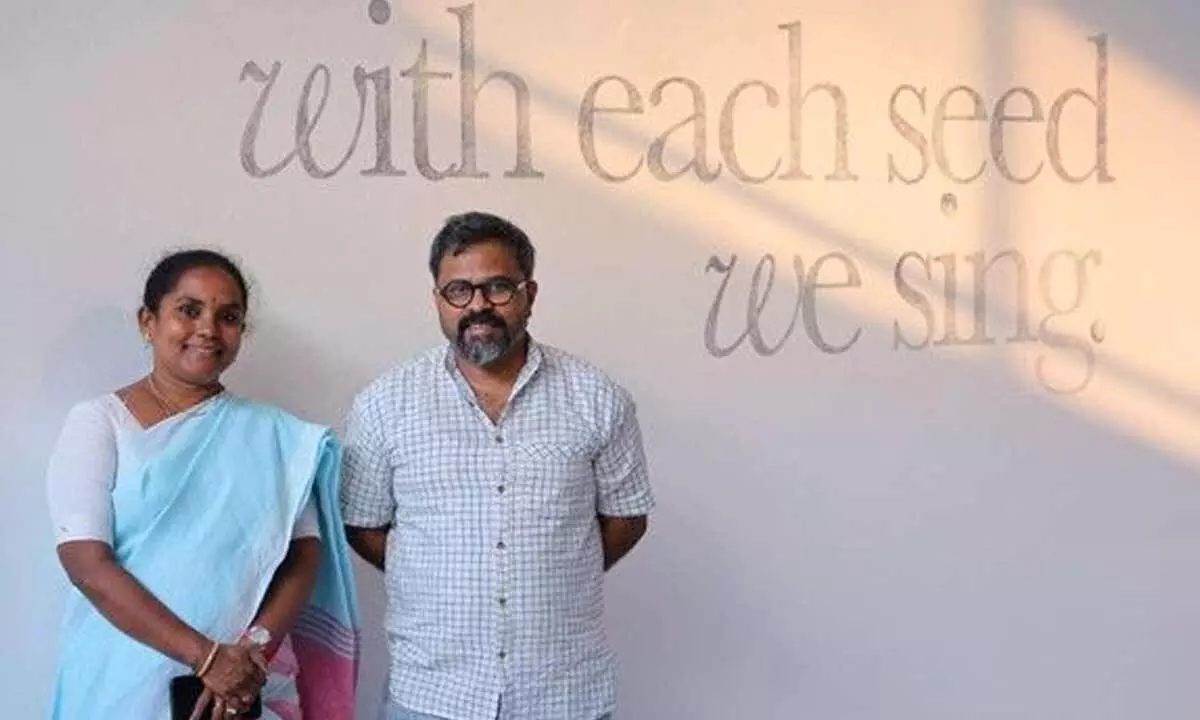
Two sustainability pioneers from Andhra Pradesh and Telangana are showcasing their transformative work in sustainable agriculture and textiles at Sustaina India 2025 in New Delhi. Their efforts highlight the power of tradition and innovation in addressing climate challenges
Two sustainability champions from Andhra Pradesh and Telangana are making waves at Sustaina India 2025, an innovative platform blending science and art to inspire climate action. Held at STIR Art Gallery, New Delhi, from February 2-16, alongside the India Art Fair, the exhibition ‘With Each Seed We Sing’ highlights the work of Saraswathi Malluvalasa, a millet farmer from Vizianagaram, and Poludas Nagendra Satish, a Hyderabad-based designer and cotton sustainability advocate. Their contributions showcase how these states are leading the charge in sustainable
agriculture and textiles.
Reviving Millets: The Arogya Millet Sisters’ Journey
Saraswathi Malluvalasa, Secretary of SABALA (Society for Awareness and Betterment of Agricultural Livelihoods in Andhra Pradesh) and founder of the Arogya Millet Sisters Network, has dedicated over 20 years to reviving millet cultivation and empowering women farmers. Once overlooked, millets are now being recognized for their nutritional and climate-resilient qualities. Under her leadership, SABALA has rejuvenated millet farming across 1,500 acres in 50 villages, advocating for its inclusion in public distribution systems. Her network includes 3,000 farmers, with significant representation from tribal and Dalit communities.
At Sustaina India 2025, Saraswathi’s installation brings the story of the Arogya Millet Sisters to life through homegrown millets, folk songs, and interactive elements.
“For years, millets were dismissed as outdated, and women were not seen as farmers. Today, we stand on a national platform, proving that these ancient grains are the future of sustainable agriculture,” she said.
Re-weaving the Cotton Ecosystem
Poludas Nagendra Satish, founder of Kora Design Collaborative in Hyderabad, is working to revive indigenous cotton and traditional hand-weaving techniques. A graduate of the National Institute of Design, Ahmedabad, his research shows that from over 1,000 organic cotton varieties in the 1980s, only 12 remain today. His work aims to restore ecological balance and strengthen farmer-artisan connections in the textile industry. His multipart installation at Sustaina India 2025 presents a compelling narrative on the loss of traditional cotton quality and efforts to restore it. “Industrialization and climate change have pushed our indigenous cotton varieties and handloom traditions towards obscurity. Through this exhibition, we are not just telling a story—we are reviving a legacy,” Satish explained.
Climate Recipes from Andhra Pradesh & Telangana
The exhibition also features ‘Climate Recipes II: Andhra Pradesh and Telangana Edition,’ a project focusing on natural farming, agroecology, and sustainable food systems. Led by researchers Srinivas Mangipudi, Srinivas Aditya Mopidevi, and Diya Shah, it documents intergenerational wisdom on sustainable food practices.
The participation of Saraswathi and Satish at Sustaina India 2025 is a proud moment for Andhra Pradesh and Telangana. Their work underscores the power of local knowledge and collective action in addressing climate challenges, ensuring a sustainable future for agriculture and crafts.