‘Ramayana’ under the lens of fundamentalist India

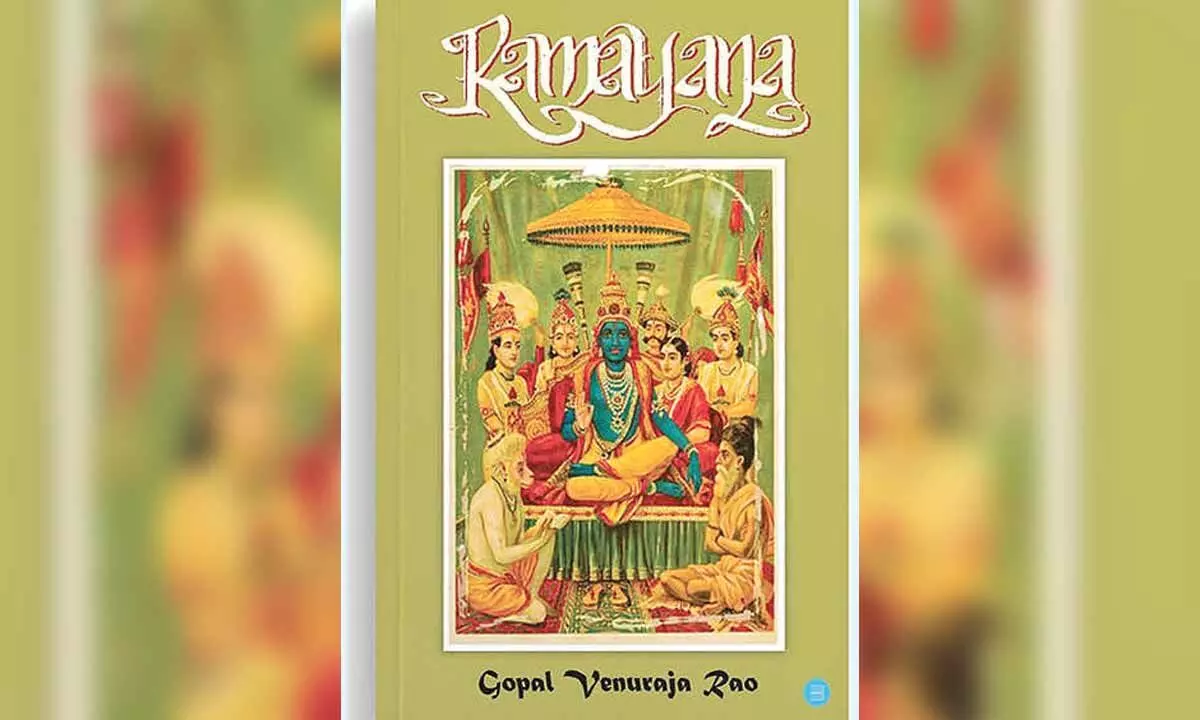
The book “Ramayana” authored by Gopal Venuraja Rao, a veteran journalist turned software programmer, emerges as a retelling that is both ambitious in its reinterpretation and relentless in its willingness to challenge the mythic, cultural, and religious boundaries that have grown around Valmiki’s original. The work is impressive for its narrative sweep and readiness to confront difficult questions about faith, historicity, and social values, but it will almost certainly ignite intense reactions among those who view the Ramayana as a sacrosanct foundation of Hindu religious identity.
Narrative Ambition and Literary Merits:
Gopal Venuraja Rao’s preface makes clear his intent: to re-tell the Ramayana in a novelistic format, re-examining episodes with both literary creativity and historical speculation. He anchors the epic as a palimpsest—drawing from not only Valmiki but subsequent additions, interpolations, local legends, and contrary interpretations developed through centuries of debate. The language, at times florid and at other times jarringly modern, is at once a strength and limitation. Vivid imagistic set-pieces, such as Sita’s abduction or the burning of Lanka, are re-imagined with detail and psychological depth. The dialogues are robust, especially when rendering iconic confrontations or the inner turmoil of central characters.
Challenges to Orthodoxy
Perhaps the defining feature of Gopal Venuraja Rao’s Ramayana, published by BlueRose Publishers, is its open challenge to traditional—particularly, fundamentalist—readings. The author goes so far as to state that “fanatical devotees” have long ignored those portions of Valmiki’s narrative that are “unpalatable truths,” and that later versions often “mutilate” the original out of a piety that cannot accept moral ambiguity. Such commentary is likely to be seized upon by conservatives as both disrespectful and provocative.
Sita is given a notably assertive and argumentative voice, frequently standing up to Rama, her mother-in-law, and even to Ravana. Gopal Venuraja Rao explicitly rejects portrayals of Sita as a passive or masochistic figure—recasting her as courageous, outspoken, and consistently willing to challenge the power structures around her. While this rendering will appeal to progressive audiences, it risks alienating those who valorize the image of the ideal, silent, suffering wife that later devotional traditions have promoted.
Ahalya’s story is likewise reworked, proposed as an allegory for tantric spiritual experience rather than a tale of sexual transgression and punishment. Such reinterpretation, while intellectually interesting, may be perceived as a secularist or rationalist intrusion on the domain of the sacred.
Depiction of Hinduism and Potential Provocations
The text tackles the cumulative accretions around the Ramayana with skepticism, highlighting the proliferation of versions and interpolations—including questioning the historicity of events such as the “Laxmana Rekha,” a trope popular in popular devotion but absent in the Valmiki text. This critical lens, though defensible for historians or literary critics, may be seen as undermining the sanctity of “eternal” Hindu values asserted by contemporary orthodox and fundamentalist groups in India.
Gopal Venuraja Rao’s attitude toward “fanatical” religiosity is uncompromising; he frequently marks the difference between reasoned belief and unreflective religiosity, sometimes in a tone that verges on polemic. His defense of rationalist hermeneutics places him at odds with current dominant narratives that emphasize devotional surrender over rational questioning.
Treatment of Controversial Themes
The author does not shy away from morally charged and divisive episodes—Rama’s assassination of Vali, and Sita’s trial by fire, for instance—foregrounding the questions of justice, gender, caste, and power that these raise. While later devotees have often glossed over or allegorized such events, Gopal Venuraja Rao insists on their confrontation, often supplying the characters themselves with modern sensibilities: Sita resists being abandoned or doubted, Vali excoriates Rama for violating dharma, and even minor figures like Shabari and Trijata receive psychologically complex treatments.
Remarkably, the narrative is not interested in simply desacralizing the epic; the supernatural, miracle-working, and mythic aspects are also preserved and, at times, even intensified. Gopal Venuraja Rao accepts the Ramayana as an epic of wonders, yet insists that these be approached with an awareness of myth-making, poetic exaggeration, and evolving social norms.
Sensitivity to Modern and Fundamentalist Sentiments
While Gopal Venuraja Rao repeatedly professes respect for the faith and devotion the Ramayana inspires, his mode is investigative rather than apologetic. When he calls upon readers to distinguish between “the Sage Valmiki’s literary invention and the unquestioning devotion of later centuries,” he appears to be making a veiled critique of contemporary religious-political movements that have adopted the Ramayana as their banner. These remarks will likely be read as provocative—if not offensive—by current Hindu right-wing groups who interpret any deviation from their prescribed narrative as a threat to communal identity and political power.
At the same time, there is a significant risk of overreading the “rationalist” and “critical” interventions as antagonistic, when in many instances, Gopal Venuraja Rao’s aim is to provoke reflection and re-ground the epic in a more plural and dialogic tradition. The narrative even gestures at the idea of “Rama Rajya” as an egalitarian, inclusive social ideal, at once questioning and affirming the epic’s place in shaping Indian modernity.
Verdict:
In sum, Gopal Venuraja Rao’s Ramayana is a formidable, provocative, and deeply literary achievement—one that will certainly polarize opinion in the current socio-political climate of India. Its willingness to challenge fundamentalist sentiment is matched by its commitment to literary quality and philosophical debate.
For orthodox or fundamentalist readers, the book may appear as sacrilege; for those who cherish critical reflection and literary boldness, it is a valuable and necessary re-engagement with a foundational text. Above all, it demonstrates that the Ramayana—like all great epics—remains a live battlefield for questions of tradition, authority, and the human quest for meaning.
(The reviewer is a former Senior Editor, The Economic Times, and now a practicing advocate, the Telangana High Court)