Presenting ‘the complete philosophy of life’

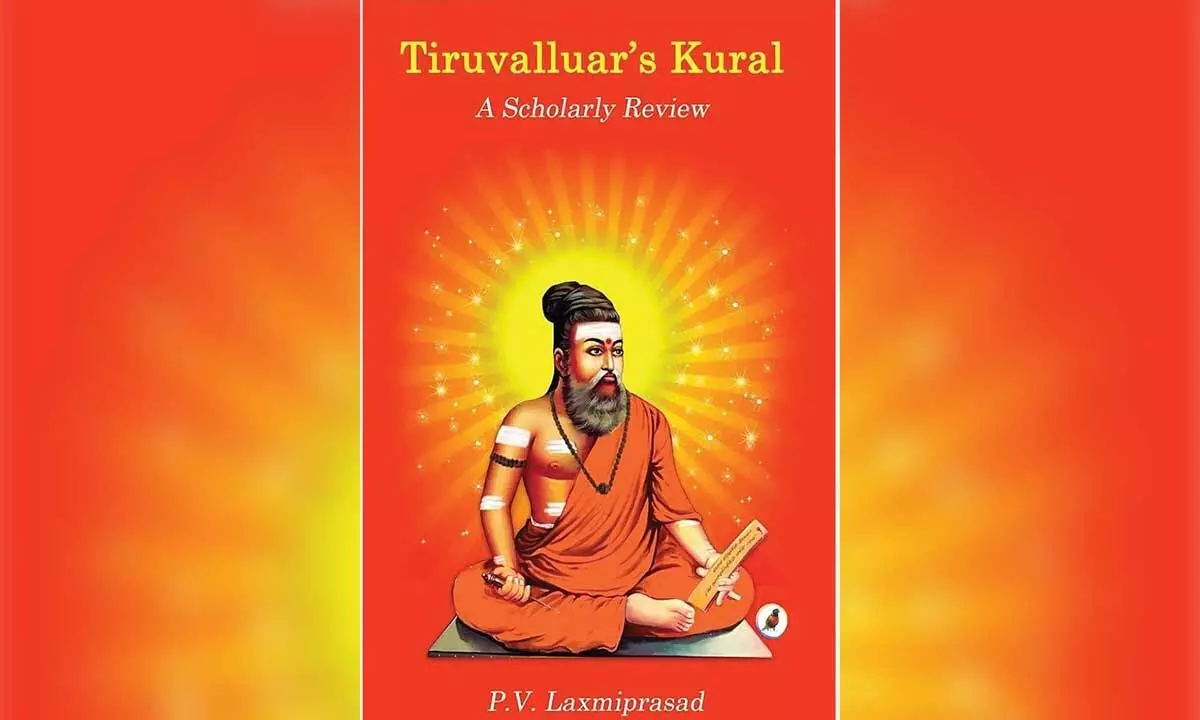
PV Laxmiprasad’s ‘Thiruvalluar’s Kurals’ offers a profound exploration of one of classical Tamil literature’s most revered ethical texts. The book presents the ‘Thirukkural’ as a complete philosophy of life, spanning virtue, worldly conduct, and love. With clarity and devotion, Laxmiprasad makes its timeless wisdom accessible to modern readers
PV Laxmiprasad’s work on ‘Thiruvalluar’s Kurals’ attempts an extensive exploration of one of the most revered ethical texts of classical Tamil literature. The book is simultaneously expository, interpretative, and devotional, yet it can be evaluated critically across several dimensions. The book traces Thiruvalluar’s life, the historical ambiguity of his origins, and the enduring universality of his couplets. Laxmiprasad captures how the ‘Thirukkural’ spans themes of Aram (Virtue), Porul (Worldly life), and Inbam (Love and pleasure), thereby presenting it as a complete philosophy of life. The Preface situates the author’s Tamil connections through family lineage and cultural exposure. This lends the book a unique personal voice while reflecting Tamil culture’s deep literary and musical heritage.
Laxmiprasad contextualizes the ‘Kural’ with references to earlier translations (C. Raja Gopalachari, K. R. Srinivasa Iyengar, and P. S. Sundaram, etc.), giving the work a scholarly foundation. Laxmiprasad offers detailed explanations of selected couplets, contextualizing them in everyday human conduct—virtue, family life, love, hospitality, justice, truth, and statecraft. His interpretative method demystifies the ‘Kurals’ for non-Tamil readers, highlighting their pragmatic and moral dimensions. The analysis weaves together references to philosophy, religion, politics, ethics, and literature. The comparisons with texts like the ‘Arthashastra’, the ‘Bhagavad Gita’, and even Schweitzer’s ethical reflections broaden the interpretive horizon.
The book repeatedly emphasizes the ‘Thirukkural’s’ non-sectarian ethos—its relevance for rulers and commoners, men and women, irrespective of caste, creed, or faith. This global framing enhances its scholarly worth. Laxmiprasad evaluates themes such as non-violence, vegetarianism, justice, love, family values, governance, and social ethics, highlighting their timeless relevance. The book includes interpretations of many individual ‘Kurals’ (couplets) with explanations in modern context—covering God, rain, virtue, love, domestic life, social justice, hospitality, self-control, truth, charity, and detachment. Each couplet is explained with moral clarity and practical examples, making it accessible for students, general readers, and researchers alike.
Laxmiprasad treats the ‘Kural’ as a guide for personal ethics, social harmony, and political order. He stresses its universal applicability, moving beyond Tamil culture into global ethics—arguing that ‘Thirukkural’s’ ideals resonate with contemporary human rights, democracy, gender roles, and environmental ethics.
Overall, Laxmiprasad’s ‘Thiruvalluar’s Kurals’ is a sincere and passionate contribution to the dissemination of Tamil wisdom literature. It is less a philosophical or critical-historical study and more a moral-literary appreciation aimed at making the ‘Kural’s’ wisdom accessible to wider audiences. Its strength lies in interpretation and universality, though its lack of rigorous critical distance places it closer to cultural commentary than strict academic analysis. Laxmiprasad succeeds in presenting the ‘Kurals’ as living wisdom for modern humanity. The introduction, analysis, and conclusion are absolutely perfect in the book.