How ancient India transformed the world

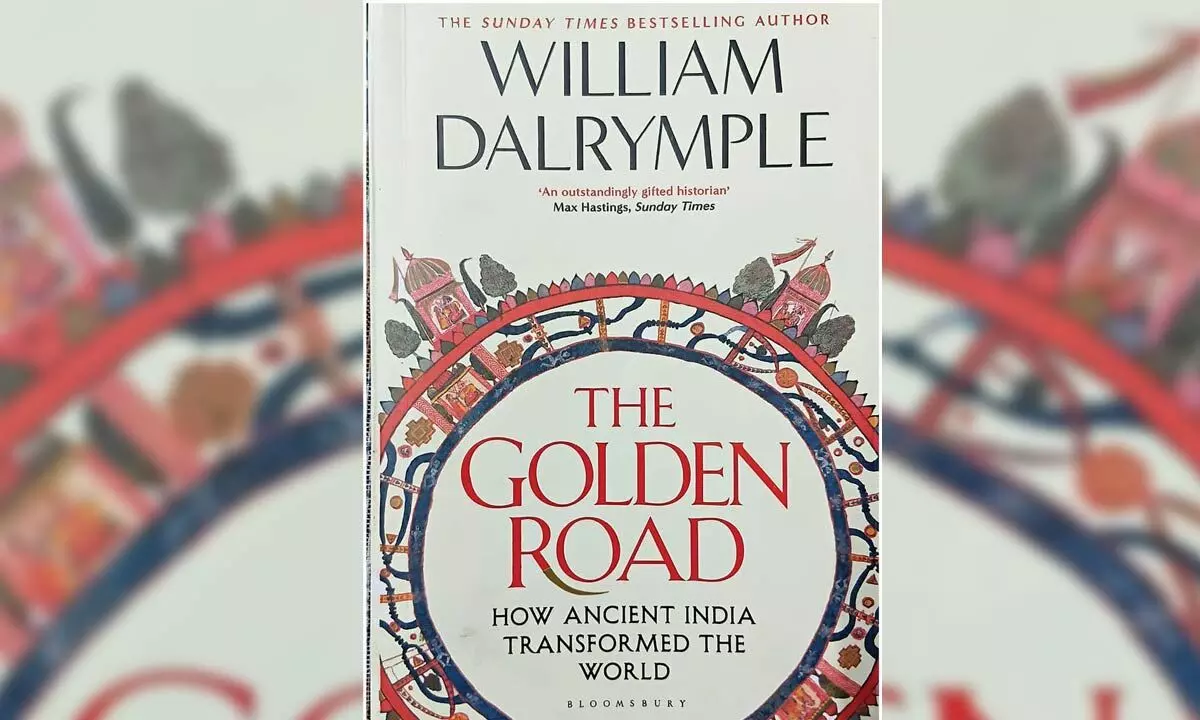
“Those who do not learn lessons from history are condemned to repeat the same.” In today’s battle of narratives, it is imperative to know actual history rather than history twisted according to one’s ideology. Historian William Dalrymple uncovered ancient Indian history in his book “The Golden Road,” written in 2024. He substantiated that “for a millennium from about 250 BCE to 1200 CE, India was a confident exporter of its own diverse civilisation, creating around it an empire of ideas which developed into a tangible ‘Indosphere’ where its cultural influence was predominant. During this period, the rest of Asia was the willing and even eager recipient of a startlingly comprehensive mass transfer of Indian soft power, in religion, art, music, dance, textiles, technology, astronomy, mathematics, medicine, mythology, language, and literature. Sanskrit had been a profoundly sacred tongue for at least a millennium before the Common Era.” Archaeologist and epigrapher Sylvain Levi called India the mother of wisdom, and the mother of law and philosophy.
Dalrymple reveals the contributions of ancient Indian mathematicians, astronomers, and scientists like Aryabhata, Varahamihira, Brahmagupta, Bhaskara, Charaka, and Sushruta to the world. He also well-documented the vast knowledge centers in science and philosophy of the ancient world, such as the great Indian observatory at Ujjain, Takshashila, Nalanda, and Vikrama Shila. The celebrated Gautama Siddhartha was the supervisor of the Bureau of Astronomy in 665 CE during the Tang dynasty in China. Bodhiruci, a Buddhist monk from South India, translated 120 Sanskrit and Prakrit scrolls into Chinese in Empress Wu’s court.
In the eighth century, the Sanskrit Buddhist monks of Afghanistan were converted to Islam. They became Vaziers of Abbasid Baghdad, also translated Indian mathematical inventions such as zero, the modern number symbols, the decimal system, algebra, trigonometry, algorithm, value of the Pai, and astronomy, which include the planetary rotation, calculation of eclipse, and introduced to the West. The Persian mathematician Muhammad Khawarizmi (780 CE) rightly said that “the first nation to have cultivated science is India.”
Dalrymple discloses peculiar features of religion in the countries of South-east Asia in the medieval period, where Buddhism and Hinduism were freely mixed, and the Buddha and Hindu gods accommodated each other. Hinduism did not impose its caste system on these countries, and upper-caste people were not averse to foreign traveling, contrary to the dictates of Manu Smriti. Buddhism was thousands of years later than Hinduism, as it opposed the Vedas, which mandated fire sacrifices and a caste system. On the issue of the decline of Buddhism in India, he divulges that “the cases of violent suppression of Buddhism are rare...My view is thatthere was almost always competition between the two faiths, and that in the end, over most of India, Hinduism won.”
Dalrymple gives ample evidence about the concept of India as a nation in ancient times, and unequivocally states that “for all its political augmentation, the idea of India as a single cultural, sacral and geographical unit was still clearly understood from the very earliest times.” He reveals the cultural and geographical identity of India as a nation, drawing on various Puranas and the Mahabharata. British colonial rulers did not want Indians to be aware of their national identity as Indians to nip the struggle for independence in the bud.
Dalrymple discusses the concept of the “Silk Road,” the overland trade route from China to Turkey, and points out bluntly that the idea of a Silk Road was completely unknown in ancient or medieval times and not a single ancient record, either Chinese or Western, refers to its existence.
He concludes that the Indic religions have dominated Asia’s religious, theological, philosophical, cultural, economic, and political discourse for almost 2,000 years. He also explains the reasons for neglect of ancient Indian history despite Indic cultural, economic, and philosophical influence from ancient times to the twelfth century CE in Afghanistan, Burma, Sri Lanka, Java, Sumatra, Malaysia, Vietnam, Cambodia, Malaya, Korea, Japan, China, and Middle Eastern countries. He observed that the Marxist orientation of many Indian historians until recently led to a lack of interest in matters of religion and art, which meant there was little or no pushback from Indian academia. He also explains biased history about underplaying the violence and iconoclasm that came with the Turkish invasions, that “during the days of Nehruvian rule in the 1950s and early 1960s, Indian textbooks and most academic histories were written by left-leaning figures.” He equally criticises the right-wing ideologues for the glorification of everything in the past. History shows that India has always been at its most creative and influential when it is at its most connected, plural, hybrid, open, and receptive to new ideas, and he hopes it will remain so.