
Enlightenment over exploitation: Civilisational realignment

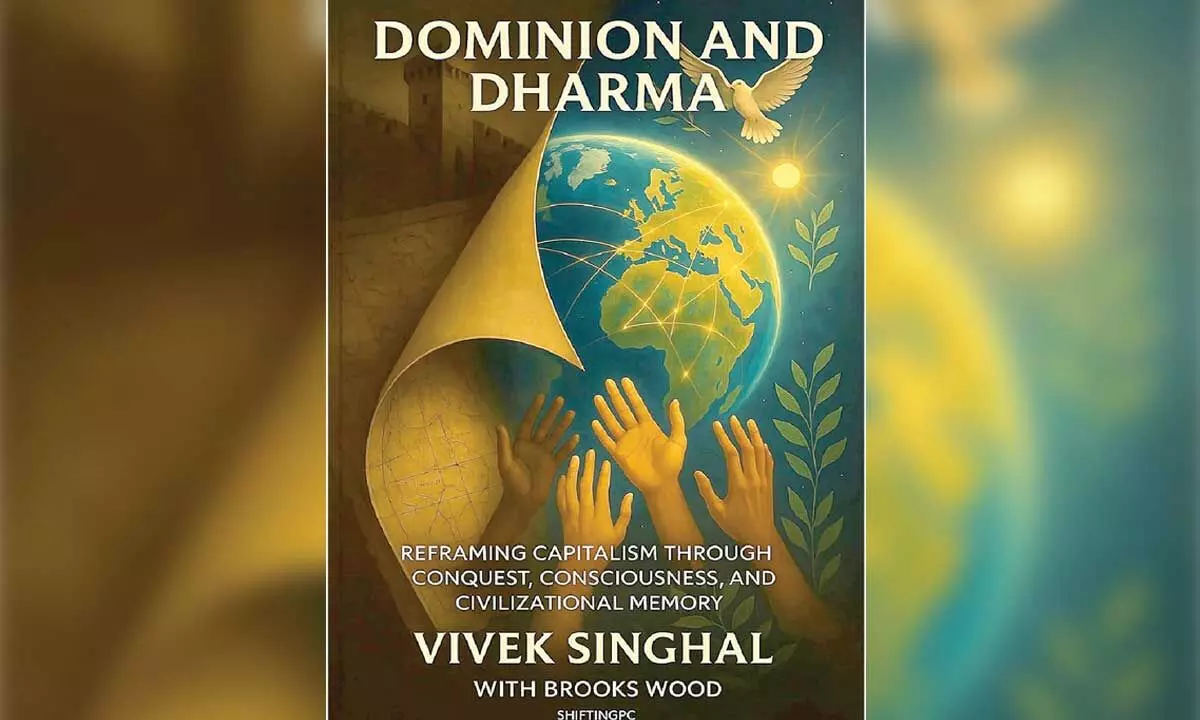
In an era of rapid technological growth and material pursuit, Vivek Singhal’s ‘Dominion and Dharma’ explores the decline of civilisational values and humanity’s estrangement from its spiritual essence. The book examines the historical and philosophical roots of exploitation, contrasting them with the ethical framework of Dharma. Through this lens, Singhal urges a realignment of society with principles that promote harmony, responsibility, and reverence for nature.
Emerging from civilisational anguish, the book argues that global capitalism, driven by domination, has become a mechanism of conquest. Singhal traces its theological foundations to the Abrahamic tradition, where empires and subjugation were justified as divine missions, and demonstrates how these forces manifested in colonialism, slavery, and modern corporations. In contrast, the Dharmic worldview prioritizes communal living, ecological respect, and ethical responsibility. By examining pre-capitalist societies in India, China, Africa, and indigenous America, the author highlights how land and resources were considered sacred, creating a stark counterpoint to Europe’s commodification and privatization of life.
Singhal identifies two primary worldviews—dominion and dharma—arguing that the former dominates modern society through exploitative capitalism, algorithmic governance, and Artificial Intelligence, which threaten individual autonomy and inner consciousness. Conversely, Dharma integrates ethical living with material activity, advocating for a civilization rooted in awareness and moral responsibility. The book also emphasizes Mahatma Gandhi as a model of civilisational critique, demonstrating how nonviolence, ethical economics, and decentralized governance offer a sustainable alternative to industrial capitalism.
Central to the book is a call for a new economic paradigm based on “sacred wealth,” where material prosperity aligns with ethical duty. Singhal urges moving beyond GDP-centric progress metrics to those reflecting well-being, ecological balance, and ethical prosperity. By fostering conscious living, cultivating presence, and engaging in deep work, humanity can shift from exploitation to enlightenment.
‘Dominion and Dharma’ challenges readers to reconsider assumptions about modern society, linking historical critique with contemporary relevance. Its exploration of spirituality, history, and technology provides a roadmap for realigning human civilization with ethical and ecological imperatives. The book lingers in the mind long after the final page, encouraging reflection, action, and a vision for a more harmonious future.


