A Legend in Devotional Music

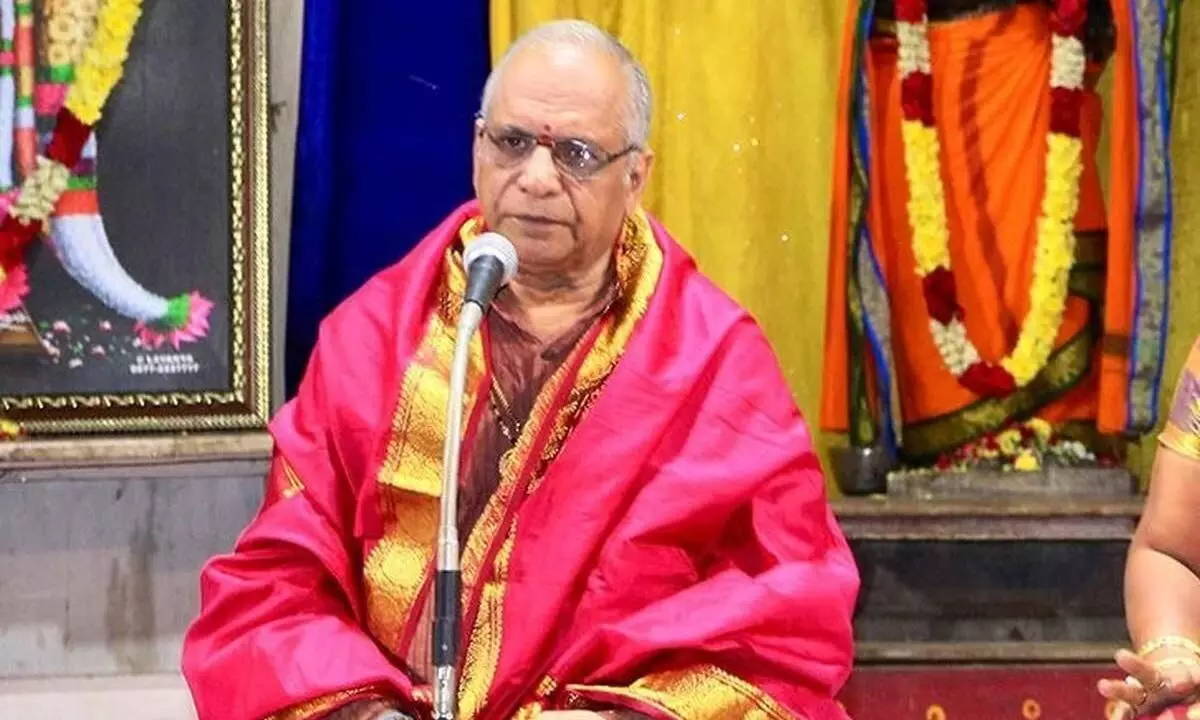
The passing away of the noted singer Balakrishna Prasad a few days ago marks the end of a chapter in devotional music, particularly in the Annamayya lore.
The passing away of the noted singer Balakrishna Prasad a few days ago marks the end of a chapter in devotional music, particularly in the Annamayya lore. Sri Prasad is seen as the present-day alter ego of the legendary composer and singer Annamayya who lived about six hundred years ago.
Music is an offering to God in the Indian tradition. Even now, toward the end of the formal puja, which is performed with Vedic mantras, the worshipper mechanically says, ‘now I am offering dance, music and recitation of puranas’. But earlier, women used to sing songs and girls used to dance to certain lyrics which were composed for dance. It was wholesome, hearty and lovely hospitality to the lord who had been invited into the idol by the worshipper. Such beauty is now very rarely seen as we have moved into modernity and governments commercialised worship in temples.
About twelve thousand songs of Annamayya were discovered about a hundred years ago in the Tirumala temple by scholars but no one knew how exactly he sung them. There were no notations, and it was left to the individual maturity and tapas of singers to delve into the heart of the old poet and visualise the rasa, the emotion embedded in the song. It was to the lot of Balakrishna Prasad to compose swara for such songs. He could compose swara for over a thousand songs and in a way resurrect Annamayya. The copper plates on which the lyrics were etched did also give a picture of the real Annamayya who almost lived a penurious life, devoted to Lord Venkateswara.
Music was as natural as breathing for several generations in Balakrishna Prasad’s family. It was also blessed with penury, which is the compatible environment for devotional pursuits. Coming from such a penurious but culturally rich background, he did not have difficulty in seeing the heart of Annamayya. Several emotions mingle in the lyrics – devotion, shringara (romantic love of the Lord and his consort), passion, longing for the deity, and so on. In addition, many of them are deeply philosophical. Annamayya wrote his songs as a lay person, for the layperson, in the lay man’s language of his day. It is a general feature of Indian knowledge tradition that the philosophy of scriptures seeped easily into the common folklore and lyrics.
They instilled values such as seeing divinity in all beings, (songs such as ‘Brahmam-okate’), advocating love for all beings, simplicity in devotion, equality of all beings in the eyes of the Lord, surrender to the divine and such. Most of the songs are on Lord Venkateswara, who is treated as a form of Vishnu. This gave the advantage of conflating all the glories of Vishnu, described in several puranas. These glories are in the common memory of several people.
Music is an upasana, which means holding the mind in a continuous stream of devotional thoughts, undisturbed by dissimilar thoughts. This is an important step in spiritual sadhana by all other seekers. But the same is done by those who dedicate their lives to devotional music. Saint Thyagaraja called it nadopasana. Such a devotee is simultaneously in two levels – the level of bhakti and the level of knowledge. These songs are also instruments for self-purification. When Annamayya says ‘nanati batuku natakamu’ (life is but a play enacted on a stage), the contemplation is meant for detaching the mind from material pursuits. Similarly, many songs of Annamayya are ideally suited for such upasana. The proof of the pudding is that even the lay persons are now familiar with several songs of Annamayya sung by Balakrishna Prasad. Prasad had a deep, faintly nasalised but youthful voice which was ideally suited for the emotion called aarti, deep longing for the deity.
There are also songs of the above poet exclusively for Lord Rama, or Hanuman and other deities who are forms of Vishnu. Such songs are heard daily in those temples and thousands of people listen to them.
The seven hills of Lord Venkateswara reverberate with the songs of Annamayya and it looks as though the poet and the singer elevated themselves to the hall of saintly fame, besides spreading devotion and culturally enriching the society.
(The writer is a former
DGP, Andhra Pradesh)