A Critique of Hindu Dharma

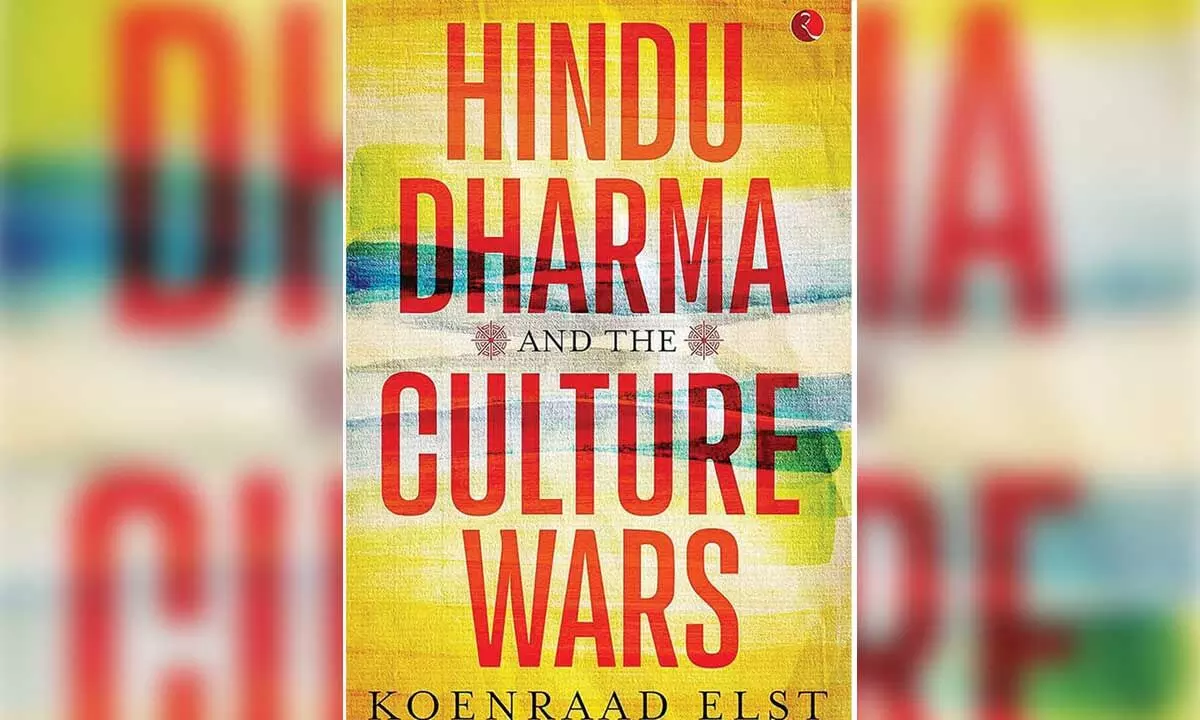
Bordering over the different dimensions of religiosity and faith, ‘Hindu Dharma And The Cultural Wars’ is a praiseworthy attempt by Koenraad Elst. The author meticulously explores the notion of Hindu Dharma and its antagonist forces, which are always on the prowl to play the shoddy politics of polarization and tarnish the image of Hindu Dharma. These destructive forces are not only foreign agencies but also emerge from within Hindu Dharma itself.
The book, which is a collection of twenty-five essays, contemplates various facets of religion in general and Hinduism in particular. The writer challenges the old, fossilized myth—even endorsed by Mahatma Gandhi—that “The Muslim is a bully, the Hindu a coward.” History bears testimony that Hindus have been gallant warriors and cannot be accused of lacking spunk or valor. Doubtlessly, Hindus have suffered immensely and endured many inhumane atrocities, but their suffering cannot be associated with any timidity on their part.
From its very origin, Hindu Dharma has preached and practiced the gospel of peace and bonhomie. Unlike other predominant religions, fundamentalism and extremism have never been governing principles of Hinduism. The beauty of Hinduism lies in the idea of “live and let live.” To buttress his standpoint that Hindus are not cowards, the author references the freedom of Bangladesh and the victory at Kargil.
Hinduism has given some of the greatest gifts to the world, and Yoga is one of them. Though commercialization has turned Yoga into a billion-dollar industry, and many other communities now attempt to claim monopoly over its practice, the truth remains that Yoga is intrinsically Hindu, with its foundational roots firmly embedded in Hinduism—a fact corroborated by abundant historical evidence.
Undeniably, Eastern and Western cultures are two distinct phenomena, each with its own beauty and grace. Here, the author quotes Rudyard Kipling: “East is East and West is West, and never the twain shall meet.”
It would be unfair to label the author as an apologist of Hinduism and its culture. He presents a dispassionate, ringside view. In his analysis of Indian secularism, he questions the validity of the secular Indian state. He opines that if secularism means the separation of government from religious institutions, then the Constitution should not exert influence in defining the religious laws of the state. The idea of a Civil Uniform Code is also critiqued thoughtfully.
Furthermore, the author undertakes a comparative study of monotheism and pluralism, offering many novel perspectives. This work is replete with profound insights on several contentious issues that must be carefully comprehended by all. He stresses the urgent need for amicable discussions to resolve the religious conflicts prevalent in the modern world. Indubitably, it is high time for the Hindu community to recognize its shortcomings and refurbish the roots of their religion.