Vance’s visit raises hopes of improved US-India relations

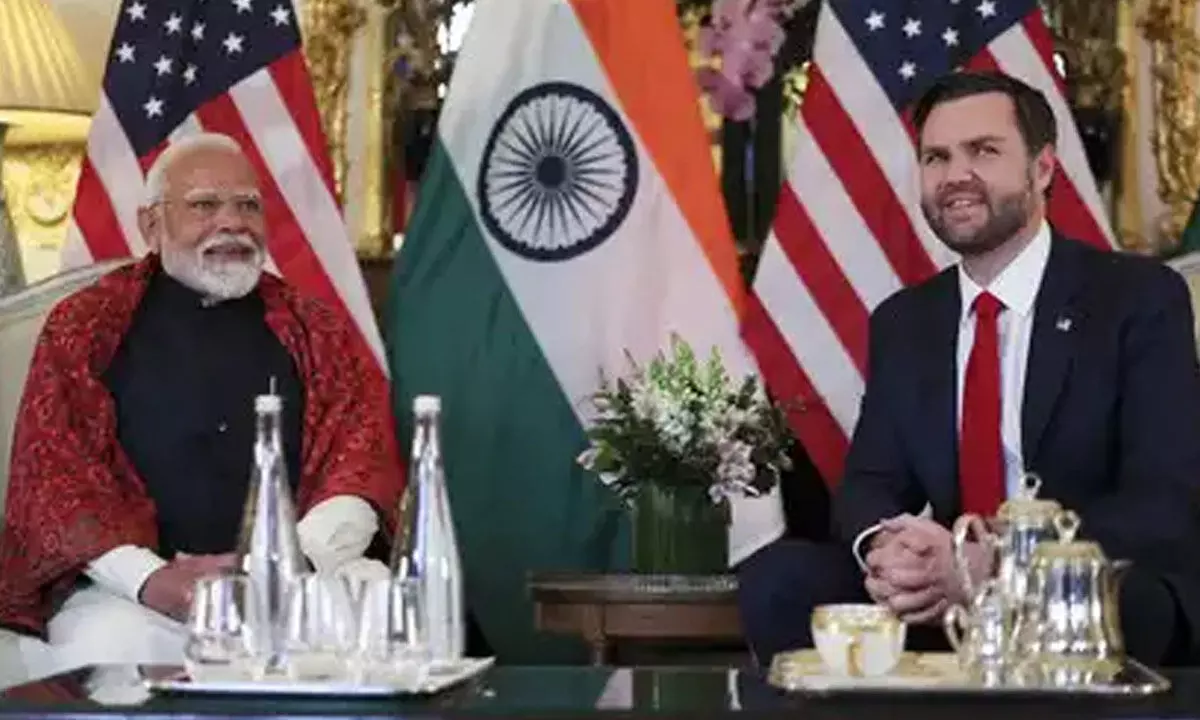
If mixing business with pleasure is considered in its totality, then JD Vance’s four-day visit to India, the first by a US Vice-president to the country in 12 years, was an overwhelming success, the challenges notwithstanding, for both countries.
If mixing business with pleasure is considered in its totality, then JD Vance’s four-day visit to India, the first by a US Vice-president to the country in 12 years, was an overwhelming success, the challenges notwithstanding, for both countries. Unfortunately, the visit was marred by a brutal terror attack in Pahalgam that killed 30 tourists, including three foreigners, on Tuesday, and left the world in shock. Described as a “private” visit, Vance, who came along with his wife and three children, did not miss the opportunity to take forward bilateral relations and later reassured Washington’s solidarity with New Delhi in its battle against terrorists from across the border. The brutal attack was a telling blow and was perhaps timed to Vance’s visit to send across a message that India was vulnerable, despite the enhanced nationwide security in place for the US Vice-president’s stay in the country.
As regards administrative developments, although his visit came when the world was caught off-guard after President Donald Trump delivered the tariff thunderbolt, and fears rose about its cascading effect on the global economy, Vance did his best to put to rest some of the worries that India was expressing, especially with regard to the retaliatory tariff threat. The apprehensions about the Trump administration’s trade policy saw a relief when the US President announced a 90-day pause on imposing the tariff, except for China. Though Vance confirmed finalisation of the Bilateral Trade Agreement (BTA), there was not much that he indicated as regards the tough measures being taken against immigrants and the manner visas of foreigners were revoked, including of many Indian students. Although, there were deep deliberations and a mutually agreeable bid to broaden defence and technology collaborations, and joint ventures in chip fabrication, Vance sought that India put an end to its ‘non-tariff barriers’, quite apparently because, although he did not express it as such, this stance, if adopted by New Delhi, will put skids on US getting access to the Indian market. One has to see which way India decides given that taking measures that please Washington as far as agricultural produce go will be detrimental to the interests of Indian farmers and those into dairy products.
As things stand, the Modi government cannot afford to take any foolhardy step that hits the farming community. There are myriad reasons. The backlash, in political parlance, would be too overwhelming, so to say. Meanwhile, many aspects have been kept in a limbo during the Vance tour or at least there have been no efforts to fast-track authoritative agreements. This is especially so with regard to defence technology transfers, evolving a uniform e-commerce framework and, of course, agricultural tariffs, which the US insists India should cut, something that New Delhi cannot dare to do as it would be inviting the wrath of the farming community. Such a retrograde measure would be suicidal and a sure shot recipe for disaster as the opposition would gleefully pounce on it with a ‘sell-out’ and ‘anti-farmers’ diatribe. Reflecting on Vance’s tour and his engagements with Indian authorities, including a meeting with Prime Minister Narendra Modi, one can summarise that although it has been unsaid both nations have demonstrated that they need one another in the current disruption-ridden geopolitical vortex. The common grounds are in bringing about economic stability and warding off the threat of China, whose anti-US and anti-India mindset is quite distinct.