RDI fund is a very good idea whose time came long back

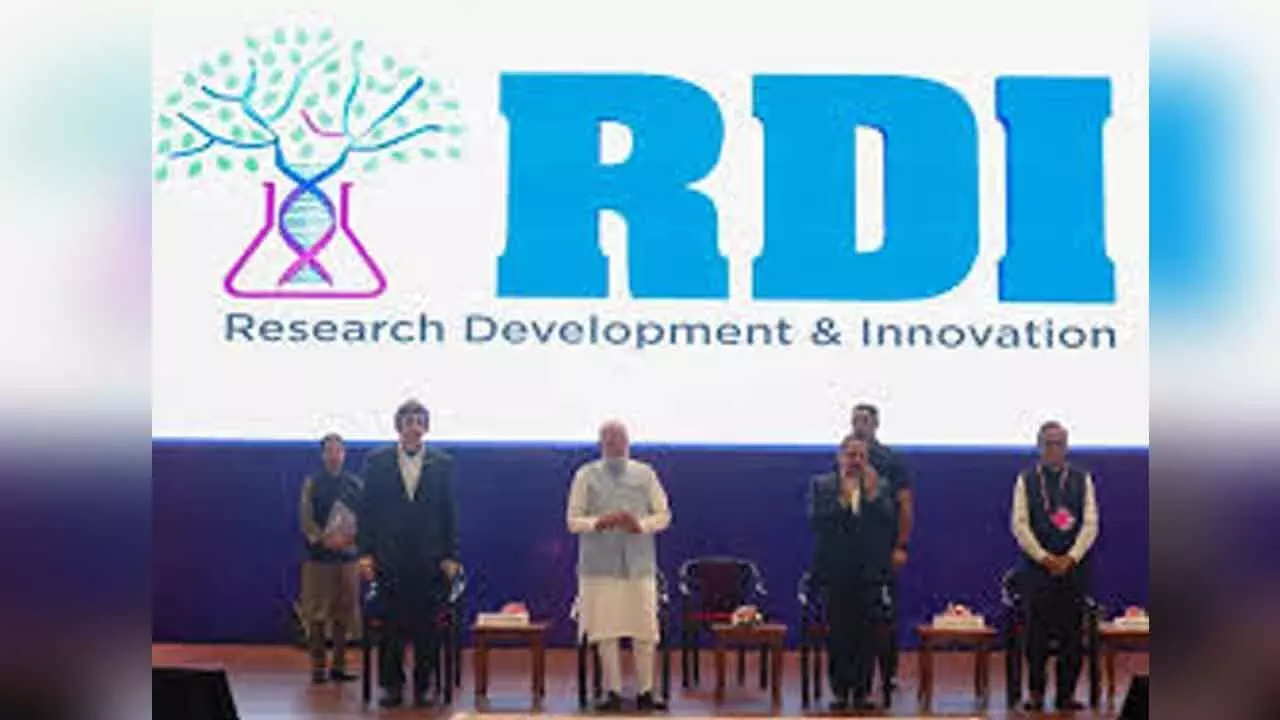
Prime Minister Narendra Modi’s announcement of the Rs 1 lakh crore Research, Development and Innovation (RDI) Fund will go a long way in boosting not just R&D in industry but also encourage private sector participation in incorporating technological innovation in businesses.
At a time when competition and other challenges in global trade are increasing, our companies can ill afford to lag behind their competitors. But that seems to be already happening. India spends very little on R&D. In reply to a question in Parliament in August, the government admitted to low gross expenditure on R&D (GERD) as a percentage of GDP; it has remained between 0.6 per cent to 0.7 per cent, which is below the global average and “lower than countries like China, South Korea, and US.
Another factor contributing to this is the relatively low investment by India’s private sector in GERD, accounting for only around 36 per cent, whereas in the aforementioned countries, private sector contributions is more than 70 per cent.” The government, while accepting low expenditure on R&D, often tends to gloss over the serious shortcomings. In his speech, for instance, PM Modi said, “In the last decade, our R&D expenditure has doubled, the number of patents registered in India has increased 17 times... Even in start-ups, India has now become the third largest startup ecosystem in the world. “ Today, more than 6,000 of our deep-tech startups are working in areas like clean energy, advanced materials. India’s semiconductor sector has also taken off now. Talking about bio-economy, it was worth $10 billion in 2014; today it has reached around $140 billion.” He also talked about India’s “promising presence” in green hydrogen, quantum computing, deep-sea research, and critical minerals.
According to World Bank data, India’s R&D expenditure in 2020 was 0.65 per cent of its GDP, whereas the figures in the same year for China, South Korea and the US were 2.56 per cent, 5.21 per cent, and 3.59 per cent. Imagine the US, with its seven times more GDP than India’s, still spending more than five times in percentage terms than India!
The US doesn’t want any letup in its supremacy in science: it has the strongest science and technological base in the world; over 70 per cent of Nobel science prize winners are Americans; and yet its focus on R&D stays undiminished. No slackening in efforts, no complacency. And we, in India, focus so little on R&D.
Against this backdrop, the RDI fund is a valuable state intervention. The Department of Science & Technology will manage the fund through a two-tier structure. At the apex level, there will be a special purpose fund under which the Anusandhan National Research Foundation (ANRF) will hold and manage the Rs 1 lakh crore corpus.
At the second level will be fund managers, including alternative investment funds, development finance institutions, and non-banking finance companies. Independent investment committees will guide the fund managers to identify and recommend projects for support.
The government’s intention is very good, and the structure for utilizing the RDI fund also seems satisfactory. “India is working to build a modern innovation ecosystem and is focusing on improving the ease of doing research,” the Prime Minister said. The success of the scheme, therefore, will now depend on the granular details of the structure and its implementation.