Murshidabad violence exposes opposition’s credibility crisis

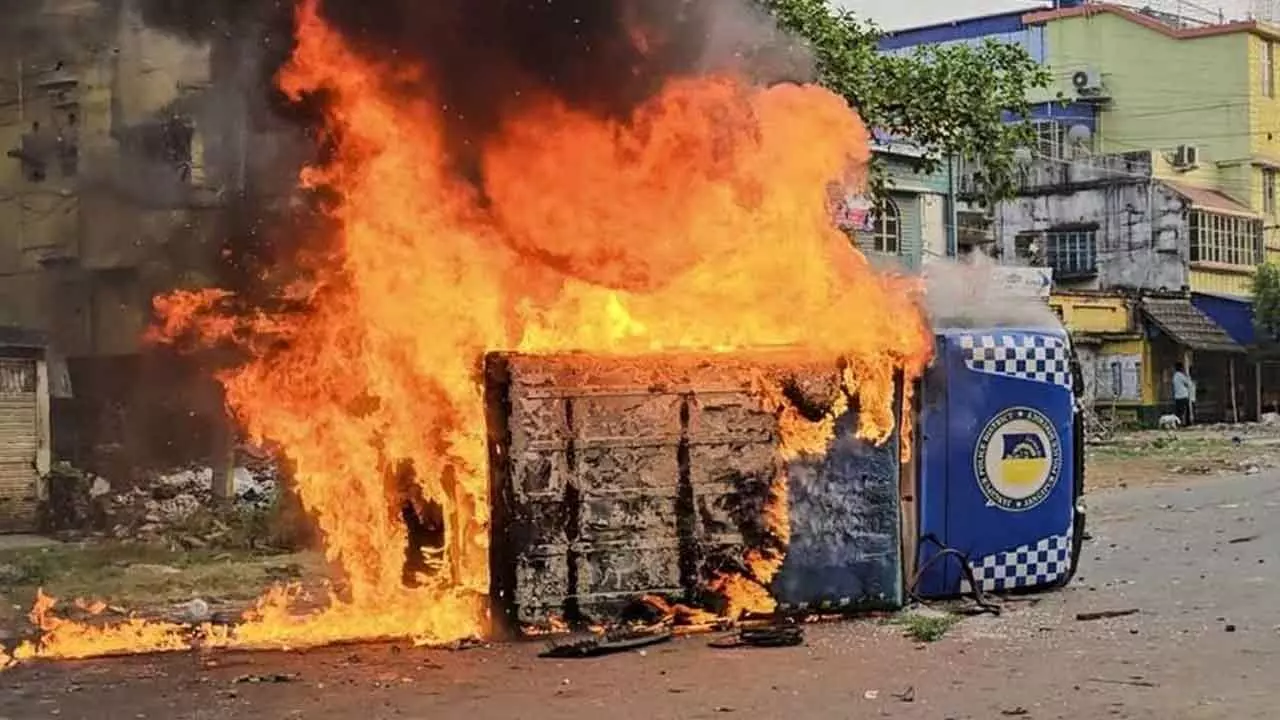
The recent violence in Murshidabad has laid bare an unsavory truth about the conduct of opposition parties in India. It is disheartening to see how these parties continue to falter in condemning what is patently wrong—regardless of whether the perpetrator is the ruling party or one of their own. At a time when collective moral clarity is most needed, the opposition appears fragmented, evasive, and politically expedient.
The events in Murshidabad illustrate this disturbing trend. The opposition neither acknowledges good governance when it occurs nor unequivocally denounces failures—especially when those failures come from within their fold. Instead, they remain shackled to a narrow, electoral calculus. It was astonishing to witness the top leadership of so-called national parties like the Congress maintain an awkward silence. Their supporters and media sympathizers, rather than question the Mamata Banerjee-led West Bengal government’s inability to control the violence, chose instead to deflect attention by invoking unrelated incidents in Uttar Pradesh or Haryana—alleging communal targeting of Muslims.
This selective outrage raises uncomfortable questions. Are these parties truly national in outlook? Is Mamata Banerjee the Chief Minister for all citizens of West Bengal, or only for a particular community? Where is the empathy for the Hindus who fled Murshidabad in fear, seeking refuge in neighboring Malda—displaced and endangered in their own homeland? Can Murshidabad be so unmanageable that the state police cannot contain the unrest? Or does this suggest that the violence was politically orchestrated—perhaps even as a diversion from the growing storm over the teachers’ recruitment scam?
Historically, communal violence in Bengal has not stemmed from organic rifts between communities. It is often incited and amplified by political machinations. Mamata Banerjee, like the erstwhile CPI(M) regime led by Jyoti Basu, may be falling into the trap of believing in political invincibility. But the people of Bengal cannot be taken for granted indefinitely. Her theatrics and populism might not continue to yield dividends. If anything, the fallout from violence may resurface during the next electoral cycle, posing a real threat to her legitimacy.
There is a deeper political cost to this crisis. Mamata’s reluctance to take responsibility, and her refusal to stem the violence, could undermine not only her standing as a regional power but also her credibility as a national leader capable of uniting a fragmented opposition against Narendra Modi’s BJP. With the 2026 elections on the horizon, the stakes could not be higher.
If she fails to restore law and order, and if her national allies remain silent for the sake of coalition politics or vote bank politics, the INDIA alliance risks alienating a public already fatigued by cycles of violence and political deflection. The rhetoric may no longer be enough. The electorate demands accountability, not excuses.
What is unfolding in West Bengal is no longer just a state issue—it has become a litmus test for the INDIA bloc’s moral coherence. When opposition parties decry the BJP’s authoritarian tendencies and democratic erosion, they must also be willing to introspect. If Mamata Banerjee demands accountability from the Centre for riots, arrests, and institutional decay, she cannot turn a blind eye to similar accusations under her own watch.
The state judiciary has already stepped in, compelled to restore a semblance of order where the government failed. The High Court’s criticism of the state’s inability to safeguard its citizens has stripped Mamata of the protective shield of victimhood she has often wielded.
In that sense, this crisis does not merely stain Bengal—it undermines the very foundation of the opposition’s national narrative. Unless the INDIA alliance addresses this with honesty and urgency, it may not only lose the moral high ground—it may lose the people’s trust altogether.