Govt’s rollback decision on Aravallis is a good move

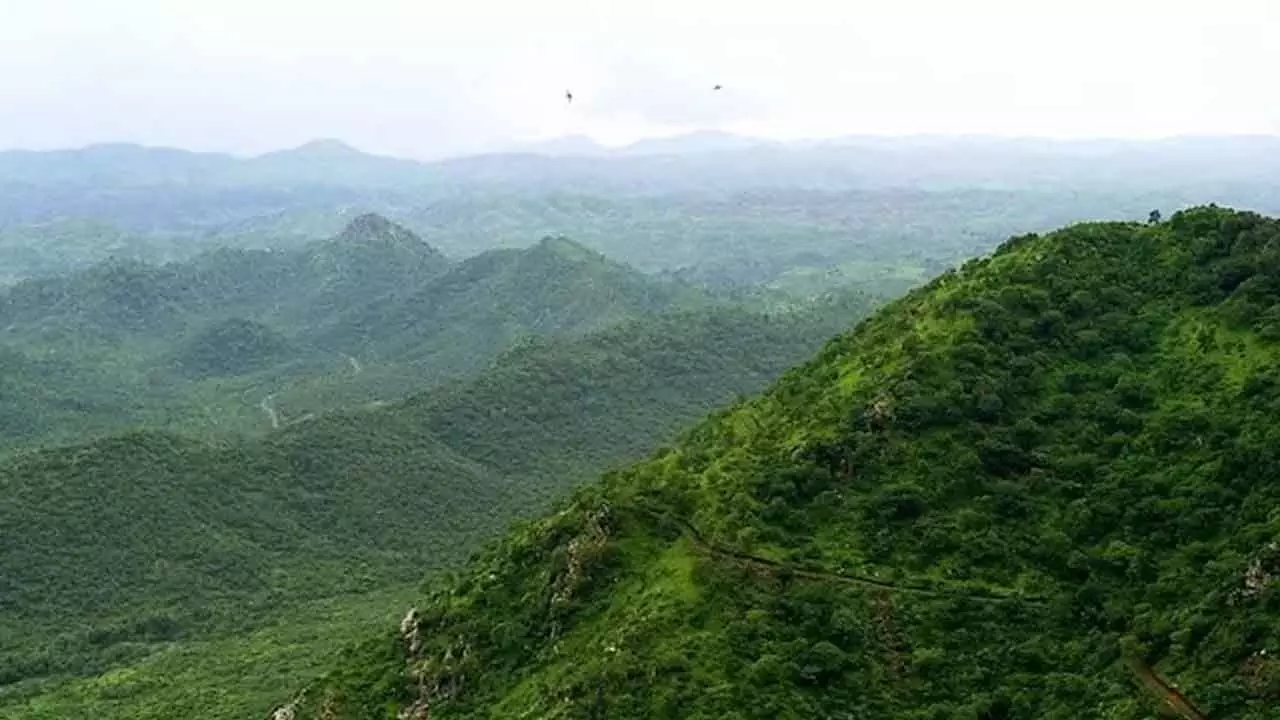
The Union Government has done well by practically rejecting the new definition of the Aravalli range. As per the new definition, which was unfortunately also accepted by the Supreme Court following the recommendations made by the Centre, an Aravalli hill is a landform that is at least 100 metres above the surrounding terrain. If there are two or more such hills within 500 metres of each other, the land between them will also be considered an Aravalli range. At the heart of the controversy was the insistence of the Union government to adopt the new definition and claiming that it would strengthen regulation and bring uniformity without diluting protections.
Environment Minister Bhupender Yadav asserted earlier that just around two per cent of the 147,000 sq km Aravalli range has the potential for mining. Environmentalists, on the other hand, believe that the new definition will make the countless lower, scrub-covered but ecologically critical hills vulnerable to mining and construction, the two activities which have already caused great damage to the range. In the meanwhile, the new facts that emerged didn’t support the government’s claims.
According to a news report, the Supreme Court’s Central Empowered Committee (CEC) said that the definition formulated by the Forest Survey of India (FSI) should be “adopted in order to ensure the protection and conservation of the ecology of the Aravalli Hills and its range.” The FSI had mapped 40,481 sq km as Aravallis in 15 districts of Rajasthan as areas above the minimum elevation with a slope of at least 3 degrees, the report said. “By this definition, even the lower hills would be protected as Aravallis.
The FSI undertook the exercise after it was engaged by the CEC under a Supreme Court order in 2010.” Thankfully, the Supreme Court decided to revisit its order on the definition. That’s a wise decision, as now it is not just conservationists who were up in arms against the government over the issue; even several opposition parties, including the Congress and Samajwadi Party, have decided to resist the new definition. By distancing itself from the government decision, the top court can shield itself from the criticism pertaining to the subject.
Unfortunately, for some time the government was not in the mood to rethink its decision. An official statement on December 21 read, “The Aravalli Hills remain under robust protection through the Ministry of Environment, Forest and Climate Change and coordinated efforts with state governments. The Government reiterates its commitment toecological preservation, sustainable development, and transparency. Also, “contrary to alarmist claims, there is no imminent threat to the Aravallis’ ecology.”
Such claims rang hollow, as there is no incontrovertible evidence to prove them. Sustainable development cannot be reduced to rhetorical commitments, nor can ecological preservation be ensured by definitions that ignore scientific and ecological realities. If anything, the controversy underscored the need for humility and course correction. Which it did on Wednesday.
The Union Ministry of Environment issued directions to the states for a complete ban on the grant of any new mining leases in the Aravallis. It realised that accepting the FSI’s broader, ecology-sensitive definition would neither halt development nor undermine governance. It has sent a powerful signal that the government is willing to prioritise long-term environmental security over short-term commercial interests.