Where AI meets a mother’s touch: The future of wound care

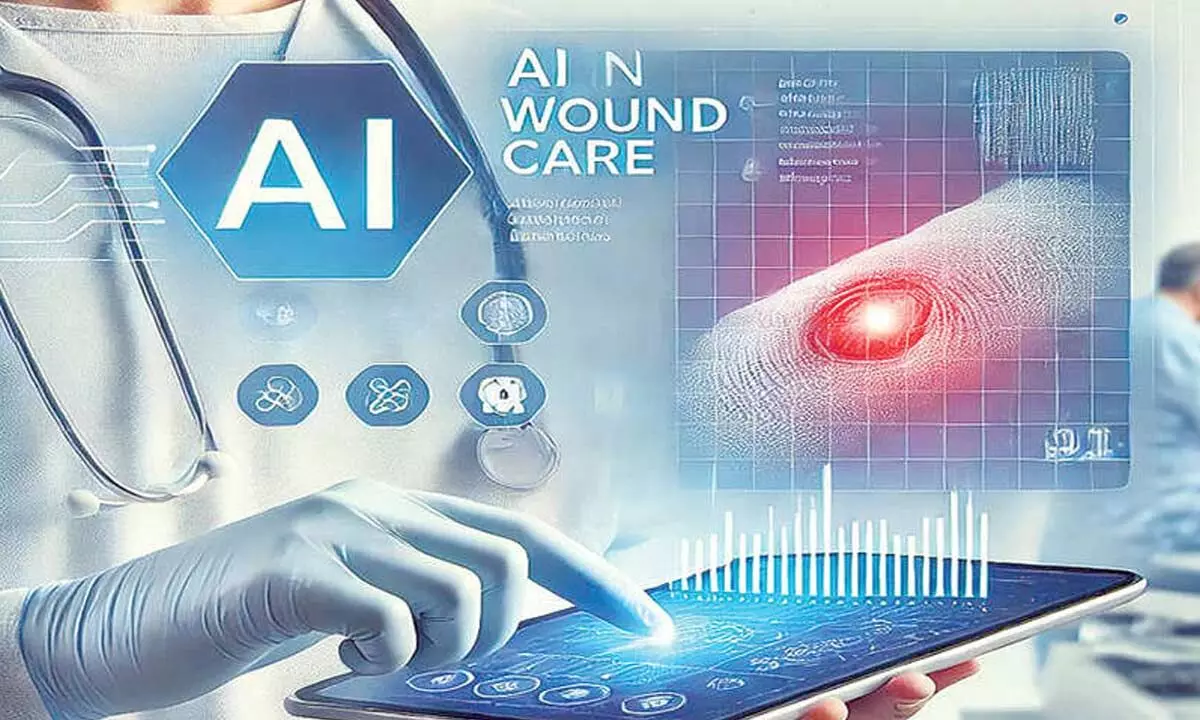
As artificial intelligence transforms healthcare delivery, a fundamental question emerges: can digital systems truly complement the ancient art of healing that begins with a mother’s instinct?
Every parent knows the moment. The sudden cry piercing through an ordinary afternoon. The sharp intake of breath as you see blood on your child’s skin. The immediate surge of protective instinct that makes your heart race faster than any emergency room alarm. In that split second between injury and response, generations of human caregiving wisdom collide with modern parental anxiety, creating a space where technology and tenderness must somehow coexist.
This intersection of primal care and digital innovation represents more than a simple technological advancement. It reveals a profound shift in how we approach one of humanity’s most fundamental acts: healing those we love when they are hurt.
The landscape of wound care management has remained remarkably unchanged for centuries, built on the foundation of inherited wisdom passed down through generations of mothers, grandmothers, and caregivers. Yet beneath this timeless ritual lies a growing crisis of confidence, access, and expertise that artificial intelligence is uniquely positioned to address—not by replacing human intuition, but by empowering it.
Universal language of care
When a young construction worker suffers a deep laceration on a remote job site, when a babysitter faces a playground injury with no parent in sight, when an elderly person living alone discovers a wound that won’t heal—these moments share a common thread. They represent the fundamental human need for immediate, reliable guidance when someone we care about is vulnerable.
Traditional wound care operates on a binary of extremes: either possess generational knowledge passed down through families, or rush to emergency medical care. This system fails the growing number of people caught between these options - busy adults managing their own minor injuries, caregivers in underserved communities without immediate medical access, parents of the increasingly fragmented nuclear family structure who lack the extended support networks previous generations relied upon.
The gap between intuitive care and professional medical judgment has widened as families scatter geographically and traditional knowledge systems fragment. Where once a grandmother’s experienced eye could distinguish between concerning and manageable wounds, today’s isolated caregivers face these decisions with only internet searches and anxious uncertainty as guides.
This evolution reflects a broader transformation in how we access and apply care knowledge.
Emotional Architecture of Healing
What distinguishes meaningful wound care from mere clinical procedure is the emotional context that surrounds it. When developers began creating AI-powered wound care applications, they understood something fundamental about human nature: the act of caring for wounds extends far beyond the physical mechanics of cleaning and bandaging.
The tremor in a parent’s hands as they examine their child’s injury carries as much healing power as any medical intervention. The gentle voice explaining what comes next, the patient attention to pain and fear, the reassuring presence that transforms a frightening moment into a manageable experience - these elements remain irreplaceably human. Artificial intelligence in wound care succeeds not by eliminating this emotional dimension but by providing the confidence and knowledge foundation that allows the human elements to flourish. When caregivers can quickly assess severity, understand proper treatment protocols, and recognize when professional medical attention becomes necessary, they are free to focus on what technology cannot provide: comfort, presence, and the healing power of genuine human connection.
This represents a fundamental reimagining of the relationship between technology and care. Rather than viewing AI as a replacement for human judgment, effective wound care applications function as sophisticated extensions of human intuition.
Democratizing ancient wisdom
The most profound impact of AI-powered wound care systems lies not in their technological sophistication but in their ability to democratize access to healing knowledge that has traditionally been concentrated in medical institutions or passed down through specific family lineages.
Consider the school nurse managing multiple minor injuries during recess, the youth camp counselor facing a hiking accident miles from the nearest hospital, or the traveling professional dealing with a concerning wound in an unfamiliar location. These scenarios represent the modern reality of distributed care - situations where immediate professional medical consultation is impractical but where the need for reliable guidance is urgent.
AI wound care applications address these challenges by making expert-level wound assessment available through the same devices people already carry. The technology performs rapid analysis of wound characteristics, severity classification, and treatment recommendations while maintaining the visual, step-by-step guidance that makes proper care accessible to non-medical users.
More significantly, these systems incorporate cultural sensitivity and diverse care approaches, recognizing that effective healing traditions exist across different communities and backgrounds. By training AI models on varied skin tones, age groups, and wound types, developers ensure that digital care guidance serves all users effectively rather than imposing a single cultural model of medical care.
Future of Integrated Care
The emergence of sophisticated AI wound care tools represents both an opportunity and a responsibility for how we structure future healthcare delivery. These systems succeed when they enhance rather than replace the human elements that make care meaningful.
Forward-thinking healthcare institutions are exploring how AI wound care applications can integrate with existing medical workflows, providing patients with reliable preliminary assessment tools while ensuring appropriate escalation to professional care when necessary. This collaborative approach recognizes that the most effective healing occurs when technology amplifies human expertise rather than attempting to supplant it.
The economic potential proves equally compelling. By enabling appropriate home care for minor wounds while improving identification of injuries requiring professional attention, AI systems can reduce healthcare costs while improving outcomes. This becomes particularly important as healthcare systems worldwide face increasing pressure from aging populations and resource constraints.
Beyond technical solutions
Perhaps the most important insight emerging from AI wound care development is its revelation of what we truly value in healing relationships. As these systems become more sophisticated, they highlight the irreplaceable aspects of human care: the ability to provide comfort during distress, to adapt treatment based on individual emotional needs, and to transform a frightening experience into an opportunity for connection and learning.
The success of AI wound care applications depends not on their ability to replace human caregivers but on their capacity to make those caregivers more confident, knowledgeable, and effective. When a parent can quickly assess their child’s injury and provide appropriate care without panic, when a caregiver in a remote location can access expert guidance instantly, when anyone facing an unexpected wound can respond with both competence and compassion—these represent the true measures of technological success.
This technological moment offers an opportunity to clarify what we most value in healthcare relationships. As AI handles routine assessment and guidance tasks, human caregivers can focus on what they do uniquely well: providing emotional support, adapting care to individual needs, and creating the sense of safety that transforms medical procedures into healing experiences.
The future of wound care lies not in choosing between human intuition and artificial intelligence but in thoughtful integration that leverages the strengths of both. AI can provide the knowledge foundation and confidence that enables effective care, while human caregivers provide the presence, empathy, and adaptability that transform technical procedures into meaningful healing.
Understanding this distinction helps us appreciate both AI’s remarkable diagnostic capabilities and the irreplaceable value of human care relationships. As we navigate this healthcare transformation, the challenge becomes embracing innovation while protecting and cultivating the uniquely human elements that make medical care a healing force rather than merely a technical intervention.
The wound may be physical and the assessment digital, but the heart of meaningful care remains fundamentally, irreplaceably human.
(Krishna Kumar is a technology explorer & strategist based in Austin, Texas in the US. Rakshitha Reddy is AI developer based in Atlanta, US)