






Pharma QR Code Traceability in India: What Manufacturers Need
In Short
Discover how pharma QR code traceability works in India, including labelling requirements, product authentication, supply chain tracking and key compliance considerations for pharmaceutical manufacturers.

Share :
Pharma QR Code Traceability in India: What Manufacturers Need
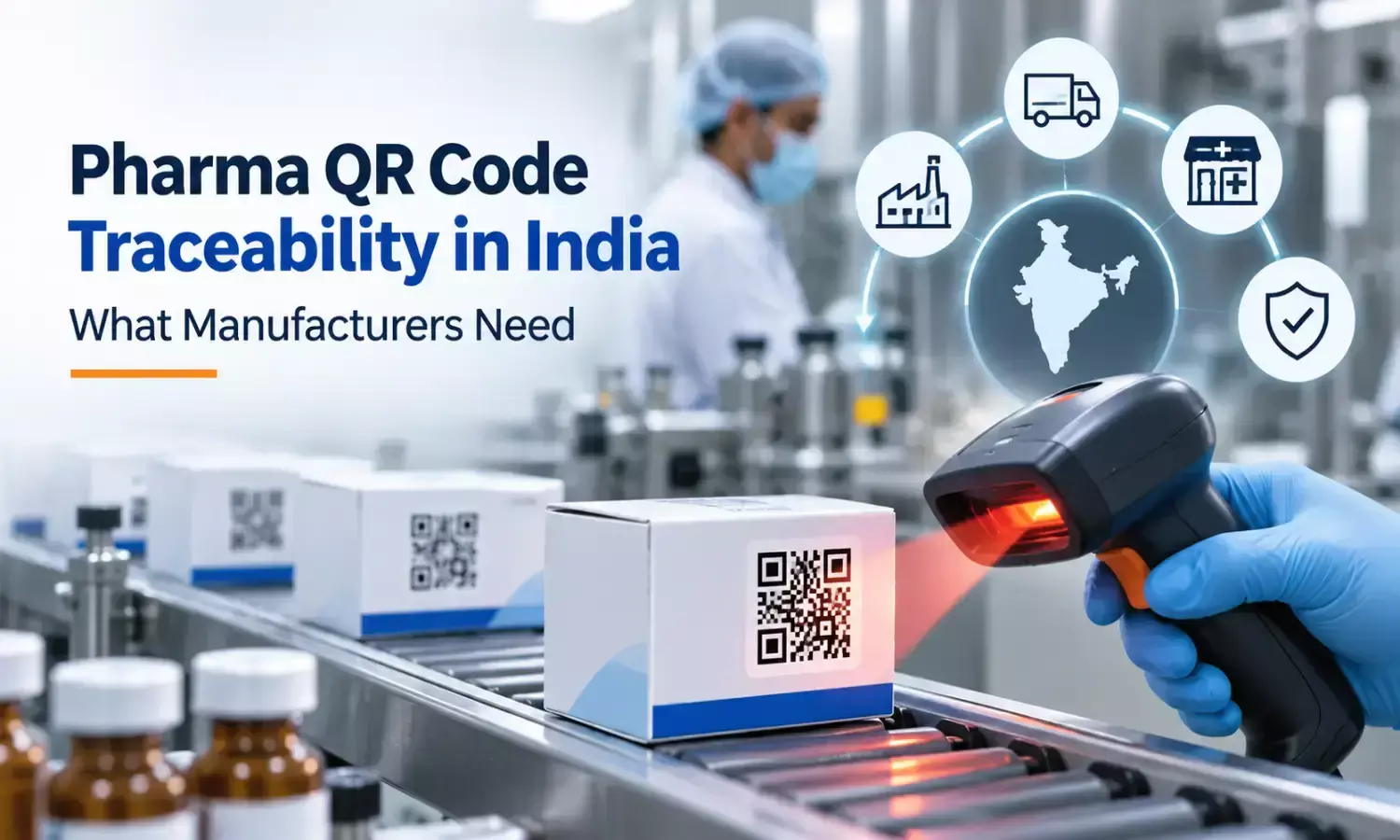
Pharmaceutical traceability in India is becoming an increasingly important part of manufacturing and supply chain compliance. QR codes and barcodes help identify medicines, verify product information and support tracking across distribution channels. Regulatory requirements under the Drugs Rules, 1945, already cover active pharmaceutical ingredients (APIs) and specified drug formulations, with further expansion notified in 2026.
Alongside marking products with a code, drug manufacturers must also ensure their products are correctly described, labelled and that suitable validation is in place to allow for product traceability. This article discusses India's regulations, relevant technology and recommendations for how to introduce QR code traceability.
Drugs are distributed to both pharmacies and hospitals. Manufacturers can struggle to confirm information about, analyse and trace drugs if there is no good system of identification and logging.
QR codes and bar-codes can be scanned to retrieve information about products. Alongside digital networks, they enable manufacturers and supply chain members to check for example:
- Product identity and brand information.
- Manufacturer and manufacturing licence details.
- Batch number and manufacturing date.
- Expiry or retesting date.
- Product movement and packaging relationships, where supported by the traceability system.
This has added benefits in enabling a clear understanding of a supply chain and in highlighting discrepancies. It also assists in preventing falsified and substandard medicines from being introduced onto an appropriate supply chain.
What Are India's QR Code Requirements for Pharmaceutical Manufacturers?
Requirements in India are detailed in the Drugs Rules, 1945. Distinctions need to be drawn between the requirements that apply to API's and to defined medicinal products.
1. QR Codes for Active Pharmaceutical Ingredients
As per Regulation 96(5) all drug substances (active pharmaceutical ingredients) both produced and imported in India must have a QR code affixed to each level of packaging. This became legal from 1 January 2023.
Information needs to be encoded in the QR code which can then be decoded by an appropriate software programme. Such information should include:
- Unique product identification code.
- Name of the API and brand name, where applicable.
- Manufacturer's name and address.
- Batch number and batch size.
- Manufacturing date and expiry or retesting date.
- Serial shipping container code.
- Manufacturing or import licence number.
- Special storage conditions, where applicable.
This applies to packaging. It is therefore key that API manufacturers and importers are able to recognise and manage information effectively.
2. QR Codes for Specified Drug Formulations
By way of G.S.R. 823(E) dated 17 November 2022, the government mandated that the top 300 pharmaceutical brands must include a QR or bar code. This came into force on 1 August 2023.
The manufacturers are required to include either a printed or attached code. Should the main packaging not have enough room then it can also be included on secondary packaging.
The original requirement covers information such as:
- Unique product identification code.
- Proper and generic name of the drug.
- Brand name.
- Manufacturer's name and address.
- Batch number.
- Manufacturing and expiry dates.
- Manufacturing licence number.
The requirement applies to Indian and foreign manufacturers producing the specified brands for marketing in India.
3. Expansion of QR Code Requirements in 2026
A further amendment notified in June 2026 expanded Schedule H2 to include additional categories of medicines. These include:
Drug category | Compliance date |
Vaccines | 1 July 2027 |
Narcotic and psychotropic drugs covered under the NDPS Act | 1 July 2027 |
Anti-cancer medicines | 1 July 2027 |
Antimicrobials | 1 July 2028 |
Manufacturers are to include barcodes or QR codes onto primary or (where necessary) secondary packaging. Information required includes the product name, ingredients, manufacturer details, batch number, manufacture and expiry date and manufacturer’s licence number along with details of excipients.
Companies need to review the range of products they manufacture and put in place procedures to comply with the relevant implementation dates. They should recognise that the initial 300 leading brands requirement in India does not constitute the complete picture of traceability requirements.
QR Codes, Serialization and Track and Trace: Understanding the Difference
These terms are connected, but they describe different parts of pharmaceutical product identification and supply chain visibility.
Component | What it does | Application in pharma |
QR code or barcode | Encodes information in a machine-readable format | Makes prescribed product details accessible through scanning |
Serialization | Assigns a unique identifier to an individual saleable unit | Distinguishes one medicine pack from another |
Aggregation | Links individual units to bundles, cases and pallets | Helps verify larger shipments without scanning every individual pack |
Track and trace | Records and monitors product movement across supply chain stages | Supports distribution visibility, verification and recall management |
Whilst a QR code exists, traceability doesn’t automatically exist. Information needs to be recorded, confirmed and integrated with appropriate systems and activities.
For manufacturers looking to strengthen supply chain visibility, track and trace solutions can bring together identification, serialization, aggregation and verification across packaging and distribution operations.
How Pharmaceutical Traceability Works
Packaging processes can be linked to digital product information through an effective traceability solution. Usually this includes;
1. Product Identification and Code Generation
Allocation of suitable product information (and if applicable a serial number) to each individual product. Information should correspond to authorised product and batch details.
2. Code Printing and Labelling
QR, barcode and 2 dimensional (2D) DataMatrix codes can all be printed onto a product using industrial print technology. The correct technology must be used depending on the packaging type, size and the speed of the production line.
3. Code Verification
Scanners and cameras are then used to verify that the codes can be successfully read and that they contain the correct data. Poorly or incorrectly printed labelling can then be removed from a production line prior to onward processing.
4. Aggregation Across Packaging Levels
Packaging can also be grouped together. Medicine packs can therefore be attached to groups, boxes and pallets. This produces a hierarchy and allows members of the distribution team to recognise what is in more substantial packages.
5. Data Integration and Supply Chain Tracking
Packaging traceability links data about packages produced to production and business information. Products can be scanned at key stages including despatch and on receiving and so are traceable throughout the supply chain.
Technology Manufacturers Need for QR Code Traceability
Technology solutions will vary according to the type of products, packaging and scale of manufacture together with relevant legislation. Typical elements used are:
- Handheld and fixed scanners: Capture product information during production, warehousing and dispatch.
- Machine vision cameras: Inspect code placement, print quality and readability.
- Serialization software: Generates and manages unique identifiers for individual saleable units.
- Aggregation systems: Connect unit-level codes with bundles, cases and pallets.
- Track and trace platforms: Record product identification and movement events across supply chain stages.
- ERP and manufacturing system integrations: Maintain consistency between production, inventory and traceability records.
These must work together. Even if a code is successfully scanned however if it doesn’t correspond to the correct product information then this can cause validation and regulatory issues.
How Manufacturers Can Prepare for Implementation
Stages are used to analyse an organisation’s processes and identify what needs to change ahead of regulatory dates.
1. Analyse product range – establish which products are affected by current and extended Schedule H2 requirements and ascertain which APIs and medicines they pertain to.
2. Investigate packaging – decide if primary packaging can be labelled appropriately or if secondary packaging is necessary.
3. Confirm products – correct product, batch, brand, date and licensing information.
4. Analyse print function – suitable printers, line speed and labelling and inspection processes.
5. Link systems together – between coding and checking and production, business and trace- back systems.
6. Trial processes – assess coding legibility, data precision, data linking and error protocols.
7. Provide training for production and quality staff. Define processes for dealing with faulty coding, data inconsistency, relabelling and IT system failure.
As well as analysing market needs, manufacturers should also analyse the relevant market country’s requirements. India’s and foreign countries’ QR coding and serialisation rules are different and so should therefore not be considered the same.
Common Challenges in Pharmaceutical Traceability
Companies especially those with a range of goods and packages can often face both practical and technical issues when implementing such systems.
- Packaging – Smaller packages may need re-located labelling (depending on local legislation).
- Printing issues – Poor print definition, mis-location and/or poor quality codes can cause scanning issues.
- Information discrepancies – Printed and digital information can differ which can lead to validation problems.
- System silos – Where production, stock and enterprise systems are not integrated, consistency of information can be challenged
- Poor employee knowledge – Staff may incorrectly scan, re-print and/or manage non-conforming packages leading to traceability problems.
- Multi-site manufacturing – Those companies that produce goods at several sites must ensure there is consistency in both data and processes.
Addressing these challenges requires coordination between production, quality assurance, IT, packaging and supply chain teams.
Building Reliable Pharmaceutical Traceability
Compliance for QR codes is a key enabler of improved pharmaceutical supply chain transparency. In addition to labelling compliance, companies should manage product data effectively. They should also validate QR codes and integrate suitable technologies. Robust procedures are key to managing pharmaceutical product flows.
A well-planned approach to pharmaceutical serialization helps manufacturers understand how unique product identities support verification, aggregation and traceability beyond basic code printing.
Effective integration of technology – both to meet regulation and business requirements – allows companies to further enhance product identification and implement managed recall procedures. It also increases assurance in the pharmaceuticals within supply chains.


