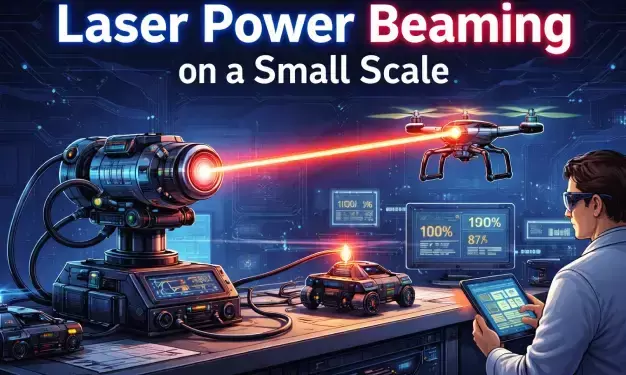
Laser Power Beaming on a Small Scale

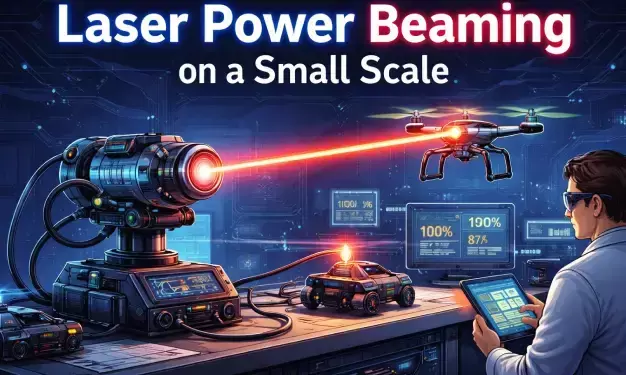
Explore how laser power beaming works on a small scale, its basic principles, experimental setups, and potential applications in wireless energy transfer, drones, and next-generation power systems.
A startup based in Kashmir is reaching for great heights amidst the tech giants of India. Started off with the vision of enabling India for a new, tech driven ecosystem that abolishes the use of wires for connectivity. The world is moving towards sustainability and newer technology. Technology that suits users, technology that solves real life problems. Laser power transmission falls under that section of new technology. It solves problems that have been troubling our daily lives for year
Video: https://youtu.be/N1CgcGqeub4
Prime Movr is trying to find its ground in an already popular market. Many big companies have already set their foot in this field such as: NTT (Nippon Telegraph and
Telephone), Defense Advanced Research Projects Agency (DARPA), and Star Catcher Industries. Both of these companies have different goals regarding laser technology. NTT (Nippon Telegraph and Telephone) has conducted experiments to transmit laser power over a kilometer, which is a significant achievement and on the other hand Star Catcher Industries is focused on building an orbital power grid to beam energy to satellites and lunar vehicles. The Defense Advanced Research Projects Agency (DARPA) has its own program to beam power over long distances.
India is not far behind in laser technological advancement either. In India the scale and usage of laser powered technology is a bit different. With innovations of laser technology that helps convenient and wire free charging for a wide range of smaller wireless applications. This innovation marks a new age in the Indian technological landscape. Prime Movr has opened the doors for a new chapter in India’s technological history. It may not be as flamboyant as foreign projects but it does address real life problems. The company hopes its technology can enable a wide range of smaller wireless applications.
Along with that, radio frequency (RF) is being tested to use instead of lasers in India. INFRGY LLC is working with the University of Kashmir’s Institute of Technology to develop that technology. It is no secret that laser technology has several unique advantages. For example higher energy density and more focused targeting is something that can be useful in inaccessible areas. Laser power transmission technology can be a great way to power applications such as remote sensors, outdoor camera systems, and other autonomous systems.
According to co-founder of Prime Movr Parvez Rishi, “This technology holds a lot of promise for applications such as charging remote sensors and outdoor cameras, where a tethered charging system is not practical”. Problems that were needed solving for years are finally getting resolved.
Prime Movr’s laser transmission system isn’t designed to power everything. Instead, it targets devices people forget about, until batteries die. Some of them are- outdoor security systems, remote sensors, IOT nodes, and robotic charging. Laser tech supported charging can open the way for many sectors like security camera charging. Wired electrical supply or solar panels for security cameras poses the risk of losing battery percentage at a higher rate which can be solved with the help of Laser tech.
Prime Movr is playing a crucial role in directing India’s future path of power supply and management. The company is showing how renewable energy can be used. In the contemporary scheme of things focusing on renewable energy is not an option rather a necessity and Prime Movr is showing how we can use it to our benefit. Co-founder Rishi comments: “We are delighted to add lasers to our collection of wireless power transfer technologies. The ability to transmit focused energy over long distances will have broad appeal across several applications.”