How India’s institutions are failing the marginalized people

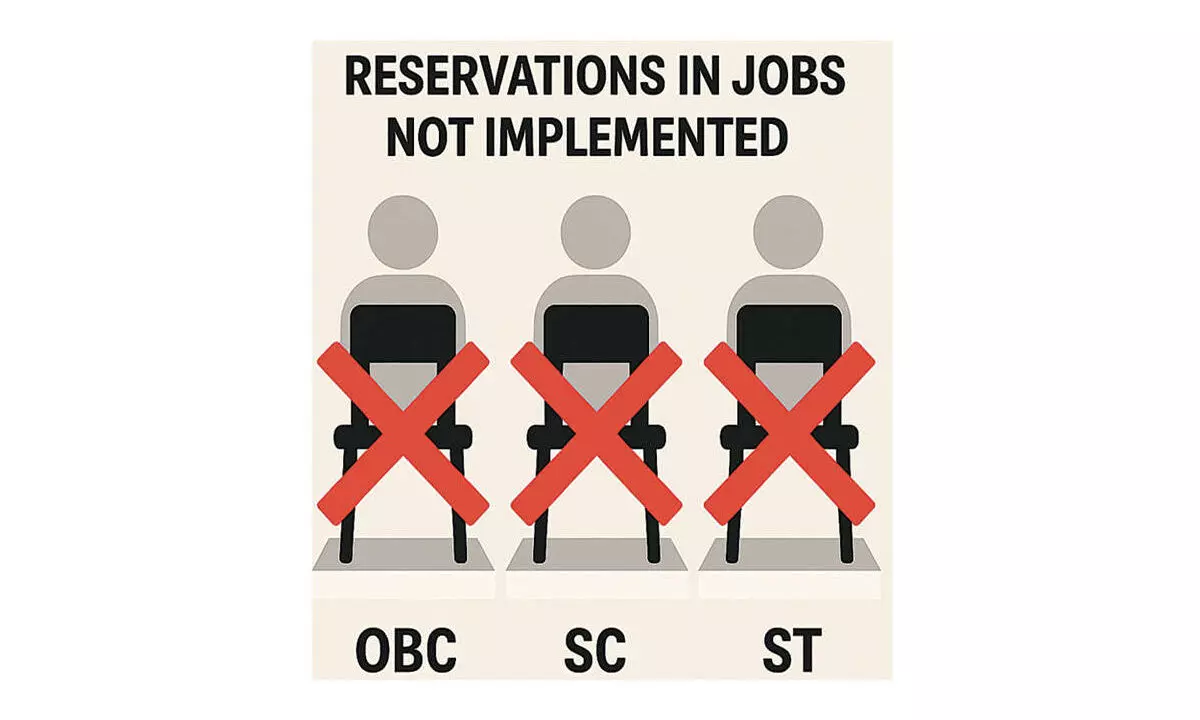
India’s history is replete with examples of systematic exclusion and discriminatory governance, particularly under colonial rule. The British administration followed a clear policy of divide and rule that deepened social fissures, marginalised communities, and denied equitable access to resources and opportunities. When India attained independence, the founding fathers of our Constitution envisioned a society rooted in justice, equality, and dignity for all. As a result, affirmative action, commonly known as reservation, was introduced to correct the historical wrongs inflicted upon communities such as the Scheduled Castes (SCs), Scheduled Tribes (STs), and Other Backward Classes (OBCs).
However, more than seven decades later, the commitment to this constitutional mandate often appears hollow. Recent data presented in the Rajya Sabha on July 23, 2025, by Union Minister of State for Education Sukanta Majumdar lays bare a disheartening reality. In response to a question by RJD MP Manoj Kumar Jha, it was revealed that a significant proportion of teaching posts reserved for marginalized communities in central universities remain vacant. This is not just an administrative lapse, but a betrayal of the values enshrined in our Constitution.
According to the figures shared, a staggering 80 per cent of the professor-level posts reserved for OBCs remain unfilled. Of the 423 sanctioned posts under this category, only 84 have been filled. The situation is even grimmer for the ST category, where nearly 83 per cent of professor posts are lying vacant, only 24 of 144 sanctioned positions have been filled. Likewise, 64 per cent of positions sanctioned for the SC category remain unoccupied, with only 111 out of 308 filled. This data is not just numbers; it reflects a systemic failure that continues to perpetuate marginalization within spaces of higher education, spaces that should ideally be at the forefront of promoting equity and inclusion. These glaring vacancies indicate either a lack of will or deeply entrenched biases in our institutions that are hindering the effective implementation of reservation policies. It is no secret that caste-based discrimination, both overt and covert, still persists in many corners of our society. When such biases find place within the corridors of power and policy-making, they directly obstruct the socio-economic mobility of communities that have already endured centuries of oppression. The excuses often provided for such lapses, like the non-availability of suitable candidates, must be scrutinized critically.
Are adequate efforts being made to create and nurture talent from these communities? Are institutions proactively reaching out to fill these posts through fair and inclusive recruitment processes? Or is the system simply indifferent? The failure to fill these sanctioned posts not only denies rightful opportunity to the deprived but also weakens the very fabric of our democracy.
In a nation as culturally rich and socially diverse as India, the true measure of progress must go beyond GDP growth, stock market milestones, or international accolades. Real advancement lies in how we treat our most vulnerable and marginalized citizens.
Today, as we envision the grand ambition of building a Viksit Bharat by 2047, coinciding with the centenary of our independence, we must ask ourselves some hard questions. Are we truly inclusive in our approach to development? Are our policies and public investments reaching those who need them the most? Or is there, perhaps, a deeper malaise, a deliberate design or systemic bias, that continues to sideline the deprived communities from claiming their rightful share of national resources, opportunities, and institutional support, proportionate to their population?
The time for symbolic assurances and policy jargon is long gone. What we need now is a transparent, data-backed, and morally driven commitment from the government and all institutions of democracy to correct historical injustices. The urgency is moral and strategic too. A nation cannot prosper in the long term if significant sections of its population remain excluded and voiceless. If the principle of ‘deprive, divide, and rule’ is allowed to take root and become surreptitiously institutionalized within our political, social, or economic systems, the consequences will be deeply destructive and far-reaching. This nefarious design – historically used to create rifts among communities, classes, and regions – has no place in a modern, democratic, and inclusive India. Institutionalizing deprivation means deliberately denying basic rights, opportunities, and resources to a section of the population, thereby reinforcing systemic inequality. Coupled with the tactic of division, whether along lines of caste, religion, language, or economic status, it will fracture the very soul of our nation.
In such a scenario, the privileged few would continue to enjoy comfort and luxury, while the marginalized masses remain trapped in cycles of poverty, exclusion, and powerlessness. It is, therefore, imperative that we do not make the grave mistake of perpetuating such a model, which only serves the interests of the select elite at the cost of national unity and human dignity. The people of modern India, more aware, more connected, and more assertive than ever before, will not tolerate such injustices.
Our shared moral compass and the foundational principles of our democracy compel us to build a society rooted in justice, equality, and unity. It is our collective duty to uphold a system of governance that is transparent, fair, and inclusive—one that prioritizes compassion over coercion and empowerment over manipulation. True democracy flourishes only when every individual feels seen, heard, and valued. Any attempt to undermine these ideals, be it through authoritarianism, discrimination, or exclusion, must be firmly and resolutely opposed. Our resolute commitment to these values must not be a choice but a necessity for a just and harmonious future.