How AI is stepping out of the laptop and into the physical world in 2025

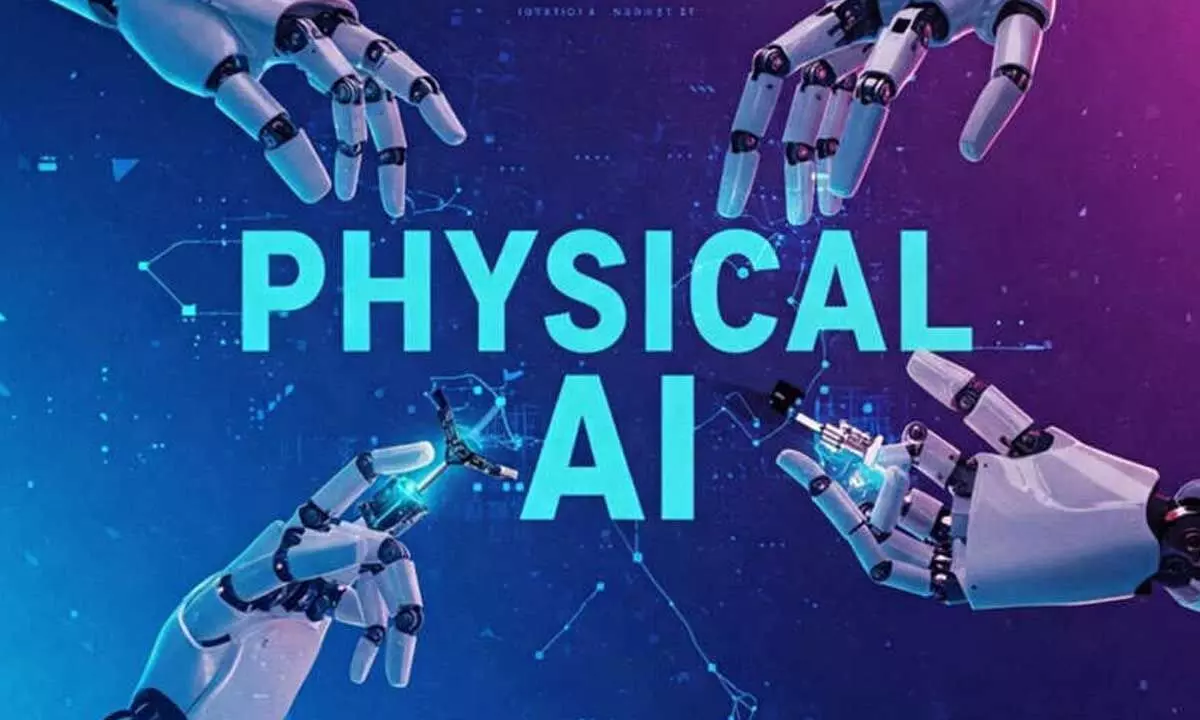
Physical AI represents the frontier where intelligence meets motion, where machines move beyond mere computation to understand and interact with the physical world
In the Mahabharata, few battlefield formations are as mysterious and awe-inspiring as the Chakravyuha: a swirling, ever-shifting spiral of warriors that opened, tightened, or redirected itself based on how the enemy advanced. It wasn’t a static trap; it was a living pattern of intelligence. Only a handful of warriors understood how to read its motion, sense its intention, and adapt in real time.
If the Chakravyuha were imagined today, it wouldn’t be made of soldiers. It would look strikingly similar to the emerging universe of Physical AI: machines, systems, and networks that sense, interpret, and act in dynamic environments.
For decades, AI lived inside screens. It predicted text, ranked posts, generated reports, and analysed datasets. It was powerful, yet the physical world was ruled by rigid mechanical systems that did exactly what they were told and nothing more. But 2025 is shattering that boundary. This is the year AI has stepped out of the laptop and into the physical world
From Digital Intelligence to Embodied Intelligence
From digital intelligence to embodied intelligence, we are witnessing a leap as drastic as the arrival of the internet. Physical AI represents the frontier where intelligence meets motion: where machines move beyond mere computation to understand and interact with the physical world. It enables systems to navigate cluttered spaces, recognize unfamiliar objects, manipulate them with dexterity, maintain balance, and adapt their actions with the fluidity of a living being. Beyond raw mechanics
This new era is being propelled by the convergence of reinforcement learning at scale, widespread deployment of low-cost, high-fidelity sensors, and general-purpose AI models trained on video, physics, and demonstrations. For the first time, machines are not just executing, they are beginning to understand.
For the first time ever, machines are not just executing, they are playing it by the ear (so to say).
Why 2025 has become the Breakout Year
Technology is spreading rapidly across sectors, driven by a rare convergence of factors. General physical intelligence models, much like GPT unlocked generative text, are now providing machines with universal motor skills, allowing them to learn and adapt in a wide range of environments.
At the same time, hardware such as robotic arms, quadrupeds, drones, and autonomous guided vehicles has become significantly more affordable, enabling companies to deploy fleets rather than just prototypes. Machines are also gaining human-level awareness of their surroundings, thanks to advances in cameras, depth sensors, and vision transformers.
Equally important, governments across India, the US, Japan, and the EU are establishing clearer safety and compliance frameworks for autonomous physical systems. The result is a perfect alignment of intelligence, affordability, and regulation: a moment where Physical AI can move from experimentation to widespread adoption.
The Wave Touching Every Industry
Physical AI is quietly reshaping entire sectors.
1. Defence & Security
Autonomous drones for surveillance, AI-assisted command centres, robotic border patrols, automated base logistics: everything is shifting to systems that react faster than human operators can.
2. Healthcare
From AI-assisted surgery to autonomous medicine delivery and patient mobility robots, hospitals are becoming intelligent support systems.
3. Manufacturing
Factories are deploying adaptable robotic co-workers that can handle variable tasks, inspect quality, shift assembly lines, and collaborate safely with humans.
4. Retail & Warehousing
This is one of the fastest-growing segments:
Autonomous pickers, sorter bots, inventory drones, and last-mile delivery robots are turning warehouses into self-organising ecosystems.
5. Mobility & Transport
Physical AI is enabling autonomous forklifts, driverless shuttles, dynamic logistics hubs, and self-healing traffic flows.
6. Smart Cities
Cities are deploying robotic inspectors for pipelines and bridges, AI-based disaster response drones, and automated utility monitoring.
This is not one industry evolving: it is all industries evolving simultaneously.
Challenges in Physical AI and How They’re Overcome
Physical AI faces hurdles that go beyond digital intelligence. Real-world training is costly and slow, as robots must learn through repeated interaction, constrained by physics: forces, friction, balance, and momentum. This is addressed with simulations, digital twins, and synthetic data that model real-world physics, letting robots practice safely at scale.
The unpredictability of objects and environments requires general-purpose embodied AI models that integrate principles like kinematics, dynamics, and contact mechanics to adapt and manipulate objects reliably. Hardware limitations are mitigated by high-fidelity sensors, precision actuators, and real-time edge computing. Finally, transferring skills across environments leverages sim-to-real methods and meta-learning, enabling robots to generalize while respecting the underlying physics of the real world.
The Size of the Opportunity
The opportunity presented by Physical AI is no longer theoretical: it is rapidly emerging as one of the largest cross-sector markets of the next decade. The global AI robotics market has projections indicating it could exceed $120 billion by 2034, growing at an annual rate of roughly 18–20 per cent. Equally compelling is the expansion of the infrastructure that underpins Physical AI: simulation platforms, digital twins, and synthetic data: which allows machines to train in both virtual and real-world environments. This market is expected to surge to nearly $375–380 billion by 2034, reflecting the growing importance of building environments where AI can learn safely and efficiently before deployment. When we step back and look at the broader robotics market, which includes industrial robots, service robots, and collaborative machines, it is projected to reach $185 billion by 2030, with AI capabilities increasingly embedded across these sectors.
Several players are leading this rapidly evolving ecosystem. In the technology and simulation space, NVIDIA, with Omniverse, Isaac, and Jetson, is providing powerful platforms for robot training and development, while Microsoft is leveraging cloud robotics and advanced simulation tools, and Google DeepMind continues to push the boundaries of embodied AI research. Industrial robotics giants such as ABB, FANUC, KUKA, and Siemens are integrating AI to make traditional automation smarter and more adaptable. Next-generation embodied AI companies like Boston Dynamics, Covariant, Sanctuary AI, Tesla, and Unitree Robotics are redefining what machines can do in real-world environments, bringing unprecedented dexterity, balance, and adaptability to robots. In logistics and retail, innovators such as Amazon Robotics, Ocado Technology, and GreyOrange are deploying fleets of intelligent robots to transform supply chains and warehouse operations.
Defence and security applications are also advancing rapidly, with companies like Anduril, Shield AI, General Dynamics, and India’s own HAL and DRDO building adaptive systems that can operate in complex and dynamic environments. Across sectors, the race is not simply to create smarter machines: it is to develop systems that can continuously learn, adapt, and operate safely alongside humans, marking the dawn of a truly embodied intelligence era.
Conclusion
Across defence, healthcare, manufacturing, logistics, mobility, and city infrastructure, a new pattern is emerging: the world is reorganising around intelligence that can act: not just compute. 2025 is the year machines became physical partners, not just digital assistants. The shift is structural and irreversible.
The Chakravyuha analogy could not be more apt. The landscape is no longer static. It moves, responds, and adapts. Those who cling to rigid tools and slow processes will be overwhelmed by the pace of evolution. Those who understand the new rhythm: who adopt early, iterate quickly, and invest boldly: will shape the next decade.
For the first time in history, the future is not just being calculated. It is moving.
(The author is the Chairman & CEO of Brightcom Group)