AI has potential to reduce burden on healthcare workforce: Health Secy

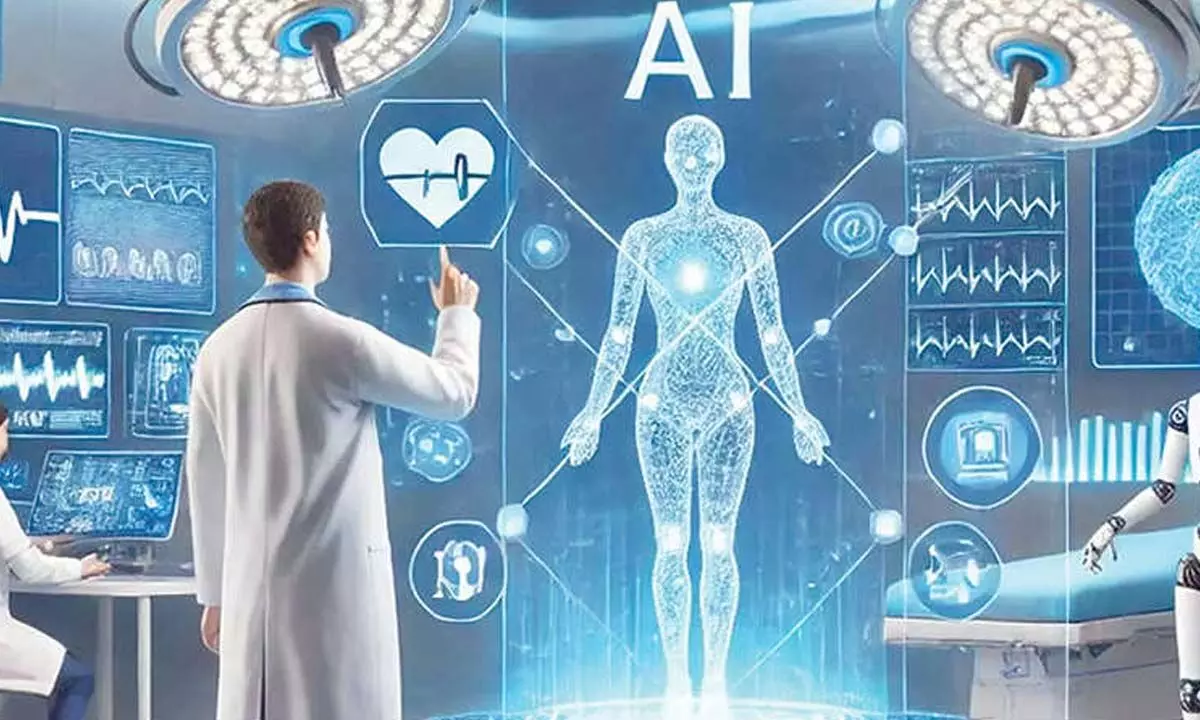
New Delhi: Artificial Intelligence (AI) has the potential to reduce the burden on the healthcare workforce while strengthening, not replacing the physician-patient relationship, Union Health Secretary Punya Salila Srivastava said on Monday.
Speaking at a high-level panel discussion organised by the Union health ministry on the theme "Scaling AI for Public Health Impact: Public-Private Partnership" as part of the India AI Impact Summit 2026 at Bharat Mandapam, Srivastava said that India's health system has evolved into a nationally interoperable digital ecosystem over the past decade.
As a key participating ministry, the Union health ministry is playing a significant role in the summit through a high-level panel discussion, the launch of key initiatives and the showcasing of AI-driven healthcare solutions at its dedicated exhibition stall.
Delivering the keynote address, Srivastava said that India's health system has transitioned over the past decade from basic digitisation of records and improved data reporting to building a nationally interoperable digital health ecosystem.
She recalled that the National Health Policy set the vision of achieving the highest attainable standard of health and well-being for all citizens, which was further operationalised through the National Digital Health Blueprint by promoting open standards, interoperability, privacy-by-design and the adoption of emerging technologies including Generative AI.
She highlighted that the Ayushman Bharat Digital Mission (ABDM) has evolved into a robust digital public infrastructure for health, with over 859 million ABHA accounts linked to more than 878 million health records. With more than 1.80 lakh Ayushman Arogya Mandirs operational across the country, digital platforms are being integrated at the primary care level.
The E-Sanjeevani, powered by AI-assisted clinical decision support systems (CDSS), has enabled over 449 million teleconsultations through more than 2.2 lakh registered healthcare providers, making it the world's largest telemedicine initiative in primary healthcare, Srivastava said.
Emphasising that digital systems enable the capture and transmission of information while AI enables its intelligent interpretation and action, she noted that "AI has the potential to reduce the burden on the healthcare workforce while strengthening, not replacing, the physician-patient relationship".
Citing examples, she referred to MadhuNetrAI for AI-based diabetic retinopathy screening, AI-enabled handheld X-rays and acoustic screening tools such as Cough Against TB (CA-TB) for tuberculosis detection, and AI-integrated surveillance systems for faster epidemic alerts.
Stressing the importance of collaboration, the Union health secretary invited industry and state representatives to share their experiences on working with government systems, improving procurement and data frameworks and identifying AI solutions most useful in field settings.