Big plan to make AP logistics hub


To link ports, harbour roads and upgrade R&B roads & highways
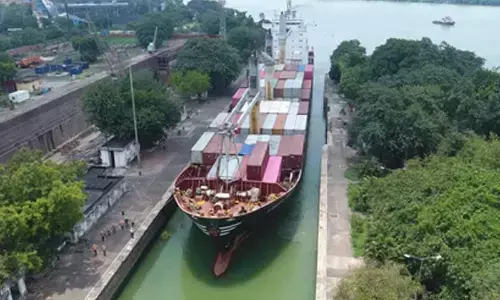
Amaravati: Andhra Pradesh, with a coastline of 975 km, and with at least 15 operational seaports, including the major Visakhapatnam Port, is now preparing to rewrite its industrial map with an ambitious Rs 23,000-crore logistics and road infrastructure plan aimed at transforming the state into one of India’s most efficient maritime gateways by enhancing cargo capacity and boosting trade.
The comprehensive plan seeks to integrate the state’s ports, highways, and logistics systems under a single vision to attract large-scale industrial investment and strengthen regional competitiveness. Of the total outlay, Rs 18,485 crore will be spent on port and harbour road connectivity, while Rs 4,500 crore will go into upgrading state highways as well as Roads and Buildings (R&B) networks.
Senior officials said the government will soon set up a dedicated Logistics Infrastructure Corporation to coordinate planning, mobilise resources, and consolidate all logistics-related operations under one roof. “The government wants to create the building blocks of the state's logistics management ecosystem,” a senior Infrastructure and Investment Department official said. “Once the corporation becomes operational, it will bring together transportation, warehousing, material handling systems, and information networks into a single integrated framework,” the official added.
The reasoning of the state government is clear. Industries, from pharmaceuticals and food processing to textiles, engineering goods, and renewable energy, have often cited logistics inefficiencies as a key constraint on competitiveness. The new plan is designed to eliminate those bottlenecks by aligning infrastructure development with industrial and export corridors.
The integrated logistics blueprint ties together infrastructure, energy, and industrial zones within one investment map. The aim is to enable holistic planning and prioritisation while ensuring that the state’s ports and highways act as natural extensions of its industrial clusters.
This approach also supports the state’s positioning as a gateway for trade linking key industrial corridors and connecting the neighbouring states of Telangana, Odisha, Chhattisgarh, Tamil Nadu, and Karnataka.
The port connectivity projects form the backbone of this plan. Twenty-three strategic road projects covering 432 km have been mapped across nine ports viz. Visakhapatnam, Kakinada, Krishnapatnam, Gangavaram, Nizampatnam, Mulapeta, Ramayapatnam, Machilipatnam, and the Krishna River terminal. Together, they will provide seamless cargo movement between hinterland industries and export terminals, a leap in efficiency that could reduce logistics costs.
The state government’s plan involves parallel efforts to improve nearly 15,000 km of R&B and state highways at a cost of Rs 4,500 crore. Under this, tenders have been finalised for upgrading 1,250 km under the NABARD RIDF tranche scheme targeted to be completed by 2026. Additional projects include the upgrading of 1,433 km of state highways and 5,946 km of district-level roads through patch and surface improvement works. In addition, 2,104 km of major highways and 4,233 km of category-C roads are slated for modernisation upon financial closure.
The state today has a total road length of nearly 1.6 lakh km, among the highest in India, comprising 8,360 km of national highways and 12,643 km of state highways. But much of this network, officials concede, needs upgrading to meet industrial standards.
For investors, the logistics master plan marks more than road upgrades; it signals a strategic shift in how the state is linking its industries with global trade routes. Improved port connectivity could cut turnaround time for exporters, while better logistics integration may make industrial land more attractive to domestic and foreign manufacturers.