AP into high-voltage green energy push

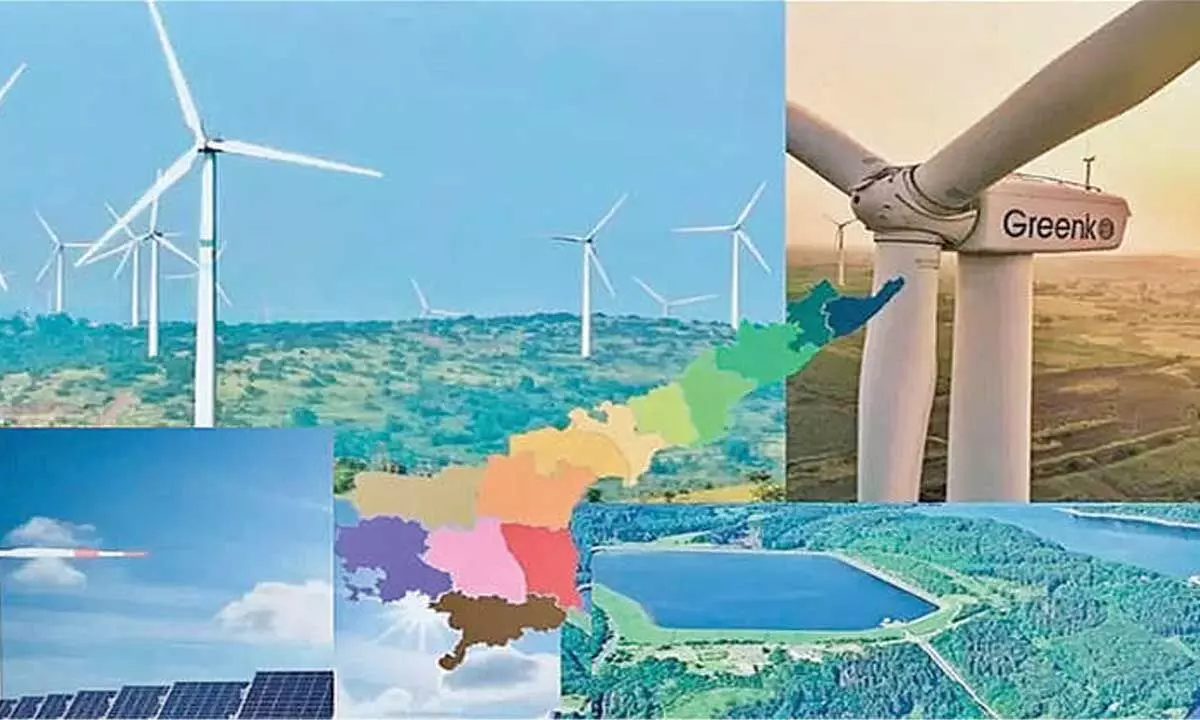
Amaravati: With Andhra Pradesh pursuing an ambitious plan to develop 5.5 GW of data-center capacity, the state’s demand for renewable energy has surged dramatically, pushing the government into one of its largest green-power expansion drives to date.
The Government of Andhra Pradesh initially constituted the Data Center Advisory Council as a step toward positioning the state as India’s digital infrastructure hub. The government, in G.O. 46 issued on October 27, said that the newly formed council will steer the state’s policy, infrastructure, and investment roadmap to achieve 6,000 MW of data centre capacity by 2030, with Visakhapatnam as the flagship destination for next-generation, AI-driven data infrastructure.
With global data-center electricity use accelerating at a phenomenal pace, driven by hyperscale cloud expansion and power-hungry AI models, the state government is now pushing large-scale green-energy investments to meet round-the-clock demand.
As global data-centre electricity consumption enters a period of steep, AI-driven growth, the state government is attempting to secure a long-term competitive advantage by guaranteeing low-cost, round-the-clock green power for hyperscale operators.
The strategy is anchored in a surge of investment commitments. At the recent Visakhapatnam Partnership Summit, the government signed MoUs in the power sector involving Rs 5.33 lakh crore, including a large share dedicated to solar, wind, green hydrogen, battery storage and pumped-hydro projects. Energy Department officials say these investments are essential because the intermittent nature of renewable generation requires installed green-energy capacity to be several multiples of the continuous load demanded by data-centre clusters.
The push comes as global data-centre electricity demand climbs at its fastest pace in two decades. Efficiency gains and renewable sourcing by hyperscale operators have tempered growth, but the rapid spread of compute-heavy generative AI is now outstripping those improvements. U S consumption jumped from 76 TWh in 2018 to 176 TWh in 2023, 4.4 per cent of national use, and is projected to reach 74–132 GW by 2028. McKinsey and IEA estimate global demand could hit 2,500–4,500 TWh by 2050.
This global energy guzzling by data centers is shaping investment decisions in Andhra Pradesh. Reliance Industries has committed to building a 1-GW AI data centre supported by a 6-GW solar power project in the state. Google, which had committed a 1 GW data centre, is preparing to scale its investments in Andhra Pradesh beyond US $ 15 billion over the next five years, according to Chief Minister N Chandrababu Naidu. The company recently announced a hyperscale facility in Visakhapatnam connected to new renewable sources and a statewide fiber backbone.
Another major addition is a 500-MW data centre in Visakhapatnam to be built by Sify Technologies, with an investment of Rs 15,266 crore. The facility, located in Paradesipalem, will be leased to Meta, making it one of the largest single-location digital-infrastructure deployments on India’s east coast. The Adani group is developing an integrated data center and technology park with 300 MW of data center capacity, with a focus on using up to 100% renewable energy.
The government’s broader target is to develop 160 GW of green-energy capacity, with an emphasis on long-duration storage solutions to ensure stable supply for high-load digital infrastructure.
Officials say cost competitiveness is central to the strategy; for, in the absence of low-tariff green power, global AI-cloud operators will not commit to multi-decade investments.
Large energy developers are responding. ReNew Energy Global Plc has announced a cumulative Rs 82,000-crore investment programme in Andhra Pradesh, including a 6-GW ingot-wafer plant, a 2-GW pumped-hydro project, a 300-KTPA green-ammonia facility, and multiple hybrid wind-solar-BESS installations.
Hinduja, Essar Renewables, GMR, Ecoren Energy, Chinta Green, Hero Future Energies and others have together pledged more than Rs 2.37 lakh crore across solar, wind, hydrogen and storage ventures.
The state government signed an MoU also with the World Economic Forum to establish a Center for Energy and Cyber Resilience, aimed at integrating advanced technology into energy-security frameworks.