Artificial intelligence should ‘serve’ real intelligence

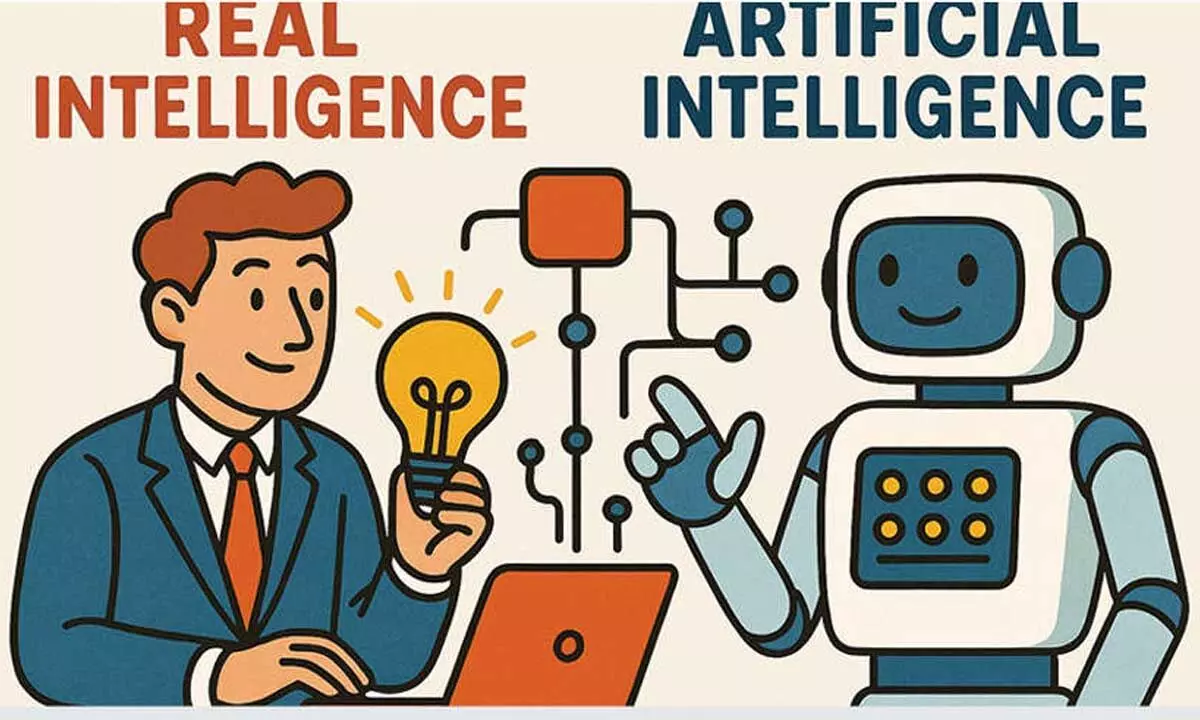
But if we forget our Indianness and our wealth of knowledge and focus only on achieving artificial intelligence, we will lose what makes our country unique. Let us welcome innovation while preserving and enhancing our traditional values. Let us embrace a fusion of old and new. AI does not compete with original human intelligence — AI exists to improve it
The education department’s move not only to equip current students with artificial intelligence (AI) as a tool, but also to take immediate measures in this direction, should be welcomed by everyone in the country! The department has decided to introduce this curriculum from grade three in the 2026–27 academic year. In other words, it is commendable that the concerned officials have already begun designing a comprehensive curriculum that will introduce AI-related classes roughly from kindergarten through grade 12.
The aim of this policy can be seen as building skills that will help future generations adapt to technical and economic changes. With foresight and the intention that we should not fall behind other countries in using AI competitively, the government has conceived this initiative. However, this will not be a cakewalk.
Significant preparations are required to make meaningful progress. More than a million teachers must be trained. For that purpose, the government is providing AI tools and establishing resources for curricula and training. Since 2019, about 10, 000 teachers have been trained with support from technical experts and organisations such as IBM, Intel, National Institute of Electronics and Information Technology. These teachers are being prepared to confidently impart AI knowledge to students. However, at this early stage it is difficult to say with certainty whether we fully understand all the obstacles that must be overcome.
This difficult, complex experiment must be carried out scientifically. Teaching the same lessons to every student in a class is one thing — but teaching technical AI skills tailored to each student’s individual aptitude and interests is quite another; this benchmark must be understood. Accordingly, students need to be given a variety of training options.
Teachers must recognize each student’s intelligence, comprehension skills, and disciplined learning preferences, and provide instruction that fits those traits. Achieving this will require a lot of effort from both students and teachers. Moreover, students who would be averse to acquiring this skill must be identified early and separated. Teaching methods for them should be different — and training for students who are going to master artificial intelligence must be conducted separately if the desired results are to be obtained. From bullock carts to motor cars, from huts to towering skyscrapers, human progress has reflected the development of human intellect. No matter what new thing is invented, it is ultimately meant to make life easier and more comfortable for people — a fact that each generation may forget, but it does not matter. The achievements of progress are already recorded in history’s pages in bold letters.
One thing must be kept clearly in mind: artificial intelligence can reform education, but it cannot replace true human intelligence. AI has not eliminated humanity from the educational process. Can artificial intelligence substitute for the human qualities that arise in a person’s mind—compassion, kindness, and affection? No. However, AI can shed new light on human thought, innovation, and detailed analysis. A lesson taught by a teacher with genuine understanding, deep knowledge, and an open heart cannot be matched by AI-driven instruction. Our current education system benefits from AI across fronts, but it has not fully replicated the training methods of a truly capable teacher — and we must not forget that no matter how many experiments we conduct, the goal should be to enhance our advantages, not to eliminate the human element, per se.
If we introduce students to AI-related technologies from the early grades, we will have the opportunity to train many people who can serve the digital economy. This will not only help us keep pace with other countries but also give our nation a stronger chance to advance using these technical skills. According to NITI Aayog’s estimates, there is potential to create four million new jobs aligned with technological progress by 2030. However, they also believe that in the next five years roughly two million existing jobs in the tech sector could be transformed or lost. At present, higher education institutions are adapting their curricula to align with artificial intelligence.
If artificial intelligence is adapted to the many cultures, ways of life, and languages in our country, its benefits will be accessible without tearing the nation apart — geographically or psychologically — and we will remain united. Artificial intelligence must not damage the diverse way of life that defines our nation. If anything divides us, we will fall apart. Our people will lose their courage. Our differences will become enemies.
Any development that undermines unity, however technically brilliant, must be shaped to serve our interests. And in pursuing technological progress, we must not abandon the roots of our civilization. The Vedas, the Upanishads, mathematics, and knowledge of space are the backbone of India. We must not forget what our ancestors refined and gave us—knowledge that other nations still emulate. Even distant advances in technology can spark a renaissance here. There is nothing wrong with redirecting our skills and expertise to benefit from those opportunities. But if we forget our Indianness and our wealth of knowledge and focus only on achieving artificial intelligence, we will lose what makes our country unique. Let us welcome innovation while preserving and enhancing our traditional values. Let us embrace a fusion of old and new. Wherever streams of knowledge come from, let us receive them warmly and wholeheartedly. Artificial intelligence does not compete with original human intelligence — AI exists to improve it. Never forget that fundamental principle.
(The writer is a retired IPS officer, who has served as an Additional DGP of Andhra Pradesh)